Look up at the night sky. Every pinprick of light is a sun, and around most of those suns whirl worlds of every imaginable kind. For decades, we’ve sorted these distant exoplanets into neat categories: gas giants, ice giants, rocky Earths, and boiling “hot Jupiters” snuggled too close to their stars. We thought we understood the rules of this cosmic dance—the laws of physics that dictate what can and cannot survive in the stellar inferno.
Then, the James Webb Space Telescope (JWST) turned its golden eye toward a planet named 55 Cancri E, and the rulebook burst into flames.
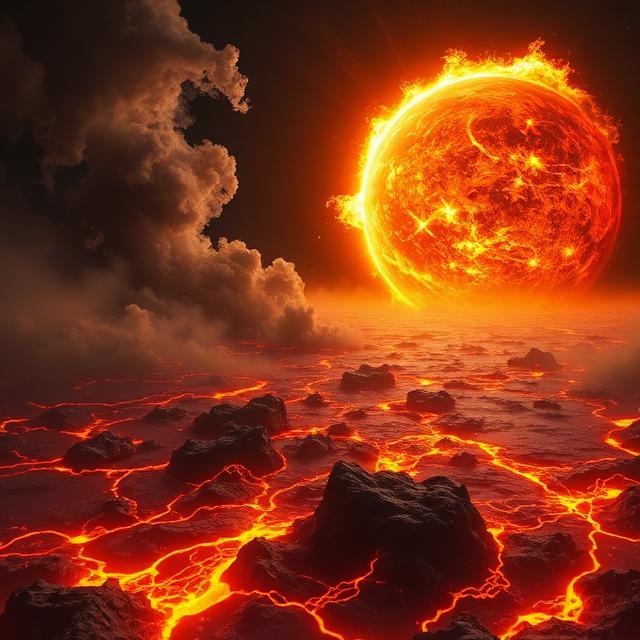
What it found has left astronomers simultaneously baffled and exhilarated. This broiling, hellish world—a super-Earth so close to its star that its surface is likely a global ocean of molten lava—should be stripped bare. Its atmosphere, by all rights, should have been blasted into the void of space eons ago by the relentless fury of its sun.
But it’s still there.
Webb detected a significant, dynamic atmosphere swirling around 55 Cancri E. It’s an atmosphere that, according to everything we thought we knew, should not exist. This isn’t just a discovery; it’s a profound mystery, a cosmic paradox that is forcing us to rewrite our understanding of how planets live, die, and cling to survival in the most extreme environments.
Meet 55 Cancri e: A Portrait of a Hell Planet
Before we unravel the mystery, let’s meet the subject of this cosmic whodunit.
- The Name: 55 Cancri E (also nicknamed “Janssen”).
- The Location: A mere 41 light-years away in the constellation Cancer, orbiting the Sun-like star 55 Cancri A.
- The Vital Stats: It’s a “super-Earth,” about 8.8 times the mass of our planet and roughly twice its diameter. But any similarity to our pale blue dot ends there.
- The Orbit: This planet is insanely close to its parent star. One year on 55 Cancri E—a single orbit—takes just 17 hours. You could celebrate your birthday twice before we finish Earth Day.
- The Climate: As you can imagine, this proximity creates apocalyptic conditions. Dayside temperatures are estimated to soar above 4,400°F (2,400°C)—hot enough to melt iron, nickel, and even granite. The surface is not solid land; it’s believed to be a global, roiling ocean of magma. If there are any mountains, they are mountains of liquid rock.
For years, scientists debated the nature of this world. Was it a carbon-rich “diamond planet”? A water world turned to steam? Or just a naked, scorched core of a once-larger planet? The prevailing theory was the latter. A rocky planet this close to its star would have its atmosphere completely vaporized and stripped away by the stellar wind and intense radiation. It should be a bare, blistering ball of rock.
The Webb Difference: Seeing the Invisible
Previous telescopes, like Hubble and Spitzer, hinted at something odd happening on 55 Cancri E. They detected strange heat signatures, but the data was fuzzy, like trying to read a street sign through a fogged-up window. The atmosphere question remained wide open.
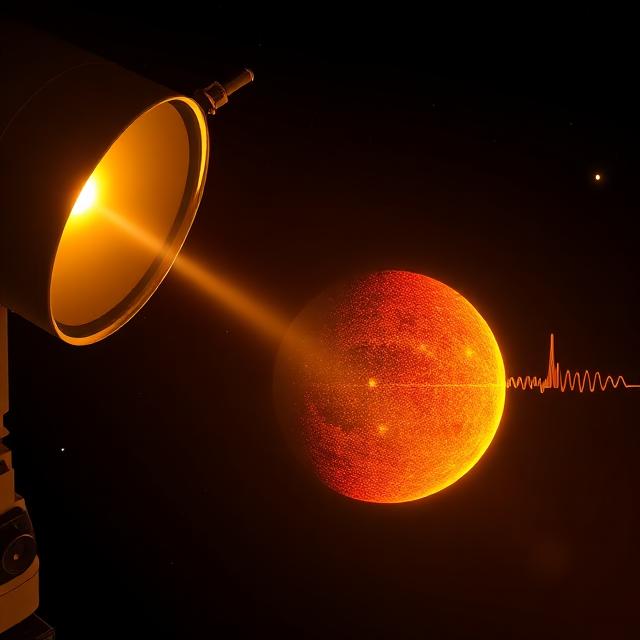
Enter the James Webb Space Telescope. With its unparalleled infrared sensitivity, Webb doesn’t just “see” planets; it senses their chemistry. The key technique used is secondary eclipse spectroscopy. Here’s how it works in simple terms:
- Webb observes the star with the planet beside it, measuring their combined light.
- It then waits for the planet to duck behind the star (an eclipse) and measures the star’s light alone.
- By subtracting the second measurement from the first, astronomers isolate the tiny, specific infrared glow coming only from the dayside of the planet.
That infrared glow is a treasure map. Different gases in an atmosphere absorb unique fingerprints of light. By analyzing which wavelengths are missing or present in the planet’s glow, Webb can identify the atmospheric chemicals.
When a team led by researchers from the Space Telescope Science Institute (STScI) and NASA pointed Webb’s NIRCam and MIRI instruments at 55 Cancri E, they expected a flat, featureless signature—the tell-tale sign of a bare rock.
They didn’t get that.
The Discovery: An Atmosphere That Shouldn’t Be
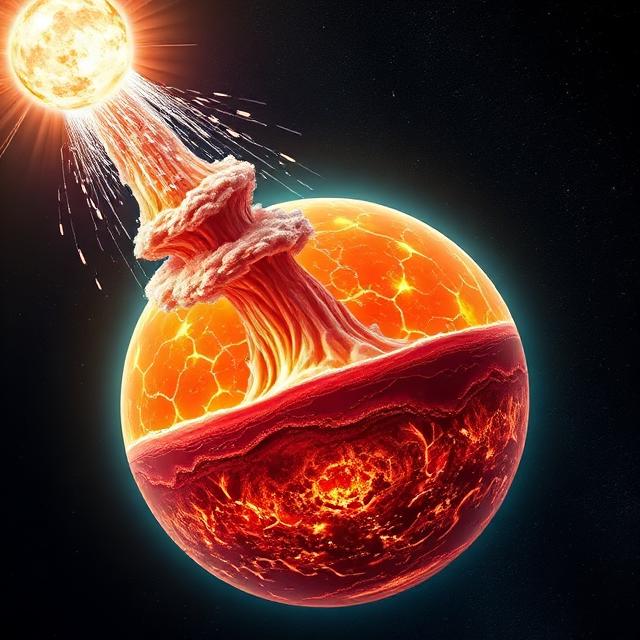
What Webb detected was a measurable cooling effect on the planet’s dayside. This is the critical clue. A bare rock heated to 4,400°F would release its infrared heat in a very specific, predictable way. But 55 Cancri e’s heat signature was different. The only plausible explanation? An atmosphere is actively redistributing that insane heat.
Think of it like this: Touch a hot pan with a bare finger (a bare rock), and you get burned instantly. Touch that same pan with an oven mitt (an atmosphere), and the heat is absorbed and moved around, making the surface you feel cooler than the pan itself. Webb detected the cosmic oven mitt.
Further analysis pointed not to a primordial, hydrogen-rich atmosphere (which would be long gone), but to a “secondary” atmosphere. This is a game-changer. It means the atmosphere isn’t a leftover from the planet’s formation; it’s being actively replenished or created right now, in the heart of the inferno.
The leading candidate? A bubbling, outgassed atmosphere of volatile compounds like carbon monoxide or carbon dioxide, possibly even originating from the planet’s own gargantuan magma ocean. The intense heat and pressure could be blasting gases from the molten rock into the sky, where they temporarily form an envelope before being torn away by the star—only to be replaced by more outgassing in a constant, violent cycle.
>>> Read the official research paper preview on 55 Cancri e’s suspected secondary atmosphere.
The Mystery Deepens: Competing Theories for an Impossible World
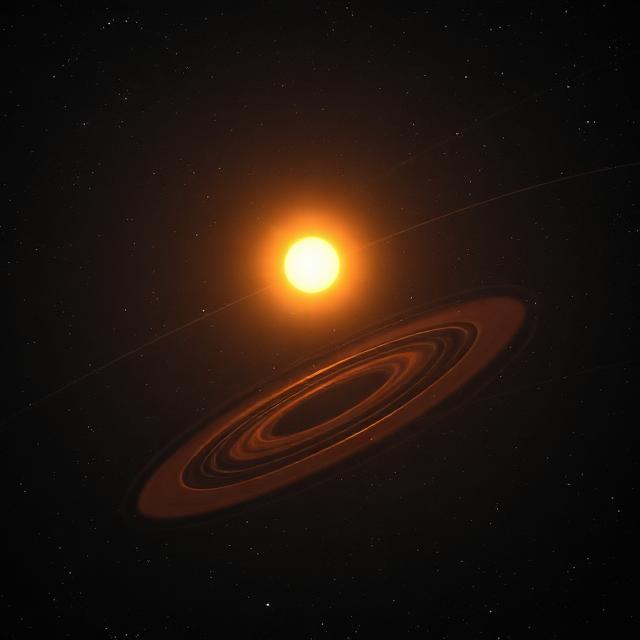
The “magma ocean outgassing” theory is compelling, but the mystery doesn’t end there. Webb’s data is so rich that other, even stranger, possibilities are on the table.
Theory 1: The Eternal Magma Ocean. This is the primary hypothesis. The planet’s surface is so hot that rock exists in a liquid state. This global magma ocean is continuously releasing dissolved gases (like CO₂), creating a tenuous but persistent atmosphere. It’s a planet sweating its own atmosphere into existence.
Theory 2: The Supercritical Fluid Shroud. Some scientists suggest the conditions might be so extreme that the boundary between liquid and gas blurs. The atmosphere might not be a gas in the traditional sense, but a dense, swirling shroud of supercritical fluid—a bizarre state of matter that exhibits properties of both a liquid and a gas. This would be an environment utterly alien to anything in our solar system.
Theory 3: A Remnant “Photon” Atmosphere? Another fascinating idea is that the extreme heat is literally vaporizing the surface rock itself. Silicate vapors (think vaporized sand or granite) could be rising to form a thin, mineral-based atmosphere that is continuously boiling off into space. Webb may be seeing the spectral signature of a rocky world literally evaporating before our eyes.
The very existence of any atmosphere means 55 Cancri e is geologically alive. It must have a dynamic interior, possibly with a still-hot, churning mantle, to drive this continuous outgassing. For a planet that should have been sterilized and stripped, this is a stunning revelation.
Why This “Hell Planet” Matters to Us
You might wonder, why should we care about a lava world 41 light-years away? The answer lies in the bigger picture of our place in the universe.
1. It Shatters Our Assumptions. For years, we assumed small, rocky planets in ultra-close orbits were “dead,” airless worlds. 55 Cancri e screams that this is not always true. Planets are resilient, dynamic, and full of surprises. If our models were wrong here, where else might they be wrong?
2. A Laboratory for Extreme Planetology. We can’t create a 4,400°F, high-pressure environment in a lab on Earth. 55 Cancri e is a natural laboratory for studying geology, atmospheric science, and chemistry under conditions we can only dream of simulating. Understanding how atmospheres form, evolve, and survive here informs our understanding of all planets, including Venus, Mars, and early Earth.
3. The Search for Life… Redefined. No one is looking for life on 55 Cancri e. It’s a hellscape. But its discovery teaches us about planetary endurance. If a planet can maintain a secondary atmosphere in such a hostile zone, what does that mean for more temperate worlds? Could a planet with a damaged atmosphere regenerate it? This expands our concept of planetary habitability.
4. A Testament to Webb’s Power. This discovery was simply impossible before JWST. It proves that Webb is not just an incremental improvement but a paradigm shift. We are now probing the very nature of distant worlds, not just detecting them. The next “impossible” discovery is just around the corner.
>>> See how Webb is revolutionizing our view of the universe with its latest news gallery.
The Cosmic Perspective: A Universe More Wonderful and Weird
The story of 55 Cancri e is more than a scientific bulletin. It’s a narrative about human curiosity. We built a $10 billion time machine, pointed it at what we thought was a known quantity—a charred cinder of a world—and it whispered back a secret: “You don’t know me at all.”
In that whisper lies the fundamental thrill of exploration. The universe is not a static museum of predictable exhibits. It is a vibrant, chaotic, and infinitely creative arena where matter and energy conspire to create the impossible. A world with a furnace for a surface, wearing a delicate, defiant veil of gas.
As the James Webb Space Telescope continues its mission, we can be certain of one thing: 55 Cancri e is just the beginning. For every mystery it solves, it will uncover two more. Each paradoxical planet, each unexpected molecule, draws us deeper into the grand, beautiful, and humbling story of the cosmos—a story where even the hellscapes have secrets, and the impossible is just a hypothesis waiting to be disproven.
So the next time you look up at those pinpricks of light, remember: Around one of them, a world of liquid rock dances impossibly close to its sun, cloaked in an atmosphere born of its own agony, teaching us that in the universe, survival takes the most unexpected forms.
FAQ: Unraveling the Mystery of 55 Cancri e
Q1: What exactly is 55 Cancri e, and why is it called a “hell planet”?
A: 55 Cancri e is a “super-Earth” exoplanet orbiting extremely close to its sun-like star. A single year there lasts only 17 Earth hours. This brutal proximity heats its dayside to a staggering 4,400°F (2,400°C), likely hot enough to maintain a global ocean of molten lava. Hence, the very fitting “hell planet” nickname.
Q2: Why is the discovery of an atmosphere here such a big mystery?
A: Planets this close to their stars are subjected to blistering stellar radiation and powerful solar winds. Scientists have long believed these forces would completely strip away any substantial atmosphere, leaving behind a bare, scorched rock. Webb’s detection of a persistent atmosphere defies these expectations, forcing a major rethink of planetary evolution and survival in extreme environments.
Q3: How did the James Webb Telescope find this atmosphere?
A: Webb used a powerful technique called secondary eclipse spectroscopy. It measured the infrared light from the star and planet together, then again when the planet was hidden behind its star. By subtracting the two, Webb isolated the planet’s own heat signature. The data showed a “cooler-than-expected” signal, which is best explained by an atmosphere redistributing the intense heat—a signature a bare rock could not produce.
Q4: If it’s a lava world, what could this atmosphere possibly be made of?
A: It’s almost certainly not a life-sustaining atmosphere like Earth’s. The leading hypothesis is a “secondary atmosphere” created by the planet itself. This could be vaporized rock (silicate vapors) or gases like carbon monoxide or carbon dioxide violently bubbling out from the immense magma ocean, creating a tenuous, dynamic shroud that is constantly replenished.
Q5: Could there be life on 55 Cancri e?
A: Almost certainly not. The conditions are far too extreme for life as we know it. However, the discovery is crucial for habitability studies in a broader sense. It shows that planets can create and sustain atmospheres in ways we didn’t anticipate, expanding our understanding of how atmospheres—a key ingredient for life—can persist under different types of stress.
Q6: What does this discovery mean for the future of exoplanet science?
A: It’s a transformative moment. It proves that Webb can directly analyze the atmospheres of small, rocky worlds, which was a primary goal of the mission. This success paves the way for studying the atmospheres of more temperate, potentially habitable planets. It also tells us that planets are more resilient and geologically complex than we imagined, promising many more surprises to come.