
Let’s be honest: when you hear “AI in cybersecurity,” your mind might conjure images of a glowing, all-knowing supercomputer from a movie, autonomously neutralizing hackers with digital swagger. Or perhaps you think of the relentless hype cycle—the promise of a silver bullet that will magically solve all our security woes. It’s easy to be skeptical.
But what if I told you that while we’re not at Hollywood levels of AI, something profound and practical is happening right now? Behind the scenes, in the unnoticed corners of our digital world, artificial intelligence has quietly shifted from a futuristic promise to a present-day workhorse. It’s not replacing human analysts; it’s giving them superhuman focus, speed, and pattern recognition. It’s not about sentient machines, but about sophisticated algorithms that are already stopping real attacks, saving businesses millions, and protecting your personal data every single day.
This is the story beyond the hype. This is how AI is actually stopping threats today.
The Core Problem: Humans are Brilliant, But Overwhelmed

To understand why AI is a game-changer, we need to grasp the scale of the problem. The modern digital landscape is a vast, noisy, and chaotic place.
- Volume: Security teams are bombarded with thousands, even millions, of alerts and events per day from firewalls, endpoints, networks, and cloud services.
- Velocity: Attacks happen at machine speed. A phishing campaign can deploy in minutes; ransomware can encrypt a network in seconds.
- Sophistication: Adversaries use automation and AI themselves, creating polymorphic malware that changes its code to evade signature-based detection and launching complex, multi-stage attacks.
A human analyst, no matter how skilled, is like a single person trying to drink from a firehose. Fatigue sets in. Critical alerts get buried in the noise. The “dwell time”—the period a threat goes undetected inside a system—stretches into weeks or months. This is where AI shifts from “nice-to-have” to “mission-critical.”
How AI Actually Works in the Trenches: It’s All About Patterns and Anomalies
Forget the idea of a single “AI.” Think of it as a toolbox of techniques—Machine Learning (ML), Deep Learning, Natural Language Processing (NLP)—applied to specific, massive security problems.
At its heart, AI in security excels at two things:
- Finding the Needle in the Haystack: Identifying subtle, malicious patterns hidden in oceans of benign data.
- Spotting the Out-of-Place: Recognizing anomalies—behaviors that deviate from a learned “normal.”
Let’s break down where this is tangibly happening.
1. The End of the “Alert Avalanche”: AI in Threat Detection & Triage

This is perhaps the most immediate and impactful application. AI acts as the ultimate filter and prioritization engine.
How it works:
Security tools ingest telemetry data—login attempts, network flows, process executions, file changes. ML models are trained on this data, both globally (from thousands of customers) and locally (on your specific environment), to establish a baseline of “normal” behavior.
Real-World Stopped Threat:
Imagine an employee’s credentials are stolen in a data breach from another site. A hacker uses them to log into your corporate cloud service. A traditional rule might flag a “login from a foreign country.” But what if the hacker is using a VPN in the employee’s home country?
An AI model sees more. It notices that the login originated from a device never seen before, at 3 AM local time, and immediately after the login, the user starts rapidly downloading entire SharePoint directories—behavior completely unlike this employee’s typical 9-to-5 activity of checking email and editing a few documents. The AI correlates these subtle anomalies, scores this as a high-fidelity, critical threat, and pushes it to the top of the analyst’s queue, often with a clear narrative: “Likely compromised account engaged in data exfiltration.“
The Result: Instead of 10,000 low-priority alerts, the analyst gets 10 high-confidence incidents. This isn’t speculation; it’s how modern Extended Detection and Response (XDR) and SIEM platforms operate today, reducing alert fatigue by over 90% for many teams.
2. Hunting the “Unknown Unknowns”: AI-Threats Hunting
Proactive threat hunters look for adversaries who have slipped past initial defenses. Traditionally, this was a manual, time-consuming process of crafting complex queries and sifting through data.
How AI is changing it:
AI supercharges hunters. Unsupervised learning algorithms constantly scan networks for hidden patterns and clusters of suspicious activity that no human would think to query for. They can identify command-and-control (C2) communication by spotting beaconing behavior—machines calling out to a server at regular intervals—even if the domain is brand new.
Real-World Stopped Threat:
A financial institution’s AI hunting tool identified a cluster of internal servers making rare, encrypted DNS queries to a set of domains that, individually, looked benign. None were on blocklists. The AI flagged the pattern as suspicious. Hunters investigated and discovered a sophisticated, slow-moving attack designed to steal transaction data. The adversary had been inside for weeks, but the AI’s pattern recognition rooted them out before any data was transferred.
3. The Phishing Net Gets Smarter: AI in Email Security

Phishing remains the top attack vector. Signature-based filters fail against novel campaigns. AI, particularly NLP and computer vision, is revolutionizing this fight.
How it works:
AI analyzes an email’s thousands of features: the sender’s reputation (and subtle spoofing attempts), the writing style (does it mimic a CEO but with odd phrasing?), the urgency of the language, the layout of the email, and even the properties of embedded links and attachments. It compares this to a vast knowledge base of known phishing tactics and benign correspondence.
Real-World Stopped Threat:
A targeted “CEO Fraud” email is sent to your company’s accounting department. It appears to come from your CEO, using a lookalike domain (e.g., ceo@your-compaηy.com with a Greek eta ‘η’ instead of ‘n’). The email is well-written, references a real upcoming project, and urgently requests a wire transfer.
A human might be fooled. The AI, however, detects the Unicode character in the domain, analyzes the slight deviation in email header pathways, and flags the unusual request pattern (this CEO never emails accounting directly for wires). It quarantines the email instantly. Gmail, Microsoft, and enterprise platforms use these techniques daily, stopping billions of phishing attempts.
4. Stopping the Breach in Milliseconds: AI in Endpoint & Network Response
Detection is only half the battle. The other half is a response at machine speed. This is where AI-driven Automated Response comes in.
How it works:
When a high-confidence threat is identified—like ransomware starting to encrypt files—AI-driven systems don’t wait for human approval. They can automatically:
- Isolate the infected endpoint from the network.
- Kill the malicious processes.
- Roll back encrypted files from a protected backup.
- Block the offending IP or hash across the entire organization in seconds.
Real-World Stopped Threat:
A user downloads a malicious document. A next-gen antivirus (NGAV) with ML models allows it to execute in a sandbox, observing its behavior. The moment it attempts to contact a known C2 server and spawn processes to encrypt files, the AI classifies it as ransomware. Within 200 milliseconds, it terminates the processes, isolates the machine, and prevents the attack from spreading. The business impact is contained to a single laptop, not a company-wide catastrophe.
5. The Battle Against Bots and Fraud: AI in the Consumer Realm
This is where AI touches your life directly, often without you knowing.
- Credit Card Fraud: ML models analyze your spending patterns in real-time. If a transaction in a foreign country occurs 10 minutes after a legitimate one at your local grocery store, the AI blocks it as anomalous. It’s not a rigid rule; it’s a probabilistic model of your behavior.
- Account Takeover Prevention: When you log into your bank, AI analyzes hundreds of signals: your typing rhythm, mouse movements, device fingerprint, location, and even the angle you hold your phone. If a bot farm tries to use stolen credentials from another continent, the AI recognizes the inorganic behavior and blocks access, often prompting for multi-factor authentication.
- Content Moderation & Disinformation: While imperfect, NLP models help platforms flag hate speech, violent content, and coordinated inauthentic behavior at a scale impossible for human moderators alone.
The Human-AI Partnership: The Real Winning Formula
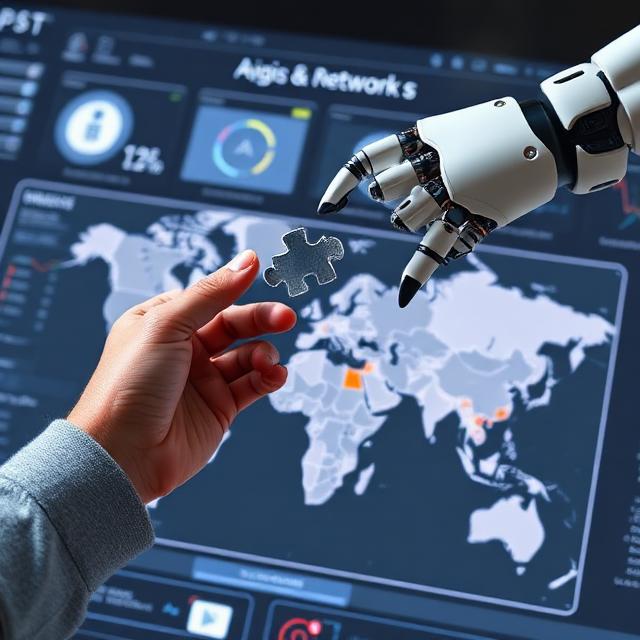
The most effective security operations centers (SOCs) now operate on a “fusion” model. AI handles the machine-scale tasks:
- Ingesting and correlating petabytes of data.
- Filtering and prioritizing alerts.
- Surfacing hidden patterns.
- Executing fast, pre-approved containment actions.
This frees human analysts to do what they do best:
- Strategic Thinking: Investigating the high-priority cases AI surfaces, asking “why,” and understanding attacker intent.
- Contextual Decision-Making: Using business knowledge to decide on nuanced responses (e.g., not isolating a critical server during a product launch).
- Improving the AI: Continuously tuning models, feeding them new data, and teaching them about the evolving business environment.
AI is the tireless, hyper-observant assistant. The human is the experienced detective making the final call.
The Challenges & The Road Ahead: It’s Not a Panacea
To go beyond the hype, we must also acknowledge the limitations.
- Adversarial AI: Attackers are using AI to create more convincing deepfakes for disinformation or to probe defenses.
- Bias & False Positives: AI models are only as good as their training data. Biased data can lead to flawed decisions.
- The Skilled Gap: We need more professionals who understand both cybersecurity and data science.
- Explainability: It’s crucial that AI can “explain” why it flagged a threat, so humans can trust and verify its decisions.
The future lies in explainable AI (XAI), more specialized models, and deeper integration across the entire security ecosystem—from code development (DevSecOps) to the endpoint to the cloud.
FAQ Section
Q1: Is AI going to replace human cybersecurity analysts?
A: Absolutely not. Think of AI as the ultimate force multiplier, not a replacement. It handles the superhuman tasks of sifting through millions of logs and events to find needles in haystacks. This frees up human analysts from alert fatigue, allowing them to focus on strategic investigation, context-based decision-making, and tackling the complex, high-priority incidents that AI surfaces. The future is a collaborative “AI-Human Fusion” team.
Q2: If AI is so good, why do we still hear about big data breaches?
A: This is an excellent question. AI is a powerful tool, not a magic shield. Breaches still occur due to:
- Integration Gaps: AI tools are only as good as the data they see. If they aren’t integrated across all systems, blind spots remain.
- Sophisticated Adversaries: Attackers also use AI and constantly adapt their tactics to evade detection.
- Non-Technical Vulnerabilities: Many breaches start with simple human error, like falling for a sophisticated phishing attack or misconfiguring a cloud server. AI helps mitigate these but can’t eliminate human factors.
- Adoption Curve: Not every organization has fully implemented or tuned these advanced tools. AI is becoming a standard in enterprise security, but its deployment is still maturing.
Q3: How can a small or medium-sized business (SMB) afford AI cybersecurity?
A: The great news is that SMBs benefit from AI primarily through consuming it as a service. You don’t need to build your own AI lab. Most modern, cloud-based security solutions—like next-gen antivirus (NGAV), Managed Detection and Response (MDR) services, and advanced email security gateways—have AI and ML baked into their core. By subscribing to these services, SMBs get access to the same powerful, enterprise-grade AI models that learn from a global threat landscape, making advanced protection scalable and affordable.
Q4: What about “Adversarial AI” – aren’t hackers using AI too?
A: Yes, and this is a critical arms race. Attackers use AI to automate attacks, craft more convincing phishing emails (through natural language generation), create deepfakes for disinformation, and even probe defenses to find weaknesses. However, defensive AI is evolving in tandem. The cybersecurity community is actively researching “adversarial machine learning” to harden AI models against poisoning and deception, ensuring our defensive tools can recognize and counter AI-powered attacks.
Q5: Does AI create more “false positives” that waste our time?
A: Ironically, a primary goal of modern security AI is to drastically reduce false positives. Legacy rule-based systems were notorious for alerting on every minor anomaly. Today’s ML models are trained on vast datasets to understand nuanced “normal” behavior, allowing them to correlate weak signals into high-fidelity incidents. The result is fewer, but much more accurate, alerts. The key is proper tuning and allowing the AI to learn your specific environment, which further reduces noise over time.
Q6: I’m worried about AI making autonomous decisions. Can I still have control?
A: Yes, control is paramount. In practice, AI-driven automated response is typically reserved for clear-cut, high-severity threats (like containing a ransomware outbreak) and is governed by pre-defined “playbooks” approved by human security leaders. For most other scenarios, AI acts in a recommendation mode, presenting analysts with evidence and a suggested action, leaving the final “approve” button in human hands. This balance ensures machine-speed response where needed and human oversight for complex judgments.
Q7: How do I know if my current security tools are using “real” AI and not just marketing hype?
A: It’s a fair concern. Ask your vendor specific questions:
- “What specific ML models or techniques do you use?” (Look for answers like supervised/unsupervised learning, behavioral analytics, etc.).
- “How is your model trained and on what data set?” (Global telemetry is a good sign.)
- “Can you provide a concrete example of how it reduces false positives or detects unknown threats?”
- “Does the tool provide ‘explainability’—can it show me why it flagged a certain behavior?”
A vendor with real AI will be transparent about its capabilities and limitations.
Conclusion: The Quiet Revolution is Here
So, is AI stopping threats today? Absolutely. It’s not a flashy robot overlord, but a foundational layer of our digital immune system. It’s the reason your credit card company texts you about fraud before you even notice. It’s the reason a major enterprise can contain a ransomware attack on a single machine. It’s the reason your email inbox isn’t an even bigger mess of spam and malicious links.
The hype promised an autonomous guardian. The reality delivered something perhaps more valuable: a force multiplier. AI is equipping human defenders with the tools to counter modern threats at the same scale and speed. It’s working in the background, turning overwhelming noise into actionable intelligence, and quietly shutting down attacks every second of every day.
The revolution isn’t coming. It’s already here, and it’s just getting started. The goal is no longer to detect threats faster, but to prevent them altogether—and with AI as a core partner in that mission, we’re closer than we’ve ever been.