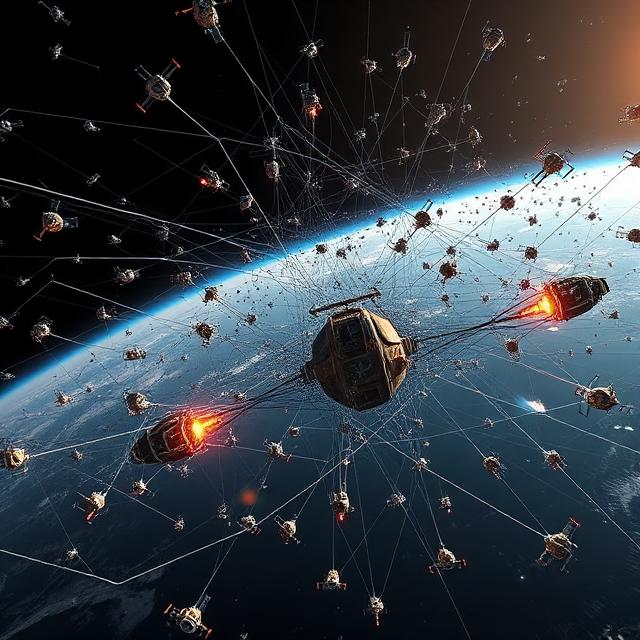
Imagine a future where, instead of a single, vulnerable spacecraft heading to a distant asteroid, a cloud of hundreds of small, intelligent robots descends upon it. They communicate seamlessly, mapping the terrain, sharing tasks, and assembling structures—like a colony of cosmic ants building a new hill. This isn’t just science fiction; it’s the imminent reality of swarm robotics in space, a field poised to revolutionize how we explore, build, and sustain ourselves beyond Earth.
Forget the clunky, singular robots of old sci-fi. The future is decentralized, adaptive, and resilient—mirroring the swarms we see in nature. In this deep dive, we’ll explore how these tiny robotic collectives are set to become the unsung heroes of our spacefaring ambitions, tackling everything from space debris cleanup to constructing lunar bases.
From Sci-Fi to Science Fact: What Exactly is Swarm Robotics?
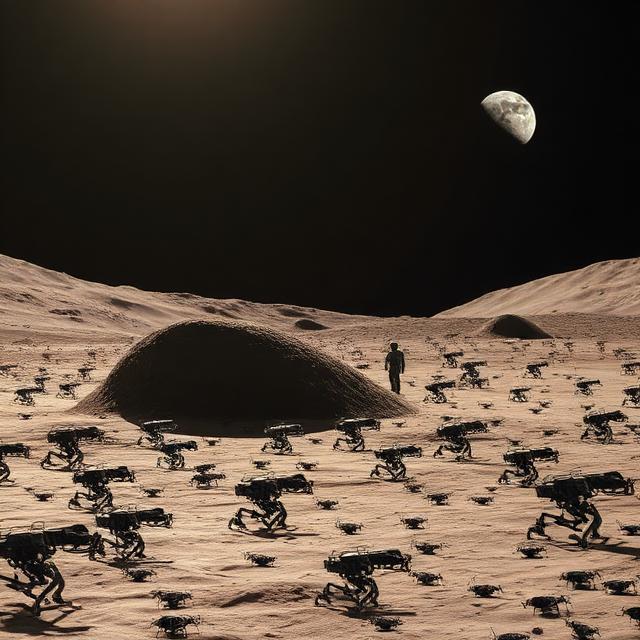
Let’s start with the basics. Swarm robotics is a field of robotics inspired by the collective behavior of social insects like bees, ants, and termites. The core idea is simple: instead of one expensive, complex robot designed to do everything, you use a multitude of simpler, cheaper robots that work together to achieve a common goal.
The magic isn’t in any individual unit (often called a “bot” or “agent”) but in the emergent intelligence of the group. Through local sensing and communication (“Hey, I found something over here!”), The swarm self-organizes, solving problems in ways a single robot never could. They are inherently robust—if a few units fail, the mission continues. They are scalable—you can add or remove bots easily. And they are flexible—the same swarm can be tasked with different missions.
Now, transpose this concept to the most challenging environment imaginable: space. The vast distances, extreme temperatures, radiation, and high cost of launching mass make the swarm approach not just attractive, but potentially the only feasible path forward for many ambitious projects.
Why Space is the Perfect Playground for Swarms
Space operations are fraught with what engineers call “single points of failure.” A tiny malfunction on a traditional satellite or probe can doom a multi-billion dollar mission. Swarm robotics turns this paradigm on its head.
- Resilience Through Redundancy: Losing one bot out of a hundred is a minor setback, not a mission-ending catastrophe. The swarm can dynamically reconfigure and reassign tasks.
- Mass and Cost Efficiency: Launching a single, large monolithic structure is incredibly expensive per kilogram. Smaller, modular robots can be packed densely and launched more affordably, even on rideshare missions.
- Distributed Sensing: A swarm can create a vast, distributed sensor array. Imagine dozens of small probes forming a giant “radio telescope” in deep space or creating a 3D map of an asteroid from thousands of angles simultaneously.
- Parallel Tasking: While a single rover might take years to explore a crater, a swarm could fan out and explore vast areas in a fraction of the time.
The Cosmic To-Do List: Swarm Missions We’re Building Today
So what will these swarms actually do? The applications are as vast as space itself.
1. The Galactic Janitors: Space Debris Cleanup
Our orbit is a mess. Thousands of defunct satellites and fragments—space debris—whiz around at lethal speeds, threatening active missions. Sending a dedicated “tow truck” for each piece is impractical. Enter the cleanup swarm.
A fleet of small, agile robots, equipped with nets, harpoons, or even drag sails, could be deployed. They could collaborate to match the tumble of a large debris object, secure it, and either de-orbit it or move it to a “graveyard” orbit. The European Space Agency’s (ESA) proposed ClearSpace mission concepts are already looking at collaborative, multi-agent approaches for this very problem. This is a critical step for ensuring the long-term sustainability of space operations.
2. The Orbital Construction Crews: Building In-Space Infrastructure
How do you build a massive space station or a fuel depot in orbit? Today, it requires complex astronaut EVAs or bespoke machinery. Tomorrow, swarms of assembler bots will do the job.
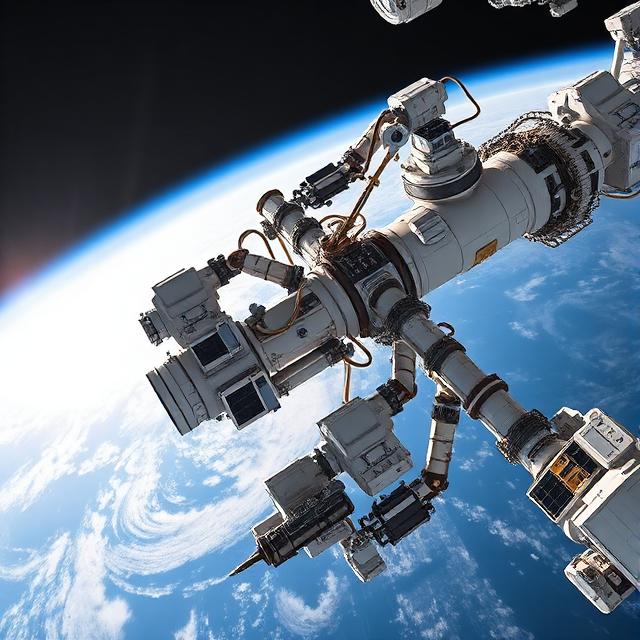
Picture this: A rocket delivers a modular truss structure and a hive of specialized robots. The swarm, guided by a shared digital blueprint, gets to work. Some act as precision movers, positioning beams. Others are “fastener bots,” bolting or welding components. Yet others perform real-time quality inspection. This method could build larger, more ambitious structures—like the giant solar arrays needed for beaming power to Earth or spacecraft preparing for deep space journeys. NASA’s On-Orbit Servicing, Assembly, and Manufacturing (OSAM) initiatives are pioneering these technologies.
3. The Unmanned Explorers: Mapping Asteroids and Planets
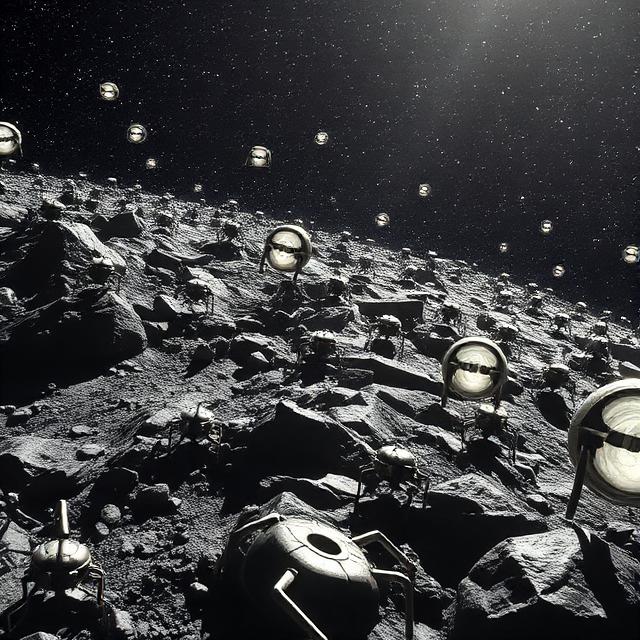
When NASA’s Psyche mission arrives at its metallic asteroid, it will be a single orbiter. A future mission might involve releasing a swarm of small “Hoppers” or “Cubesats” to land on the surface, measure composition in multiple locations simultaneously, and even probe crevices unreachable by a single lander.
On airless bodies like the Moon or asteroids, swarms could use simple hopping mechanisms to move. On Mars or moons with atmospheres, like Titan, swarms of small flying drones (an aerial swarm) could change everything. Imagine a mothership releasing a flock of tiny sensors into the methane lakes of Titan or the canyons of Mars, creating a rich, real-time network of atmospheric and geological data.
4. The Lunar Pioneers: Preparing for a Sustained Human Presence
Before astronauts return for a long-term stay, swarms could prepare the lunar surface. Excavator swarms could work in concert to regolith (lunar soil), building landing pads or radiation-shielding berms. Another swarm, using a process called additive manufacturing (essentially 3D printing), could then use that same regolith to fabricate habitats, layer by layer, using concentrated sunlight as their energy source.
These autonomous construction swarms would be critical for establishing a sustainable lunar infrastructure, minimizing the material we need to launch from Earth—a concept known as In-Situ Resource Utilization (ISRU).
The Nuts, Bolts, and Brains: How Space Swarms Actually Work
Creating a swarm for Earth is hard enough. Space adds layers of extreme complexity.
The Hardware Challenge:
Space-grade hardware must be radiation-hardened, withstand wild temperature swings, and operate in a vacuum. Swarm bots need to be even more minimalist. We’re talking about printed circuit boards (PCBs) with solar cells on one side, simple cold-gas thrusters for propulsion, and basic sensors (cameras, accelerometers, spectrometers). The goal is functional simplicity in each unit.
The Communication Conundrum:
This is the heart of the swarm. How do they talk? They likely use a mix of:
- Local, short-range links: Like Wi-Fi or ultra-wideband for bots working close together on a structure.
- Mesh networking: Where each bot relays messages for others, creating a resilient communication web.
- A “Queen” or Hub (sometimes): For certain missions, a larger mothership might act as a central communicator with Earth and a coordinator for the swarm, though purists aim for full decentralization.
The Intelligence Layer: The Real Secret Sauce
The software algorithms are what make a collection of robots a true swarm. This is where artificial intelligence meets biology.
- Bio-inspired Algorithms: Techniques like Ant Colony Optimization (simulating how ants find the shortest path to food) or Particle Swarm Optimization help the bots make decentralized decisions about navigation and task allocation.
- Emergent Behavior: Programmers don’t code every action. They code simple rules (“don’t crash,” “follow the gradient of this signal,” “mimic your neighbor’s direction”). Complex, coherent group behavior emerges from these simple interactions.
- Machine Learning On-the-Go: Advanced swarms might use federated learning, where each bot learns from its local environment and shares knowledge with the swarm, collectively getting smarter about navigating unforeseen terrain or obstacles.
The Challenges: It’s Not All Smooth Sailing (or Flying)
The path to deploying operational space swarms is littered with hurdles:
- Autonomy vs. Control: The deeper into space they go, the longer the communication delay with Earth. Swarms must be fully autonomous, raising big questions about verification and safety. Can we trust a fully autonomous swarm to make its own decisions near a billion-dollar space station?
- Navigation and Coordination: Without GPS, swarms must navigate using stars, onboard landmarks, and relative positioning with each other. Precision coordination for tasks like assembly requires incredible synchronization.
- The Energy Dilemma: Small size means small solar panels and tiny batteries. Swarm missions will need to be designed around cycles of activity and recharge, or tap into novel power sources.
- The Legal and Regulatory Void: Who is responsible if a swarm bot from one nation damages a satellite from another? Current space law is ill-equipped for multi-agent, autonomous systems. The policy and ethics of autonomous space systems are a growing field of debate.
The Current Vanguard: Projects Leading the Charge
This isn’t just theory. Exciting projects are already laying the groundwork:
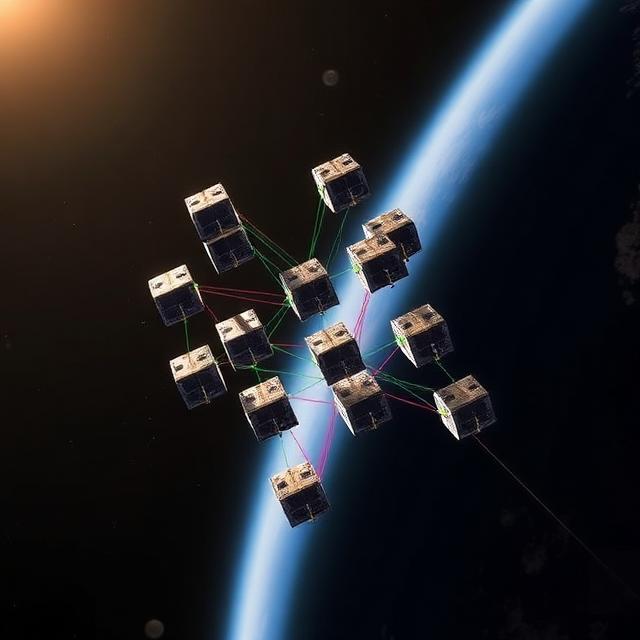
- NASA’s Starling Mission: This is a flagship swarm technology demonstration in low-Earth orbit. A cluster of CubeSats is testing key swarm capabilities: autonomous navigation, networking, and maneuvering as a group.
- ESA’s Hive Concept: Exploring how swarms of small satellites can provide continuous, global Earth observation, with units being replaced as they fail for a truly sustainable system.
- ALLEGRO (University of Luxembourg): A project focused on the algorithms and control systems for asteroid exploration swarms.
- Breakthrough Starshot: The most ambitious vision of all—propelling a swarm of gram-scale “star chips” by laser light to reach Alpha Centauri within a generation. It epitomizes the swarm philosophy: redundancy and miniaturization for an otherwise impossible journey.
The Human Connection: Why This Matters for All of Us
You might wonder, “This is cool, but how does it affect me?” The technologies developed for space swarms have profound terrestrial spin-offs. The mesh networks could revolutionize disaster response robots. The miniaturized sensors could lead to new medical diagnostics. The distributed AI could optimize traffic flow or energy grids.
More philosophically, swarm robotics represents a shift in how humanity interacts with the cosmos. Instead of sending our fragile, monolithic creations, we are learning to send resilient, adaptable, and collective extensions of our will. We are moving from the era of the lone astronaut and the solitary probe to the age of cooperative, distributed exploration.
FAQ Section
Q1: What exactly is “swarm robotics,” and why is it useful for space?
A: Swarm robotics takes inspiration from colonies of ants, bees, or birds—where many simple agents work together to achieve complex tasks through local cooperation. In space, this approach offers unparalleled resilience and flexibility. Instead of a single, vulnerable multi-billion dollar probe, a swarm can lose members and still complete its mission, distribute risk, and cover vast areas in parallel. It turns the high-stakes, “single point of failure” model of traditional space missions on its head.
Q2: What are the most promising immediate applications for space swarms?
A: The low-hanging fruit is orbital debris cleanup and in-space assembly. Swarms of small, specialized “janitor” satellites could collaboratively capture and de-orbit dangerous space junk. Similarly, swarms acting as orbital construction crews could assemble large structures like next-generation telescopes or fuel depots. Closer to Earth, projects like NASA’s Starling mission are already testing the core technologies for these applications.
Q3: How do the robots in a swarm communicate and coordinate in space?
A: They use a combination of technologies! For close-proximity work (like assembly), they might use short-range wireless links (like Wi-Fi or laser comms). Over larger distances, they often form a mesh network, where each bot relays messages for others, creating a robust communication web. Their coordination is powered by bio-inspired AI algorithms (like ant colony optimization) that allow complex, intelligent group behavior to emerge from simple, pre-programmed rules.
Q4: What’s the biggest challenge facing the development of space swarms?
A: While hardware and AI are tough, one of the thorniest challenges is full autonomy. In deep space, communication delays with Earth make real-time control impossible. We must be able to trust a swarm to make its own safe, ethical decisions—a major leap in software verification and reliability. Beyond tech, there are also significant legal and regulatory gaps regarding responsibility for the actions of an autonomous robotic collective.
Q5: Are there any real-world missions using this technology right now?
A: Absolutely! NASA’s Starling 1.0 mission, launched in 2023, is a key demonstration. A cluster of four CubeSats in low-Earth orbit is testing autonomous swarm navigation, reconfiguration, and mesh networking. On the conceptual side, the Breakthrough Starshot initiative envisions using a laser-propelled swarm of gram-scale probes for interstellar travel. You can learn more about current NASA projects in our article on The Future of Autonomous Space Missions.
Q6: Could swarm robotics help build a base on the Moon or Mars?
A: It’s a leading candidate for the job! Before astronauts arrive, swarms of excavator bots could prepare landing pads and dig out habitats. Following them, 3D printing swarms could use local soil (regolith) as building material to construct shelters, roads, and radiation shields. This approach, called In-Situ Resource Utilization (ISRU), is critical for sustainable, affordable off-world construction and is a major focus for agencies like NASA and ESA.
Q7: Does more autonomy in robots mean less need for human astronauts?
A: Not at all—it means a powerful shift in their roles. Swarms will act as force multipliers and risk reducers for human crews. They’ll handle the “dull, dirty, and dangerous” tasks: scouting ahead, assembling infrastructure, and conducting repetitive maintenance. This frees astronauts to focus on high-level decision-making, scientific discovery, and exploration—making human missions both safer and more productive. The future is one of human-swarm teamwork.
Conclusion: A Swarm-Powered Future
The dream of a sustainable, bustling presence in space—with lunar bases, orbital factories, and probes at every planet—rests on our ability to work smarter, not just bigger or with more brute force. Swarm robotics in space offers that smarter path.
It’s a future where failure is localized, and innovation is distributed. Where our machines cooperate with the elegance of a murmuration of starlings, even in the silent void. The journey has already begun, in labs and in orbit, as we teach our robotic collectives to think, work, and explore as one.
The next giant leap for mankind won’t be taken by a single boot. It will be prepared, built, and scouted by a thousand tiny, intelligent feet, wheels, and thrusters, working together in a dance of silicon and starlight. And that future is nearer than you think.