You’ve heard the buzz. A friend used it to draft an email. A colleague generated code with it. Your cousin wrote a sonnet about her cat in the style of Shakespeare. Suddenly, “ChatGPT” is everywhere—from watercooler chats to boardroom meetings to alarming headlines. But what exactly is it? Is it a magical oracle, a job-stealing menace, or just a very sophisticated autocomplete?
If you’re feeling a mix of curiosity and confusion, you’re in the right place. Consider this your friendly, no-jargon guide to ChatGPT. We’ll unpack what it is, how it works, why it’s such a big deal, and how you can actually use it in your daily life. Let’s pull up a chair and demystify this AI phenomenon together.
What Is ChatGPT, Anyway? Let’s Start Simple.
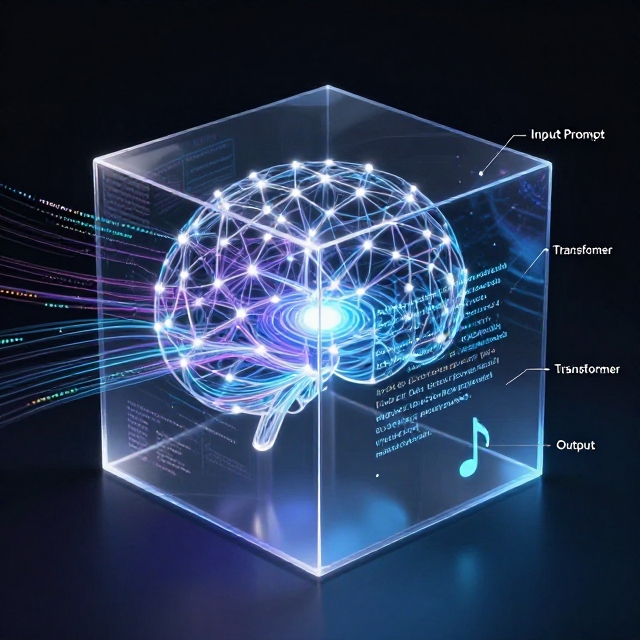
At its heart, ChatGPT is a highly advanced computer program designed to understand and generate human-like text. It’s a chatbot, but one that’s been trained on a vast portion of the internet—books, articles, websites, and more—allowing it to converse, answer questions, and create content on a staggering array of topics.
Think of it like this: Imagine you could give the collective writing of humanity to a super-intelligent, lightning-fast reader. This reader doesn’t “understand” in the human sense, but it learns patterns—how words fit together, how ideas are structured, how a query leads to an answer. When you ask it a question, it predicts, word by word, what a helpful response should look like based on all those patterns. That’s ChatGPT in a nutshell.
Its full name gives more clues: Chat Generative Pre-trained Transformer. “Chat” is obvious. “Generative” means it creates new text. “Pre-trained” means it learned from that massive dataset before you ever talked to it. And “Transformer” is the type of AI architecture it uses, which is brilliant at handling sequences of data (like sentences).
It was created by OpenAI, an AI research and deployment company. You can access it for free through a simple chat interface on their website, or subscribe to ChatGPT Plus for priority access and newer features. Since its public release in November 2022, it has become the fastest-growing consumer application in history, a testament to its utility and wow factor.
The Engine Under the Hood: How Does It Actually Work?
You don’t need a computer science degree to grasp the basics. Here’s the simplified journey of your prompt:
- You Provide Input (The Prompt): This is your question, instruction, or conversation starter. “Explain quantum physics like I’m 10,” or “Write a grocery list for a vegan chili.”
- The AI Processes the Pattern: ChatGPT breaks down your words into tokens (pieces of words) and uses its neural network—a digital web of connections modeled loosely on the human brain—to analyze the context. It doesn’t “know” facts but references the statistical relationships between words and concepts from its training.
- It Generates a Response, Word by Word: It doesn’t have a pre-written answer. Instead, it calculates the most probable next word, then the next, and so on, building a coherent reply one step at a time. This is why it can generate entirely novel paragraphs, poems, or code that didn’t exist before.
- You Get the Output & Refine: You read its answer. If it’s not quite right, you can provide follow-up instructions. “Make that shorter,” or “Use a more formal tone.” This back-and-forth, called prompt engineering, is key to getting great results.
Underpinning this process are two critical concepts from OpenAI:
- Reinforcement Learning from Human Feedback (RLHF): This is the secret sauce that made ChatGPT feel so much more aligned and helpful than previous chatbots. After its initial training, human AI trainers provided conversations and ranked responses. The AI learned from these preferences, refining its ability to be harmless, truthful, and useful. You can read about this groundbreaking approach in OpenAI’s original research paper on InstructGPT, ChatGPT’s predecessor.
- Large Language Model (LLM): ChatGPT is a specific type of LLM. These models are characterized by their enormous size—both in the amount of data they’re trained on and the number of parameters (think: the adjustable settings in its neural network) they have. GPT-3.5 has 175 billion parameters, and GPT-4 is even more massive. This scale is what allows for such nuanced and seemingly understanding responses.
Beyond Small Talk: What Can You Actually Do With ChatGPT?
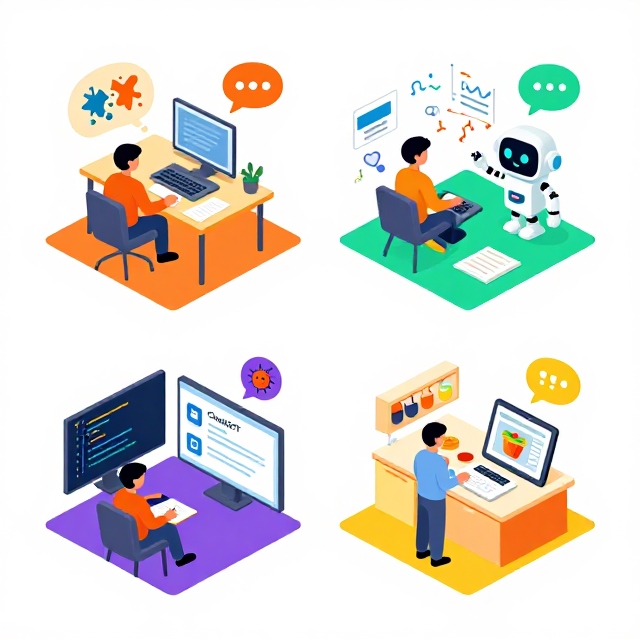
This is where the fun begins. ChatGPT is a Swiss Army knife for the mind. Here are just a few ways people are using it:
1. The Creative Partner:
- Brainstorming: Stuck on a blog title, product name, or story idea? ChatGPT can generate lists of creative options in seconds. “Give me 10 catchy names for a new coffee shop that specializes in cold brew.”
- Drafting Content: Emails, cover letters, social media posts, blog outlines, video scripts. It’s a fantastic first-draft machine. “Write a polite follow-up email to a client I haven’t heard from in two weeks.”
- Creative Writing: Poems, short stories, song lyrics, and even script dialogue. You can specify style and tone. “Write a haiku about procrastination.”
2. The Learning & Explaining Tutor:
- Simplify Complex Topics: Ask it to explain anything from the theory of relativity to blockchain to baking sourdough at a 5th-grade level. It’s endlessly patient.
- Generate Study Aids: Create practice quiz questions, summarize lengthy articles or chapters, or get different perspectives on a historical event.
- Learn a Language: Practice conversations, get grammar explanations, or translate phrases (though for critical translations, dedicated tools are better).
3. The Productivity Powerhouse:
- Coding & Tech Help: It can write code snippets in Python, JavaScript, HTML, and more, debug errors, or explain what a piece of code does. It’s become an invaluable tool for developers, as noted in communities like Stack Overflow (though they initially had to set policies around AI-generated answers).
- Analyze & Summarize: Paste a long article, report, or set of meeting notes and ask for a summary, a list of key points, or an analysis of the main arguments.
- Organize & Structure: Turn disorganized thoughts into a structured outline, a bulleted list, or a table. “Organize these random tasks into a project plan with phases and deadlines.”
4. The Everyday Assistant:
- Plan a Trip: “Suggest a 3-day itinerary for Rome focused on art and food.”
- Cook & DIY: “Give me a recipe using chicken, spinach, and feta cheese.” Or, “How do I fix a leaking faucet?”
- Roleplay & Prepare: Practice for a job interview by having it act as the interviewer. Simulate a difficult conversation.
The Flip Side: Important Limitations & Things to Keep in Mind

ChatGPT is powerful, but it’s not omniscient. Being aware of its limits is crucial for using it effectively and safely.
- It Can Hallucinate: This is the biggest one. ChatGPT can generate information that sounds utterly convincing but is completely fabricated. It might cite a non-existent academic paper, give you false historical dates, or make up a news story. Always fact-check its outputs, especially for critical information. The BBC published a great piece on this phenomenon when ChatGPT was accused of fabricating legal cases.
- It’s a Snapshot in Time: The free version of ChatGPT (GPT-3.5) has a knowledge cutoff. It doesn’t know about events that occurred after its last training update (around early 2022). GPT-4 has better recency through its browsing feature, but it’s not real-time.
- It Lacks True Understanding & Emotion: It simulates empathy and understanding based on patterns, but it doesn’t feel or comprehend like a human. It’s a pattern-matching engine, not a conscious being.
- It Can Be Biased: Since it’s trained on data written by humans (who have biases), it can sometimes reproduce those biases in terms of gender, race, culture, or perspective. OpenAI works to mitigate this, but it’s an ongoing challenge.
- It’s Not a Source of Truth: It’s a tool for generation and assistance, not a search engine like Google. Its strength is in creating and synthesizing, not retrieving verified facts.
The Bigger Picture: Why Is ChatGPT Such a Watershed Moment?
ChatGPT isn’t the first AI chatbot, but its launch felt different. Why?
1. Accessibility: The simple, conversational interface made advanced AI available to everyone. You didn’t need to be a programmer or a researcher. This triggered massive public engagement and imagination.
2. The “Chat” Factor: Previous AI often felt transactional. ChatGPT’s ability to maintain context in a conversation, remember what you said earlier, and accept follow-up corrections made it feel like a collaborative partner. This shifted the human-AI interaction paradigm.
3. The Spark of a New Era: It acted as a global demo for the potential of generative AI. It made tangible the idea that AI could be a co-pilot for human intellect across nearly every field—writing, law, medicine, education, art, and software. The ripple effects are just beginning, with experts at places like The Brookings Institution analyzing its profound impact on the economy and labor market.
Getting the Best Results: A Quick Guide to Prompting
The art of talking to ChatGPT to get great answers is called prompt engineering. It’s simple but powerful:
- Be Specific: “Write a story” is okay. “Write a 300-word mystery story for children about a missing set of magical paints, with a twist ending” is much better.
- Assign a Role: “Act as a seasoned marketing professional. Create a social media campaign strategy for launching a new sustainable sneaker brand targeting Gen Z.”
- Provide Context & Format: “I am preparing a 10-minute presentation for my non-technical boss on cloud computing. Provide an outline with three main sections, using simple analogies.”
- Use Iteration: Don’t expect perfection on the first try. Refine: “That’s good, but make the tone more enthusiastic,” or “Now, turn those points into a bulleted email.”
What’s Next? The Future of ChatGPT and AI Chat
ChatGPT is evolving rapidly. With GPT-4, its reasoning, accuracy, and ability to handle longer contexts improved significantly. OpenAI is also integrating multimodal abilities—meaning future versions won’t just process text but also images, audio, and video.
We’re moving towards AI assistants that are more deeply integrated into our software (like Microsoft Copilot in Office 365) and our daily workflows. The focus will be on augmentation—using AI to amplify human creativity and productivity rather than replace it.
The conversation around ethics, regulation, and the societal impact is also heating up. How do we ensure this technology is used for good? How do we prepare for shifts in the job market? These are critical questions we’ll all be grappling with.
Final Thoughts: Your New Digital Companion
So, is ChatGPT a magic trick? In a way, yes—but the magic is the result of decades of research, immense computational power, and human ingenuity. It’s a tool, and like any tool, its value depends on how you use it.
Approach it with curiosity and a critical mind. Use it to offload mundane tasks, spark creativity, and accelerate learning. But never outsource your final judgment to it. Fact-check its work. Apply your own ethics and empathy. Use it as a starting point, not an ending point.
The AI genie is out of the bottle, and it’s not going back in. Instead of fear or passive awe, the most productive stance is one of engaged experimentation. Go ahead, head to OpenAI’s platform, create an account, and start a conversation. Ask it something you’ve always wondered about. Have it help you with a task you’ve been putting off.
Welcome to the future of conversation. It’s just getting started.
What’s the most surprising or useful thing you’ve done with ChatGPT? Share your experiences in the comments below—let’s learn from each other!