

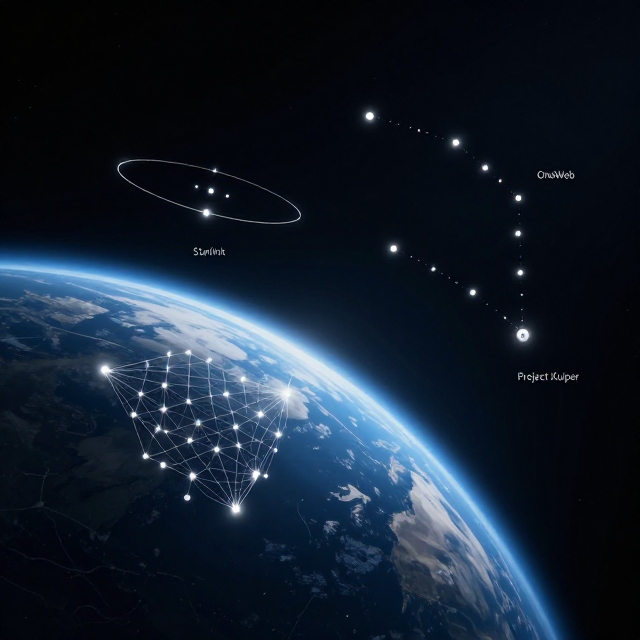
Look up at the night sky. What do you see? Stars, planets, the occasional passing airplane. But silently, invisibly, a revolution is unfolding in that vast darkness. Not with the giant, school-bus-sized satellites of old, but with thousands of minuscule marvels, some no bigger than a loaf of bread. These are the ages of the nano-satellites constellation, and they’re changing everything from how we grow our food to how we connect across the globe.
Let’s start by demystifying the term. A nano-satellite is broadly defined as a satellite with a mass between 1 and 10 kilograms. To put that in perspective, your average laundry detergent jug holds about 4-5 kilos of liquid. These are not the multi-billion-dollar, handcrafted behemoths that take decades to build. They are the smartphones of space: compact, standardized, and built with commercial off-the-shelf components.
Now, imagine not just one, but dozens, hundreds, or even thousands of these working together in a synchronized flock. That’s a constellation. Unlike a lone satellite that might pass over a specific spot on Earth once a day, a constellation can provide continuous, global coverage. It’s the difference between a single security camera and a wall of monitors showing every angle in real-time.
From Garage Dreams to Global Networks: The Democratization of Space
This story begins with a fundamental shift. For decades, space was the exclusive domain of governments and a handful of colossal aerospace contractors. The cost, risk, and complexity were simply too high for anyone else. Enter the CubeSat standard in the early 2000s. Developed by universities as an educational tool, it created a simple, modular blueprint: a single “1U” CubeSat is a 10 cm cube. You can stack them like Lego bricks (1.5U, 3U, 6U, 12U) for more capability.
This standardization was a game-changer. Suddenly, universities, small startups, and even high schools could dream of building and launching a satellite. Companies like Planet Labs, founded by ex-NASA scientists, saw the potential. They pioneered the use of “Dove” satellites—3U CubeSats equipped with powerful telescopic cameras—and began launching them in batches. Their audacious goal? To image the entire Earth every single day.
And they succeeded. Planet’s constellation of over 150 nano-satellites has created an unprecedented, living atlas of our planet. As they state on their website, this data provides “insights at the speed of change,” helping monitor deforestation, track agricultural health, and even assess disaster damage. (Source: Planet Labs: Our Constellations)
The Drivers of the Boom: Why Tiny Sats are Taking Over
So, what’s fueling this explosion of tiny spacecraft? Several key factors converged:
- The Cost Plunge: Launching mass into orbit is astronomically expensive, but nano-satellites are light. This allows them to “ride-share” on larger rockets as secondary payloads. Companies like SpaceX, with its dedicated smallsat rideshare program (Transporter missions), have turned launch access into a relatively affordable, routine service. You can now book a spot to orbit much like you book a flight. (Source: SpaceX SmallSat Rideshare Program)
- The Tech Trinity: The same miniaturization that gave us powerful smartphones also empowered nano-satellites. Advances in microelectronics, miniaturized sensors (like hyperspectral and SAR radars now fitting on small sats), and battery technology have made these devices incredibly capable. Furthermore, innovations in software and AI allow them to process data in orbit, sending down only the most valuable insights.
- The Connectivity Craze: The most famous and controversial constellation is SpaceX’s Starlink. With over 4,000 nano-satellite-class satellites already in orbit and plans for tens of thousands more, its goal is to blanket the Earth in high-speed, low-latency internet. Love it or debate its impact on astronomy, it’s a staggering proof-of-concept for what nano-constellations can achieve in terms of scale and service delivery. (Source: SpaceX Starlink)
- The Data Demand: Our world runs on data. Farmers want to know the health of each square meter of their field. Shipping companies want to track every container. Scientists need to measure urban heat islands or methane leaks with pinpoint accuracy. Nano-constellations provide this data with a frequency and affordability that were previously unimaginable.
Beyond Internet: The Surprising Uses of Tiny Constellations
While broadband grabs headlines, the applications are beautifully diverse:
- Earth Observation (EO) for Good: Companies like Spire Global operate a constellation that uses radio occultation to measure atmospheric conditions (temperature, pressure, humidity). This data significantly improves weather forecasting and hurricane tracking. (Source: Spire Global: Data & Analytics)
- Precision Agriculture: Constellations can monitor crop health, soil moisture, and pest infestations, allowing farmers to use water and fertilizer more efficiently, boosting yields sustainably.
- Maritime and Border Security: Automatic Identification System (AIS) tracking from space allows nations and companies to monitor ship movements across the entire ocean, combating illegal fishing and piracy.
- Disaster Response: In the aftermath of floods, fires, or earthquakes, nano-constellations can be tasked to provide rapid, high-resolution imagery to first responders, mapping damage and guiding relief efforts.
- Environmental Guardianship: They are key tools in the fight against climate change, monitoring deforestation in the Amazon, tracking oil spills, and detecting illicit emissions from industrial sites.
The Flip Side: Navigating the Challenges of a Crowded Sky
This gold rush to low-Earth orbit (LEO) isn’t without its very real problems. As the visionary founder of the Secure World Foundation has noted, the sustainable use of space is a pressing global issue. Three major challenges loom large:
- Space Debris: With thousands more objects launched, the risk of catastrophic collisions increases. Each collision creates thousands of new debris fragments, potentially leading to a cascade known as the Kessler Syndrome, where certain orbits become unusable. Responsible operators are now designing satellites for automatic de-orbiting at end-of-life, but regulation and universal compliance are still catching up. (Source: European Space Agency: Space Debris)
- Regulatory Traffic Jam: National and international regulatory bodies, like the Federal Communications Commission (FCC) in the U.S. and the International Telecommunication Union (ITU), are scrambling to manage spectrum allocation and orbital slots. The question of “who gets which space in space” is becoming a complex diplomatic and commercial puzzle.
- The Astronomer’s Dilemma: The reflective surfaces of large constellations, especially in the hours after launch and before reaching final orbit, are creating bright streaks that mar astronomical images and interfere with observations of distant galaxies. The astronomy community and companies like SpaceX are actively working on mitigation strategies, such as sunshades and darkening coatings, but it remains a heated topic. (Source: International Astronomical Union: Dark and Quiet Skies)
The Future: Smarter, More Sustainable, and Beyond Earth

So, where do we go from here? The nano-satellite story is just entering its second chapter.
- The Rise of the “Smart” Constellation: Future flocks won’t just collect data; they’ll talk to each other. Using inter-satellite links (laser communications), they’ll form a mesh network in space, relaying information instantly across the constellation and down to fewer ground stations. This increases speed and resilience.
- On-Board AI: Instead of drowning ground stations in terabytes of raw images, satellites will process data in orbit using edge computing. They’ll send down alerts—”There’s a new ship in this restricted zone,” or “I detected a fire starting at these coordinates”—not just endless pixels.
- Sustainable by Design: The next generation will prioritize design for demise, using materials that completely burn up on re-entry. Active debris removal missions and in-orbit servicing (refueling, repairing) will also become part of the ecosystem.
- Beyond Earth Orbit: The success in LEO is a blueprint for the solar system. NASA’s MarCO mission proved that CubeSats can operate as far as Mars. Future missions envision swarms of nano-satellites exploring the icy plumes of Enceladus or the thick atmosphere of Venus.
Conclusion: A Connected World, From the Ground Up
The growth of nano-satellite constellations is more than a tech trend; it’s a fundamental rewiring of our planetary intelligence. We are knitting a digital nervous system around the Earth, one tiny, inexpensive node at a time. This isn’t just about billionaires or broadband; it’s about a farmer in Kenya accessing soil data, a researcher tracking penguin colonies in Antarctica, or a village in Peru getting online for the first time.
It reminds us that sometimes, the most profound changes come not from a single giant leap, but from a thousand small steps—or in this case, a thousand small orbits. As we look up at that seemingly quiet night sky, we can now imagine it pulsing with potential, alive with tiny sentinels working together to help us understand, protect, and connect our fragile, beautiful planet. The future overhead is small, smart, and incredibly promising.
FAQ Section
Q1: What exactly is a nano-satellite?
A nano-satellite is a small, low-mass spacecraft, typically weighing between 1 and 10 kilograms. The most common type is the CubeSat, a standardized design based on a 10 cm cube unit (1U). Think of them as the smartphones or standardized building blocks of space—compact, affordable, and built with commercial technology.
Q2: How is a constellation different from a single satellite?
A single satellite in orbit can only observe or communicate with a specific area of Earth as it passes overhead. A constellation is a coordinated network of dozens to thousands of satellites working together. This allows for continuous, global coverage, meaning any spot on Earth can be monitored or connected to at any time, much like how cell phone towers provide seamless coverage.
Q3: Why are they so much cheaper than traditional satellites?
The low cost comes from a perfect storm of innovation: miniaturization of electronics (similar to what powers your laptop), standardized designs (like the CubeSat) that streamline manufacturing, and rideshare launch opportunities where many small satellites share a single rocket ride, dramatically splitting the launch cost.
Q4: Isn’t all this space junk a major problem?
It is a serious and growing concern, known as the space debris issue. With thousands of new objects in Low-Earth Orbit, the risk of collisions increases. Responsible operators are now designing satellites to automatically de-orbit and burn up in the atmosphere at the end of their life. The international space community is actively working on debris mitigation guidelines and active removal technologies to ensure space remains sustainable.
Q5: Besides the internet (like Starlink), what are they actually used for?
The applications are incredibly diverse! Key uses include:
- Earth Observation: Daily imaging of the entire planet for agriculture, forestry, and urban planning.
- Environmental Monitoring: Tracking deforestation, ice melt, methane leaks, and oil spills.
- Weather & Climate Science: Collecting atmospheric data to improve forecasting accuracy.
- Maritime & Aviation Tracking: Global monitoring of ships and planes for safety and security.
- Disaster Response: Providing rapid, post-disaster imagery to coordinate relief efforts.
Q6: How do they affect astronomy?
The bright, reflective surfaces of large satellite constellations (especially shortly after launch) can create streaks across telescope images, interfering with observations of distant stars and galaxies. This is a significant issue for ground-based astronomy. In response, companies are testing dark coatings, sunshades, and new orbital orientations to reduce reflectivity, and astronomers are developing software to help filter out satellite trails.
Q7: What does the future hold for nano-satellite constellations?
The trend is toward smarter, more capable, and more sustainable systems. Future constellations will feature:
- Laser Communication: Enabling ultra-fast data transfer between satellites.
- Advanced Sensors: Like miniaturized radar (SAR) for seeing through clouds and at night.
- Beyond Earth Orbit: Swarms of nano-satellites could one day explore moons and planets throughout our solar system.
- AI-Powered Satellites: Processing data in orbit to send down only critical insights.

buy cannabis products online with worldwide shipping