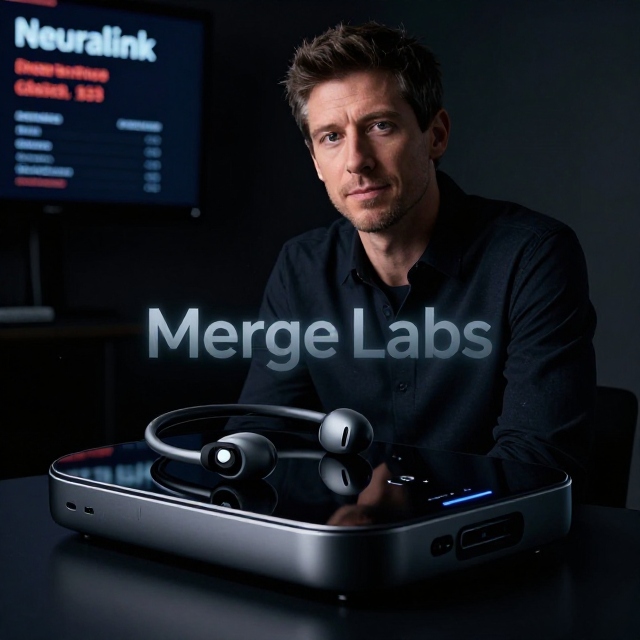
In a move that encapsulates the increasingly self-referential nature of Silicon Valley’s elite investment circles, OpenAI has placed a significant bet on Merge Labs, a brain-computer interface (BCI) startup led by its own CEO, Sam Altman. This investment, confirming earlier reports, sees OpenAI writing the largest single check in Merge Labs’ substantial $250 million seed round, valuing the nascent “research lab” at $850 million. The deal, announced as Merge Labs emerged from stealth, underscores a deepening convergence of capital, control, and technological vision at the highest levels of the AI industry, while also intensifying Altman’s quiet rivalry with another tech titan, Elon Musk.
Sam Altman’s Brain-Computer Interface
Merge Labs defines its mission in ambitiously philosophical terms: “bridging biological and artificial intelligence to maximize human ability.” In its inaugural statement, the company posits that our conscious experience is a product of “billions of active neurons,” and that interfacing with this neural tapestry at scale could unlock revolutionary outcomes—restoring lost sensory or motor functions, fostering healthier mental states, deepening human connection, and, crucially, expanding creative and cognitive potential in tandem with advanced artificial intelligence. This vision positions the company not merely as a medical device developer, but as an architect of the next phase of human evolution.
The startup’s approach, however, seeks to differentiate itself from the current BCI paradigm, most visibly championed by Musk’s Neuralink. Where Neuralink’s technology requires invasive neurosurgery—a robot removing a small skull piece to implant electrode threads directly into brain tissue—Merge Labs states its intention to pioneer non-invasive methods. The company aims to develop “entirely new technologies that connect with neurons using molecules instead of electrodes,” leveraging “deep-reaching modalities like ultrasound” to transmit and receive information. This fundamental divergence in methodology highlights a key battleground in BCI development: the trade-off between the high-fidelity data of invasive implants and the safety and accessibility of external systems. Neuralink, which last raised $650 million at a $9 billion valuation in mid-2025, has focused its initial applications on restoring autonomy to individuals with severe paralysis. Merge Labs’ broader, enhancement-focused language suggests a different primary market: the Silicon Valley aspiration for cognitive augmentation.
This distinction is reflected in the commentary from investors. Seth Bannon of Fifty Years, one of the participating investment firms alongside Bain Capital, Interface Fund, and Valve co-founder Gabe Newell, framed the investment on social media as supporting the culmination of humanity’s tool-building journey to “extend ourselves and our capabilities.” OpenAI, in its own blog post, affirmed that “BCIs are an important new frontier,” creating a “natural, human-centered way for anyone to seamlessly interact with AI.” The subtext is clear: while acknowledging medical use cases, the primary excitement lies in BCIs as the ultimate user interface for artificial general intelligence, a seamless conduit between human thought and AI capability.
Herein lies the profoundly circular nature of the deal, a characteristic that has drawn significant scrutiny. If Merge Labs succeeds in creating a popular, non-invasive BCI, it would naturally drive immense usage and dependency on the AI systems that interface with it—systems likely to be powered by OpenAI. This, in turn, would validate and amplify the return on OpenAI’s investment. Furthermore, the investment effectively uses capital from a company Altman runs (OpenAI) to increase the value of a company he owns (Merge Labs). This pattern is not isolated within Altman’s network. The OpenAI Startup Fund has previously invested in several other Altman-connected ventures, including biotech firm Red Queen Bio, AI chip company Rain AI, and legal AI startup Harvey. OpenAI has also engaged in commercial agreements with Helion Energy and Oklo, nuclear energy companies, where Altman serves as chairman.
The co-founding team of Merge Labs itself reads as a map of Altman’s professional constellation. Alongside Altman, founders include Alex Blania (CEO) and Sandro Herbig (product and engineering lead) from Tools for Humanity, the Altman-backed company known for its Worldcoin orb. Also on the list are Tyson Aflalo and Sumner Norman, co-founders of the implantable neural tech company Forest Neurotech, and Caltech researcher Mikhail Shapiro. Notably, Blania and Herbig confirmed they will maintain their roles at Tools for Humanity, while Shapiro will continue teaching. Merge Labs stated that Forest Neurotech will continue operating with a “wonderful working relationship” with the new lab, though the ongoing roles of Aflalo and Norman were not clarified. A spokesperson confirmed all co-founders will serve on Merge Labs’ board, consolidating control within this core group.
As a formal part of the investment, OpenAI and Merge Labs will collaborate on “scientific foundation models and other frontier tools” to accelerate progress. OpenAI elaborated that AI will be instrumental not just in accelerating R&D in bioengineering and neuroscience, but also in creating the AI operating systems necessary to make BCIs practical—systems that can “interpret intent, adapt to individuals, and operate reliably with limited and noisy signals.” In a very tangible sense, Merge Labs could become the hardware remote control for which OpenAI’s software is the essential, intelligent signal. This synergy invests a strategic vertical integration for OpenAI, securing a potential dominant pathway for its models to reach the human mind.
This investment is one piece of a broader hardware strategy at OpenAI. The company is also working with io, the startup founded by former Apple designer Jony Ive that it acquired last year, to develop an AI hardware device that eschews screens. Reports suggest this device may take the form of an AI earbud, another potential conduit for ambient, always-available AI interaction. Together, these moves signal OpenAI’s ambition to escape the confines of the chatbox and integrate its intelligence into the very fabric of human perception and action.
The philosophical underpinnings of Merge Labs can be traced directly to Altman’s long-held personal speculations. In a 2017 blog post, he mused about “the merge”—the concept of humans and machines coalescing—predicting it could occur between 2025 and 2075. He envisioned forms ranging from neural implants to deep, symbiotic friendships with AI. For Altman, the merge represents the “best-case scenario” for humanity’s survival alongside a potentially conflictive superintelligent AI, which he views almost as a separate species. He framed humanity’s choice starkly: serve as a “biological bootloader for digital intelligence” before fading into obsolescence, or consciously engineer a successful integration. “Although the merge has already begun,” he wrote, “it’s going to get a lot weirder. We will be the first species ever to design our own descendants.”
This context transforms the Merge Labs investment from a simple financial transaction into a deliberate step toward a specific technological future. It is a future where the boundaries between a company, its leadership’s personal ventures, and its overarching existential mission become intentionally blurred. The deal deepens Altman’s competition with Musk on a tangible product level, but also on an ideological one: both are funding and championing different visions of how humanity should connect with and evolve alongside the powerful AI they are also helping to create.

The emergence of Merge Labs raises immediate questions about regulatory pathways, ethical boundaries between therapy and enhancement, data privacy at the most intimate level imaginable, and the societal implications of a technology that could widen cognitive divides. As with all frontier technologies, the promise of restoring abilities and expanding potential is inextricably linked to risks of misuse, inequality, and unintended consequences.
In the end, OpenAI’s investment in Merge Labs is a defining artifact of our current technological moment. It is a circular deal, yes, reflecting the insulated capital flows of a niche ecosystem. But it is also a concrete wager on a particular vision of the future—one where the lines between investor and investee, between CEO and founder, between human biology and artificial intelligence, and between a tool and its user, are not just crossed, but permanently erased. The merge, as Altman predicted, is indeed getting weirder, and it is now being built, in part, with a check from one of his own companies. The world will be watching to see what, and who, emerges from the other side.
FAQ Section
Q: What is Merge Labs, and what is its goal?
A: Merge Labs is a brain-computer interface (BCI) research lab co-founded by OpenAI CEO Sam Altman. Its stated mission is to bridge biological and artificial intelligence to “maximize human ability.” This includes aims to restore lost functions, support brain health, and expand human creativity and cognition in partnership with advanced AI.
Q: Why is OpenAI’s investment considered a “circular deal”?
A: The deal is circular because OpenAI, led by Sam Altman, is investing heavily in another company he owns and leads. If Merge Labs succeeds, it would create a dominant hardware interface for AI, likely driving immense usage back to OpenAI’s software. This means OpenAI’s investment could significantly boost the value of Altman’s personal venture while also benefiting OpenAI itself.
Q: How does Merge Labs differ from Elon Musk’s Neuralink?
A: The core difference is invasiveness. Neuralink’s current technology requires invasive brain surgery to implant electrode threads. Merge Labs states it is prioritizing non-invasive methods, aiming to use molecules and ultrasound to interface with neurons without surgery. Their focus also appears broader, leaning toward cognitive enhancement and AI integration, whereas Neuralink’s initial applications are medical, focusing on restoring mobility and communication.
Q: What is the “merge” that Sam Altman has discussed?
A: “The merge” is a concept Altman has written about since at least 2017, describing a future where humans and machines biologically or cognitively integrate. He sees this as humanity’s best path to coexist with superintelligent AI, speculating it could happen via brain implants or extremely deep symbiotic relationships with AI. Merge Labs is a direct venture to build this future.
Q: How will Merge Labs’ technology supposedly work?
A: While details are scarce, Merge Labs has said it intends to develop new technologies that use “molecules instead of electrodes” to connect with neurons. It plans to use “deep-reaching modalities like ultrasound” to transmit and receive information non-invasively, a significant technical departure from current implanted BCI systems.
Q: Who else is involved in funding and founding Merge Labs?
A: The $250 million seed round included investment firms Bain Capital, Interface Fund, and Fifty Years, as well as Valve co-founder Gabe Newell. Co-founders include executives from Altman’s other company Tools for Humanity (Worldcoin), founders from implantable BCI company Forest Neurotech, and a Caltech researcher. The co-founders will also serve on the board.
Q: What are the main ethical or concerns surrounding this development?
A: Key concerns include the profound privacy and security risks of brain data, the potential to widen societal inequalities through cognitive enhancement, the blurry line between therapy and augmentation, and the concentration of power that occurs when the same individuals control both the leading AI and the interface to the human brain. The circular investment pattern also raises corporate governance questions.