

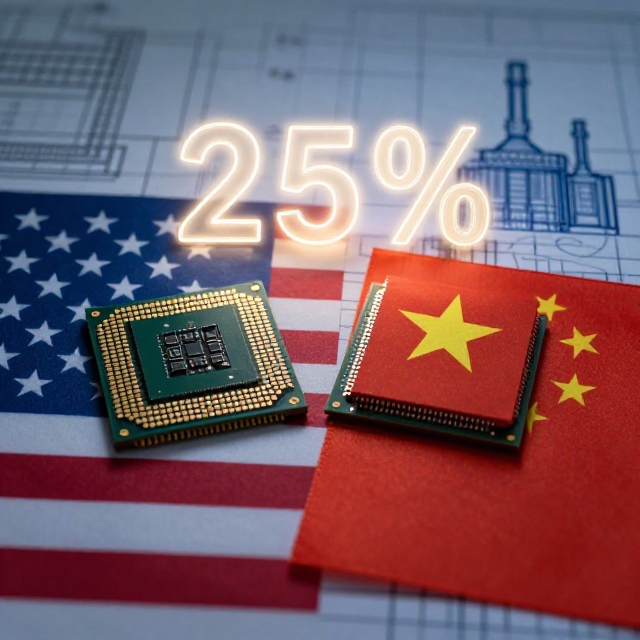
For months, the tech and geopolitical spheres buzzed with anticipation and anxiety. Whispers from Washington suggested a new salvo was imminent in the ongoing strategic competition between the United States and China, this time targeting the lifeblood of the modern digital age: semiconductors. This week, those rumors crystallized into definitive policy. In a move that formalizes and extends a complex web of export controls, the Trump administration announced a 25% tariff on Nvidia on specific advanced artificial intelligence (AI) semiconductors, casting a long shadow over the global AI race and the intricate supply chains that fuel it.
U.S. Tariff on Nvidia
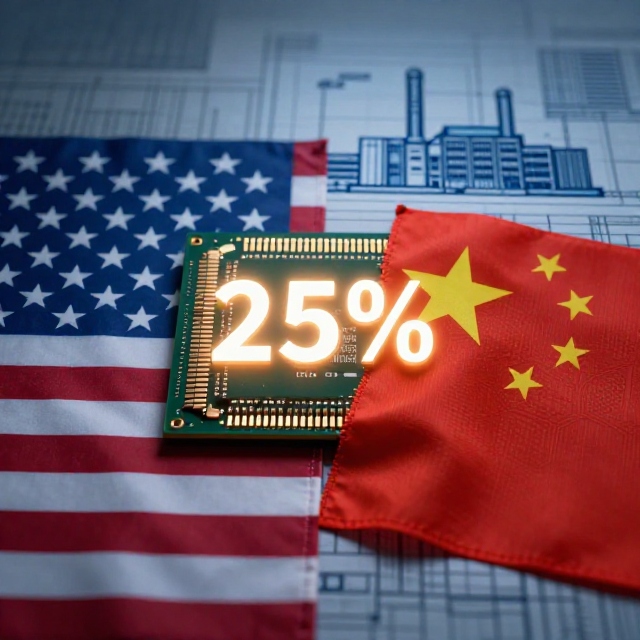
President Donald Trump’s proclamation, signed on Wednesday, marks a pivotal moment. It imposes a significant levy on cutting-edge AI chips produced outside the United States that subsequently pass through American territory en route to customers in other countries. While carefully circumscribed, the tariff’s primary impact lands squarely on products like NVIDIA’s highly sought-after H200 advanced AI chip and comparable offerings from rivals like AMD, including the MI325X. This is not a blanket tax on all semiconductors; it is a surgical, geostrategic instrument aimed at controlling the flow of the most potent computational power.
At first glance, this policy appears to contradict another recent development. Just last December, the U.S. Department of Commerce granted NVIDIA a crucial license, green-lighting the shipment of its H200 chips to pre-vetted customers in China. Wednesday’s tariff proclamation formalizes a key component of that conditional approval. It creates a financial disincentive and a regulatory hurdle, ensuring that while sales can proceed to approved commercial entities, they do so under terms that are economically and strategically favorable to the United States. The message is clear: access to the pinnacle of American chip innovation is not being outright denied, but it is being meticulously gatekept and monetized.
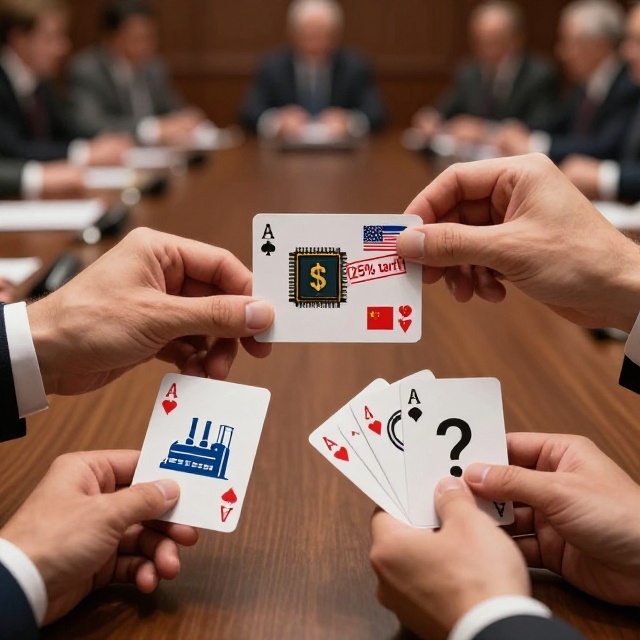
Perhaps the most telling reaction came from NVIDIA itself. In a statement emailed to TechCrunch, the company publicly applauded the administration’s decision. “We applaud President Trump’s decision to allow America’s chip industry to compete to support high-paying jobs and manufacturing in America. Offering H200 to approved commercial customers, vetted by the Department of Commerce, strikes a thoughtful balance that is great for America,” a spokesperson said. This cheerleading from a company facing a new tax on its products reveals the nuanced reality of the situation. For NVIDIA, the alternative—a complete ban—was far worse. The tariff, while denting margins, legitimizes a continued revenue stream from the massive Chinese market, a market so hungry for AI capability that NVIDIA was reportedly considering ramping up H200 production due to a surge of early Chinese orders. The tariff, therefore, is the cost of admission—a premium China’s tech giants may begrudgingly pay to stay competitive in the short term.
The dynamic in China, however, is one of profound tension. The nation finds itself in a parallel, yet inverted, predicament to the United States. Both are engaged in a high-stakes race for AI supremacy, but their starting positions differ. China is fiercely determined to build a self-sufficient, world-class domestic semiconductor industry, pouring billions into initiatives like the “Big Fund” to reduce reliance on foreign technology. Yet, this is a marathon, not a sprint. While its domestic foundries like SMIC make strides, they currently lag behind leaders like TSMC and Samsung in producing the most advanced nodes required for chips like the H200. Consequently, China cannot afford to wholly cut off access to foreign AI accelerators without risking a debilitating slowdown in its own AI research, product development, and commercial application.
This internal conflict is leading to a policy pivot. According to reports from Nikkei Asia, the Chinese central government is actively drafting rules to govern how many advanced semiconductors its companies can purchase from overseas. This represents a significant reversal from a stance of outright adversity toward such imports and acknowledges a painful interim reality: to stay in the race while building its own capabilities, China must strategically permit and manage a degree of dependence. The U.S. tariff directly interacts with this nascent framework, influencing the calculus of cost and supply for Chinese firms and planners.
Crucially, the White House proclamation carves out explicit exemptions. The 25% duty does not apply to chips imported into the U.S. for domestic consumption—whether for critical research, national defense projects, or commercial use within American borders. This exemption underscores the policy’s true objective: it is not a protectionist measure to shield the U.S. market, but an offensive tool to shape technological diffusion abroad. It aims to ensure that the most powerful chips are used to bolster U.S. capabilities and those of its allies, while simultaneously imposing a financial and regulatory speed bump on their deployment by strategic competitors.
The rationale for this approach is rooted in what the proclamation itself identifies as a profound vulnerability: “The United States currently fully manufactures only approximately 10% of the chips it requires, making it heavily reliant on foreign supply chains. This dependence on foreign supply chains is a significant economic and national security risk.” This statement cuts to the core of the global semiconductor dilemma. While the U.S. dominates in chip design (with firms like NVIDIA, AMD, and Intel) and essential design software (EDA), its share of global manufacturing capacity has eroded. Advanced fabrication is concentrated in Taiwan and South Korea, with packaging and testing often performed in Southeast Asia. This geographic fragility was exposed during the COVID-19 pandemic’s supply chain shocks and is now a central focus of national strategy.
Therefore, the tariff on advanced AI chips is more than a revenue-generating measure or a simple trade barrier. It is a multifaceted lever in a broader strategy. First, it creates an economic incentive for companies to consider shifting portions of their advanced packaging, testing, or even limited manufacturing back to U.S. soil to avoid the tariff, aligning with the goals of the CHIPS and Science Act. Second, it provides the U.S. government with unprecedented visibility and control over the end-use of its most powerful technology, as every shipment to a sensitive destination requires vetting and triggers a tariff decision. Third, it signals to allies and partners the seriousness of the U.S. intent to manage the geopolitical aspects of technology, potentially encouraging them to adopt similar, aligned controls.
The long-term implications are vast. For the global tech industry, it further fragments an already splintering market, forcing companies to navigate an increasingly complex web of national regulations. It accelerates China’s drive for semiconductor independence, guaranteeing intensified investment and competition in the years to come. For AI research worldwide, it risks creating distinct “tech spheres,” where the pace of innovation is partially dictated by access to specific hardware.
In conclusion, the imposition of a 25% tariff on specific advanced AI semiconductors is far more than a footnote in trade policy. It is the crystallization of a new era of “techno-nationalism,” where the flow of foundational technology is managed as an instrument of statecraft. By allowing sales but attaching a premium and stringent conditions, the U.S. seeks to maintain economic benefit from its technological lead while throttling the speed at which that advantage proliferates to a strategic rival. The cheers from NVIDIA and the deliberative rule-drafting in Beijing are two sides of the same coin, reflecting a global landscape where every transistor counts, and every shipment carries the weight of geopolitical ambition. The semiconductor war has not escalated into a full blockade; it has evolved into a sophisticated campaign of controlled, taxed, and monitored access
FAQ Section
Q1: What exactly did the Trump administration announce regarding semiconductors?
A1: The administration announced a 25% tariff specifically on advanced AI semiconductors that are manufactured outside the United States and then pass through the U.S. before being exported to customers in other countries. It is not a blanket tariff on all chips.
Q2: Which chips are affected by this new tariff?
A2: The tariff targets specific high-performance AI chips, including Nvidia’s H200 and AMD’s MI325X, when they are shipped under certain conditions. It primarily impacts sales to destinations like China.
Q3: Does this mean Nvidia is banned from selling to China?
A3: No. This tariff actually formalizes a process that allows Nvidia to sell its H200 chips to approved, vetted customers in China, as per a December Department of Commerce license. However, it makes those sales more expensive with the 25% duty.
Q4: Why did Nvidia applaud the move if it’s a tax on their products?
A4: Nvidia supported the decision because the alternative—a complete ban on sales to China—was worse. The tariff provides a legal pathway to maintain a valuable revenue stream from the Chinese market, even at a higher cost to their customers.
Q5: How is China likely to respond to these tariffs?
A5: Reports indicate China is drafting its own rules to manage and potentially limit how many advanced chips its companies can import. This represents a shift from outright opposition to imports, acknowledging a need for foreign tech while its domestic industry catches up.
Q6: Are any chips exempt from this tariff?
A6: Yes. The proclamation explicitly exempts chips that are imported into the U.S. for domestic use, whether for research, defense, or commercial purposes within the country. The tariff is focused on controlling re-exports.
Q7: What is the U.S. government’s stated reason for this action?
A7: The proclamation cites U.S. reliance on foreign semiconductor supply chains as a significant economic and national security risk, noting the country manufactures only about 10% of the chips it needs. The policy aims to bolster domestic competitiveness and control the flow of critical technology.
Q8: What does this reveal about the broader U.S.-China “chip war”?
A8: This move shows the conflict is evolving beyond simple bans. It’s becoming a complex regulatory and financial struggle, where the U.S. seeks to monetize and control access to its technology while slowing a rival’s progress, and China balances immediate needs with long-term self-sufficiency goals.

Если организуете поездку на Тенерифе, обязательно посетите Monkey Park Tenerife и бассейны Lago Martianez для замечательного отдыха. Также важно узнать о расписании автобуса линии 343 (teneriffa bus 343 fahrplan), чтобы удобно перемещаться по острову и посмотреть достопримечательности, например, пляж Тереситас и прославленное драконовое дерево.
Для тех, кто обожает культурой и событиями, хочу посоветовать заглянуть в программу Carnevale Tenerife 2025, где можно прочувствовать традициями и весельем. Подробнее о Тенерифе, Канарских островах и их красотах можно ознакомиться тут: пляж тереситас . А если вас волнуют другие города Испании у моря, как Барселона, Валенсия или Малага, то обязательно посмотрите пляжи и архитектуру, например, кафедральный собор Валенсии или парк Цитадель в Барселоне.
При планировании тур в Италию, настоятельно советую обратить ваше внимание на сельский туризм в Тоскане — это прекрасная шанс оценить окружающей природой и традиционной кухней. Деревенский туризм Италия Тоскана предоставляет неповторимые направления, дающие возможность познать с традициями и живописностью региона. Для тех, кто увлекается шопингом, аутлетные магазины во Флоренции, в том числе знаменитый The Mall, нередко приобретают отличные отзывы и следует их посмотреть для хороших покупок милан венеция .
Для тех туристов, которые стремятся спланировать план маршрута по Венеции или стороне Амальфитанского побережья на машине, крайне важно знать, как доехать до центральных точек, в частности до исторической Аппиевой дороги или Доломитовых Альп, и верно спланировать экскурсии. Туристический маршрут по Венеции на 24 часа помогает осмотреть главные достопримечательности, в числе которых прогулку в гондоле — прайс гондолы в Венеции меняется, но воспоминания незабываемы. В случае если кто-то едет на Сицилию или в Дольчеаква, там тоже есть немало чудесных мест и любопытных маршрутов.
Организуя поездку из Неаполя в Сорренто, полезно знать правильное расстояние и оптимальные варианты транспорта, будь то поезд или паром из Неаполя на Капри. Для знатоков истории стоит отвести время на осмотр Палатина в Риме — это замечательное место с разнообразной археологией, а также Национальный Римский музей, который обнаруживает множество сокровищ Древнего Рима.
Если вы намерены максимально использовать всего один день в Венеции, советую пеший маршрут по Венеции, который позволит охватить центральные площади и достопримечательности, включая площадь Венеции и катание на гондоле (цена достаточно доступна). Более детальные советы и маршруты по Италии можно посмотреть здесь неаполь сорренто , это обеспечит лучше составить путешествие и не забыть важного.
В случае если решили заглянуть в Потсдам и подбираете, что изучить за однодневную поездку, точно поместите в список Сан-Суси, Нидерландский квартал и дворцовый комплекс Глиникке. Для энтузиастов природы и походов прекрасно будет уместен японский парк в Дюссельдорфе и водопад в Лихтенхайне – оба места чудесно демонстрируют великолепие парков Германии. Также не пропустите про блошиный рынок Дюссельдорфа, где получится обнаружить интересные вещи, точку и график которого просто разузнать на профильных ресурсах японский сад дюссельдорф . Тем, кто планирует соединить культурную программу с отдыхом, показаны визиты на заводы Германии и поездка в Фантазия Ленда, где проездные возможно заранее оформить онлайн, для того чтобы уклониться от очереди. Когда интересует охрана экологии и поддержка естественной среды в Германии, рекомендуется посмотреть на соответствующие выставки и культурные карты, получаемые в главных крупных городов. Не упустите про данные иконы Германии, как замок Берлина и форт Кёнигштайн, которые идеально расширят всякий туристический маршрут.
Ежели вы планируете отдых на озере Шира, стоит обратить внимание на базы отдыха, которые предоставляют комфортное проживание и широкий спектр услуги. Например, база отдыха Шира с бассейном или дома на Шира Жемчужный великолепно подойдут для всей семьи отдыха. Кроме того, есть альтернативы с уютными домиками, где можно нанять жилье по разумной цене, что особенно ценно для тех, кто ищет экономный и вместе с тем замечательный отдых.
Для приверженцев природы и спокойствия будет интересно посетить такие места, как сад камней Шира или прошвырнуться по берегам озера. Если хотите разузнать больше о базах отдыха на Шира, их расположении и условиях, рекомендую перейти на сайт базы шира . Там можно прочитать про разные базы отдыха, в том числе такие, как Три звезды Шира или Бегущая по волнам Шира, и оформить свой отдых максимально выгодно.
Greetings! Hope you’re having a good one.
Dear Administrator, My organization supports digital platforms through grant programs. Your website seems like a potential candidate. Would you like to learn more? Please contact me on WhatsApp +66825547845
Организуя поездку в Таиланд, немало людей хотят узнать, сколько стоит турпутёвка в Тайланд и сколько брать денег на отдых. Так, путёвка в Тайланд расценки меняется в зависимости от сезона — рекомендуется ехать в Тайланд, Пхукет в временной отрезок с ноября по февраль, когда погода крайне подходящая. На Пхукете стоит побывать с рынком Патонг и торговыми центрами на Патонге, где можно не только приобрести сувениры, но и вкусить необычные фрукты Таиланда. Дополнительно про прайсы, программы и перевозки, вместе с паром Пхукет Самуи, можно изучить здесь сколько денег брать на пхукет на 10 дней 2025 .
Говоря о ориентирования, в аэропорту Пхукета навигация сравнительно несложно: одна из основных трудностей — определить самый лучший обменник на Пхукете или честное такси до отеля. За десятидневку на Пхукете нередко настаивают брать с собой деньги, примерно где-то 30-40 тысяч бат, чтобы спокойно покрыть съём байка, процедуры и пропитание. Если важно, что предпочтительнее — Самуи или Пхукет, то каждый остров чудесен по-своему, и большая часть исходит из ваших требований, например, дух пляжей или туристические маршруты.
Ежели вы готовитесь к поездку в Таиланд, стоит заранее определиться, какой остров определить — Пхукет или Самуи. Самуи отличается своими прекрасными пляжами, и на карте Таиланда без труда найти превосходные пляжи Самуи, которые прекрасно подойдут для спокойного отдыха. Для тех, кто занимается историей, целесообразно вспомнить про цунами в Таиланде 2004 года: на Пхукете и Самуи всё ещё можно найти фото и рассказы, посвящённые с этим событием.
При готовности к поездке рекомендую изучить моменты обмена валюты на Пхукете и сколько денег привезти в Таиланд на 10 дней, а также узнать правила въезда в страну в 2025 году. Для туристов будет полезна информация об аренде байка на Пхукете — это удобный способ перемещения. Подробности, включая карту Таиланда с островами и tips по маршрутам, можно изучить здесь массаж пхукет .
Сейчас дистанционное обучение детей становится всё более актуальным.
Подход с интерактивными занятиями позволяет учиться из дома.
Интересное решение для родителей, которые ищут понятное обучение для детей.
Информация- https://newsblok.ru/obshhestvo/sbory-v-pervyj-klass-chto-ne-zabyt-i-kak-podgotovit-rebjonka-moralno/