
You just asked your smart speaker for the weather. You unlocked your phone with a glance. Your Netflix recommended that show you can’t stop watching. Artificial Intelligence is no longer a futuristic concept; it’s the invisible electricity powering our modern lives.
But where does this intelligence actually live? Is it in a vast, ethereal cloud, or is it humming quietly in the device in your hand?
This is the central question sparking one of the most important tech debates of our time: Edge AI vs Cloud AI.
If you imagine AI as a brain, then for the last decade, that brain has almost exclusively lived in the “cloud”—massive, centralized data centers thousands of miles away. But a revolution is underway. We’re putting tiny, powerful brains directly into devices at the “edge” of the network—your phone, your camera, your car, your factory robot.
This isn’t just a technical shift; it’s a fundamental rethinking of how intelligence is distributed. It will determine everything from the speed of your apps to the security of your data and the very fabric of our future smart cities.
So, let’s demystify this. Let’s break down Cloud AI and Edge AI, not with impenetrable jargon, but by understanding their strengths, weaknesses, and the powerful synergy they create together. By the end of this guide, you’ll not only understand the difference—you’ll see the world through a new, intelligent lens.
Let’s Start with a Simple Analogy: The Human Brain

Think of your own cognitive processes.
- Cloud AI is like your conscious, deliberative mind. When you’re planning a complex vacation, you sit down, research flights, compare hotel reviews, and map out an itinerary. This requires pulling in vast amounts of information (memories, internet data, advice), significant processing power, and time. It’s a centralized, powerful operation.
- Edge AI is like your subconscious reflexes. When you touch a hot stove, you don’t consciously think, “My skin receptors are signaling intense heat, which may cause tissue damage. I should initiate a muscular retraction sequence.” You just yank your hand back. Instantly. This processing happens locally, in your spinal cord, because waiting for the signal to travel to your brain and back would mean a serious burn.
This simple analogy captures the essence of the divide: centralized, deep thought vs. decentralized, instant action.
Part 1: Cloud AI – The Powerhouse in the Sky
Cloud AI refers to artificial intelligence models that are trained and run on powerful, remote servers in data centers. Your device (a smartphone, a sensor) acts as a terminal, collecting data and sending it to this central brain for processing, then receiving the answer.
How Does Cloud AI Work?
The process is a digital relay race:
- Data Collection: Your device (the “edge”) captures data—a voice command, a photo, a sensor reading.
- Data Transmission: This data is packaged and sent over the internet (via Wi-Fi, 4G/5G) to a cloud server, which could be continents away.
- Centralized Processing: The powerful CPUs and GPUs in the cloud server run the complex AI algorithm on the data.
- Result Transmission: The server sends the result (“It’s 72° and sunny,” “That’s a picture of a cat,” “Recommend ‘The Crown'”) back to your device.
- Action: Your device acts on this command.
The Unbeatable Strengths of Cloud AI
Cloud AI became the dominant paradigm for a reason. Its advantages are immense.
1. Virtually Unlimited Computational Power
Cloud data centers house thousands of state-of-the-art processors stacked together. This allows them to train and run incredibly large and complex AI models (like GPT-4 or massive recommendation engines) that would be impossible to fit on a single device. The cloud is where the heavy lifting happens.
2. Centralized Management and Updates
Imagine you have a facial recognition algorithm running on a million smartphones. If you need to improve it, updating the model in the cloud instantly upgrades the AI for every single user. There’s no need to push updates to a billion devices individually. This makes management, maintenance, and iterative improvement incredibly efficient.
3. Vast Data Aggregation and Learning
Cloud AI thrives on big data. By processing information from millions of users, the model can learn patterns, trends, and nuances that it could never learn from a single source. Your Netflix recommendations are so good because the cloud AI analyzes the viewing habits of everyone, not just you.
4. Scalability and Cost-Effectiveness
For many applications, it’s far cheaper to rent processing power in the cloud (via services like AWS, Google Cloud, or Azure) than to build and maintain that infrastructure yourself. You can scale up or down instantly based on demand, paying only for what you use.
The Critical Weaknesses of Cloud AI

For all its power, the cloud model has some fundamental flaws, primarily related to the physics of distance.
1. Latency: The Speed of Light Problem
Latency is the delay between sending a request and receiving a response. Even at the speed of light, a round trip to a cloud server and back can take 100-200 milliseconds or more. That might not sound like much, but for real-time applications, it’s an eternity.
- A self-driving car traveling at 65 mph covers about 95 feet in one second. A 200-ms delay in identifying a pedestrian could be the difference between a safe stop and a tragedy.
- A live video call with real-time language translation would be full of awkward pauses if it relied solely on the cloud.
2. Bandwidth: The Data Traffic Jam
Sending raw, high-volume data like 4K video streams from thousands of security cameras to the cloud consumes enormous bandwidth. It’s like trying to pour a lake through a garden hose. It’s inefficient, expensive, and can clog the network.
3. Connectivity: The “No Service” Dilemma
Cloud AI is useless without a stable, high-speed internet connection. What happens to your smart factory, your agricultural drones, or your offshore wind turbines when they lose connectivity? The entire intelligent system grinds to a halt.
4. Privacy and Security: The Data Voyage
Sending sensitive data—medical records, private conversations, proprietary factory floor data—across the public internet and storing it in a centralized location is a security and privacy risk. It creates a single, attractive target for hackers and raises compliance issues with regulations like GDPR and HIPAA.
Part 2: Edge AI – The Genius in Your Pocket (and Everywhere Else)

Edge AI brings the intelligence to the data. Instead of shipping data to a central brain, the brain itself is miniaturized and embedded directly into the device at the “edge” of the network.
How Does Edge AI Work?
The process is elegantly local:
- Data Collection: The device (e.g., a smart camera) captures data.
- On-Device Processing: A specialized chip (like an NPU – Neural Processing Unit) within the device itself runs a streamlined AI model on the data.
- Instant Action: The device makes a decision and acts immediately.
The cloud is often still involved, but in a different role—for periodically updating the on-device models and for aggregating anonymized insights, not for real-time decision-making.
The Revolutionary Strengths of Edge AI
Edge AI solves the core weaknesses of Cloud AI, unlocking a new class of applications.
1. Real-Time Processing and Ultra-Low Latency
By eliminating the round trip to the cloud, Edge AI enables true real-time intelligence. Decisions are made in milliseconds.
- Example: A collaborative robot (cobot) on an assembly line can instantly adjust its movement if a worker’s hand gets too close, ensuring safety without any lag.
2. Drastic Bandwidth Reduction
Instead of streaming endless hours of empty hallway footage, a smart security camera with Edge AI only sends a brief clip to the cloud when it detects a person. This can reduce bandwidth consumption by over 95%, saving massive costs and network resources.
3. Uninterrupted Operation Offline
Edge devices work perfectly fine in connectivity dead zones. An AI-powered drone can inspect a remote pipeline, and an agricultural sensor can analyze soil conditions in a field with no cell service, storing the data to sync later.
4. Enhanced Data Privacy and Security
Sensitive data never has to leave the device. Your faceprint for unlocking your phone stays on your phone. Your private health metrics from a smartwatch are processed locally. This “data sovereignty” is a game-changer for privacy-conscious industries like healthcare and finance.
The Inevitable Weaknesses of Edge AI
Of course, this distributed intelligence comes with its own set of trade-offs.
1. Limited Computational Resources
You can’t fit a data center’s worth of processing power into a thermostat. Edge devices have constrained compute, memory, and power. This means the AI models that run on them must be highly optimized, compressed, and sometimes less complex than their cloud counterparts.
2. Management and Update Challenges
How do you ensure that the AI model on ten thousand scattered smart cameras is up-to-date? Managing a fleet of intelligent edge devices—securing them, updating their software—is a complex logistical challenge compared to updating a single cloud model.
3. Higher Upfront Hardware Costs
Designing and manufacturing devices with specialized AI chips (NPUs, TPUs) is more expensive than producing “dumb” sensors that just stream data. The cost is shifting from operational (cloud bills) to capital (device costs).
Part 3: Edge AI vs Cloud AI: A Detailed Comparison Table
| Feature | Cloud AI | Edge AI | The Winner? |
|---|---|---|---|
| Processing Power | Virtually unlimited, scalable | Limited by device hardware | Cloud AI for heavy lifting |
| Latency | High (100ms+) due to network travel | Ultra-low (<10ms) | Edge AI for real-time needs |
| Bandwidth Usage | Very high, requires constant data transfer | Very low, only sends key insights | Edge AI for efficiency |
| Connectivity Dependency | Requires constant, reliable connection | Operates fully offline | Edge AI for remote areas |
| Data Privacy | Data travels and is stored centrally | Data processed and stored locally | Edge AI for sensitive data |
| Scalability | Effortlessly scalable in the cloud | Scalable but requires hardware deployment | Cloud AI for easy scaling |
| Management & Updates | Centralized, simple to update | Distributed, complex to manage | Cloud AI for simplicity |
| Cost Model | Operational Expense (Ongoing subscription) | Capital Expense (Higher upfront hardware) | Depends on scale and use case |
| Ideal For | Big data analysis, model training, complex simulations, non-time-critical tasks | Real-time control, video analysis, predictive maintenance, privacy-first apps | It’s not a winner-takes-all. |
Part 4: Real-World Applications: Where They Shine
The theory is great, but the magic happens in application. Let’s look at how both are being used today.
Cloud AI in Action:
- Content Recommendation: Netflix, Spotify, and YouTube. Their algorithms analyze billions of data points across all users to find your next obsession.
- Voice Assistants (Complex Queries): When you ask Alexa, “What’s the meaning of life?” it uses Cloud AI to search the web and formulate a complex answer.
- Large Language Models (LLMs): ChatGPT and its counterparts are quintessential Cloud AI. The model is far too large and requires too much power to run anywhere but in a massive data center.
- Medical Research & Drug Discovery: Analyzing vast genomic datasets to find patterns and discover new treatments is a classic cloud task.
Edge AI in Action:
- Autonomous Vehicles: A self-driving car can’t wait for a cloud server to tell it to hit the brakes. It uses Edge AI for immediate object detection, lane keeping, and collision avoidance.
- Smartphones: Face ID, live photo editing, voice-to-text transcription, and even the portrait mode on your camera all use on-device Edge AI.
- Industrial IoT & Predictive Maintenance: Sensors on a factory machine use Edge AI to listen for abnormal vibrations that signal an impending failure, allowing for repairs before a costly breakdown.
- Smart Homes: A smart doorbell with Edge AI recognizes a person at your door and alerts you instantly, without streaming all video to the cloud.
- Augmented Reality (AR): For AR glasses to overlay digital objects seamlessly onto the real world, the tracking and rendering must happen locally with zero lag.
Part 5: The Future is Hybrid: The Symbiotic Intelligence
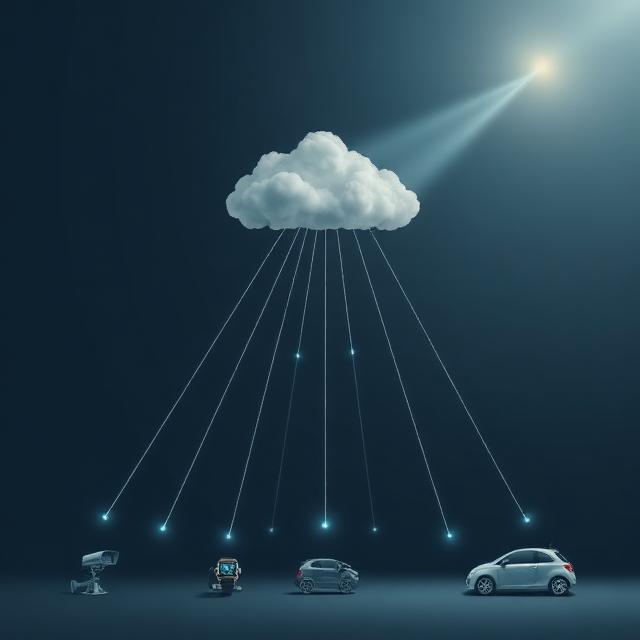
The most powerful insight is that Edge vs. Cloud is not a binary choice. The future lies in a hybrid, symbiotic model where they work together seamlessly. This is often called “AI at the Edge” or “Distributed AI.”
Here’s how it works:
- The Edge handles real-time, immediate tasks. It filters the world, making millisecond decisions and only sending what’s important to the cloud.
- The Cloud handles aggregation, deep learning, and model refinement. It takes the summarized data from millions of edge devices, retrains and improves the central AI model, and then pushes these smarter, updated models back down to the edge.
A Perfect Example: The Smart City Traffic System
- At the Edge: Each smart traffic camera and sensor at an intersection uses Edge AI to count cars, detect pedestrians, and optimize the traffic light timing in real-time to reduce congestion at that specific junction.
- In the Cloud: The city’s central traffic management system aggregates data from all intersections. It uses Cloud AI to identify city-wide traffic patterns, predict congestion for major events, and coordinate the timing of green light “waves” along major arteries. It then sends updated traffic flow algorithms to the edge devices overnight.
The edge handles the instant, localized reaction. The cloud handles the strategic, city-wide learning and planning. Together, they create a system far more intelligent than either could be alone.
Part 6: How to Choose for Your Project or Business
So, when you’re planning a new product or service, how do you decide where the intelligence should live? Ask yourself these questions:
- What is the latency requirement?
- < 100ms for a critical decision? -> Lean heavily towards Edge AI.
- A few seconds is acceptable? -> Cloud AI is a strong candidate.
- What is the bandwidth and connectivity situation?
- Limited bandwidth or unreliable connection? -> Edge AI is almost mandatory.
- Plenty of cheap, reliable bandwidth? -> Cloud AI is simpler.
- How sensitive is the data?
- Highly sensitive (medical, financial, private video)? -> Edge AI for privacy and security.
- Non-sensitive or already anonymized? -> Cloud AI can leverage its power.
- What is the scale and management overhead?
- Massive, globally distributed hardware fleet? -> A Hybrid approach is best for manageable updates.
- A centralized software service? -> Cloud AI is easier to manage.
- What is your cost structure preference?
- Prefer lower upfront costs and predictable monthly fees? -> Cloud AI (OpEx).
- Okay with a higher initial investment to save on long-term data/cloud bills? -> Edge AI (CapEx).
In many cases, the answer will be a resounding “both.” Start by prototyping in the cloud for its simplicity and scalability, then identify the components that require real-time performance or pose privacy challenges, and migrate just those parts to the edge.
Conclusion: Two Halves of a Whole New Intelligence
The debate between Edge AI and Cloud AI is not a war with a single victor. It is the natural evolution of a distributed computing nervous system.
Cloud AI is the cerebral cortex—the seat of deep learning, memory, and complex thought.
Edge AI is the spinal cord and peripheral nervous system—the network of reflexes that allows for instantaneous reaction and interaction with the physical world.
One is not superior to the other; they are complementary forces. As AI continues to weave itself into the fabric of our existence, this collaborative dance between the centralized cloud and the intelligent edge will become the defining architecture of our technological future. It will make our devices not just connected, but truly perceptive and responsive, creating a world that is safer, more efficient, and more intuitively in tune with our needs.
The intelligence is no longer just in the cloud. It’s everywhere.
FAQ: Edge AI vs Cloud AI
1. What is the main difference between Edge AI and Cloud AI in simple terms?
Think of Cloud AI as a powerful central brain in a data center that your device connects to for complex thinking. Edge AI, on the other hand, is like giving a smaller, efficient brain to the device itself, allowing it to make instant decisions without needing to connect to the cloud. The key difference is where the processing happens.
2. Which is faster, Edge AI or Cloud AI?
For real-time, immediate actions, Edge AI is significantly faster. It processes data locally on the device, eliminating the network delay (latency) of sending data to the cloud and back. Cloud AI involves a round-trip over the internet, which takes more time.
3. Is Edge AI more secure than Cloud AI?
It can be, especially for sensitive data. With Edge AI, data like your face or private conversations can be processed directly on your device and never needs to be transmitted or stored on a central server. This reduces the risk of a mass data breach. Cloud AI requires sending data over a network, which can be a vulnerability point.
4. Why wouldn’t I always use Edge AI for everything?
While powerful, Edge AI has limits. The devices have less computational power, so they can’t run the massive, complex AI models that the cloud can. It’s also more challenging to manage and update thousands of individual edge devices compared to updating a single model in the cloud. For large-scale data analysis and model training, Cloud AI is still essential.
5. Do I have to choose one, or can they work together?
They absolutely work best together in a hybrid model. A common setup is for the Edge AI to handle immediate, real-time tasks and privacy-sensitive processing, while only sending important summarized data to the Cloud AI. The Cloud AI then uses this aggregated data from many devices to retrain and improve the model, which is then sent back to the Edge devices, making them smarter over time.