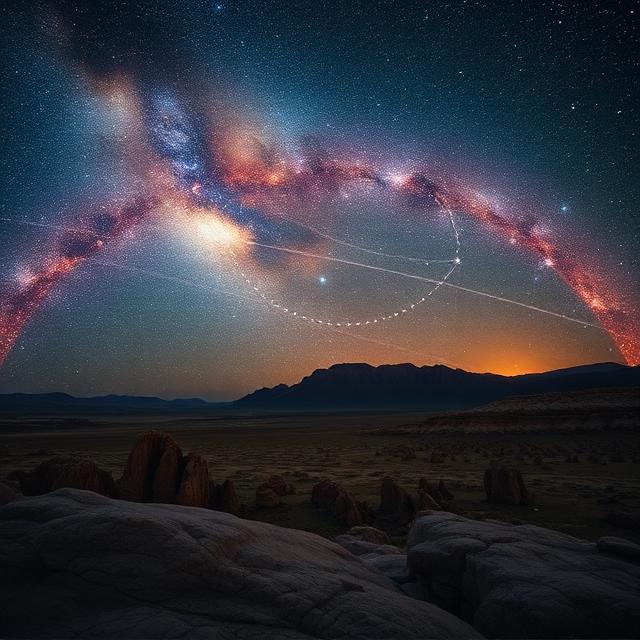
Look up at the night sky, away from the city lights. What you see is not just a beautiful, static tapestry of stars. You are looking at the active, dynamic, and deeply layered archive of our home galaxy—the Milky Way. Every star, from the brightest beacon to the faintest twinkle, holds a story. Its composition, its motion, its very existence is a data point in a cosmic detective story spanning over 13 billion years.
This is the realm of Galactic Archaeology, a field that transforms astronomers into historians, using telescopes as time machines to piece together the epic saga of how our galaxy formed, evolved, and found its present shape. It’s the science of reading the “fossil record” of the cosmos, written not in stone, but in starlight.
Forget Indiana Jones; the most thrilling excavations are happening in the digital data streams of space observatories. This blog post is your guide to this fascinating frontier. We’ll explore how scientists dig into the galactic past, what breathtaking discoveries they’ve made, and why understanding our galaxy’s history is fundamentally a quest to understand our own origins.
What is Galactic Archaeology, Really?
Let’s break down the term. Archaeology is the study of human history through the excavation of sites and the analysis of artifacts. Galactic Archaeology applies the same principle to the Milky Way.
Instead of shovels and brushes, galactic archaeologists use:
- Spectrographs to dissect starlight into rainbows, revealing a star’s chemical DNA.
- Astrometry to measure the precise positions and motions of stars.
- Supercomputers to run simulations that connect the ancient past to the present.
The “dig sites” are different regions of our galaxy: the crowded bulge at the centre, the vast disk (home to our Solar System), and the sparse, ancient halo that surrounds it all. The “artifacts” are the stars themselves, grouped into distinct populations and stellar streams that hold clues to their birth and the violent events that shaped them.
The core premise is elegant: stars that formed together, from the same molecular cloud, share a common chemical fingerprint and move in similar ways. By mapping the chemistry and motion of millions of stars, we can identify which are siblings, trace them back to their birthplace, and reconstruct the galactic mergers and growth spurts that assembled the Milky Way as we see it today.
The Tools of the Trade: Telescopes as Time Machines
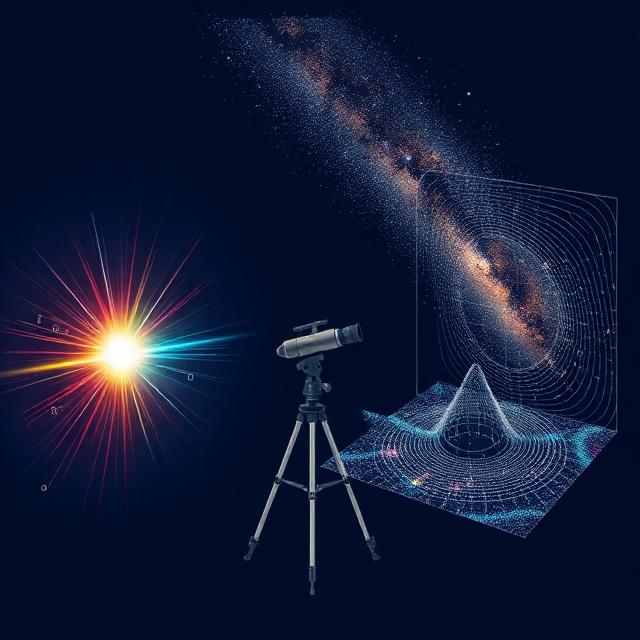
1. Stellar Spectroscopy: Reading a Star’s Chemical Autobiography
When you pass sunlight through a prism, you see a rainbow. Pass a star’s light through a spectrograph, and you see that same rainbow sliced by thousands of dark and bright lines. These are absorption and emission lines, the direct fingerprints of elements in the star’s atmosphere.
- The Cosmic Recipe: A star’s spectrum tells us how much hydrogen, helium, oxygen, iron, carbon, and even gold it contains. This is crucial because the universe started with only hydrogen, helium, and a trace of lithium. Every heavier element—collectively called “metals” by astronomers—was forged inside generations of stars and scattered by their explosive deaths (supernovae).
- Metallicity as a Clock: Generally, older stars have lower “metallicity.” They formed early in the universe, from gas that hadn’t been enriched by many prior supernovae. Younger stars, like our Sun, are metal-rich, born from well-recycled interstellar material. By measuring a star’s metal content, we get a rough estimate of its age—its place in the galactic timeline.
2. Astrometry: Mapping the Galactic Crime Scene
Knowing a star’s composition is only half the story. We need to know where it is and where it’s going. Astrometry provides a precise 3D map of the galaxy.
- The Game Changer: Gaia Mission: Launched by the European Space Agency in 2013, the Gaia spacecraft is the single most important tool for galactic archaeology. It painstakingly measures the position, distance, and motion of over two billion stars in our galaxy. This creates an unprecedented, dynamic 3D map of the Milky Way.
- Connecting the Dots: With Gaia’s data, we can rewind the clock. By calculating the orbits of stars backwards in time, we can see which groups of stars share a common origin, flowing into the galaxy from past collisions.
3. Asteroseismology: Listening to the Heartbeats of Stars
Like geological seismologists studying earthquakes to understand Earth’s interior, asteroseismologists study starquakes. Stars pulsate and ring like giant bells. The frequencies of these oscillations reveal their internal structure, density, and—very accurately—their age. This provides an independent check on ages derived from chemistry.
4. Supercomputers: The Digital Laboratory
All this observational data feeds into colossal cosmological simulations. Researchers create virtual universes in silicon, governed by the laws of physics, and let them evolve from the Big Bang to the present. By comparing our real galactic map to these simulations, we can test theories of galaxy formation and identify which ancient events left the specific fingerprints we see today.
Key Discoveries: The Milky Way’s Story Unveiled
Galactic archaeology has moved from theory to concrete discovery. Here are the headline-making finds that have rewritten our galactic history.
1. Galactic Cannibalism: The Gaia-Sausage-Enceladus
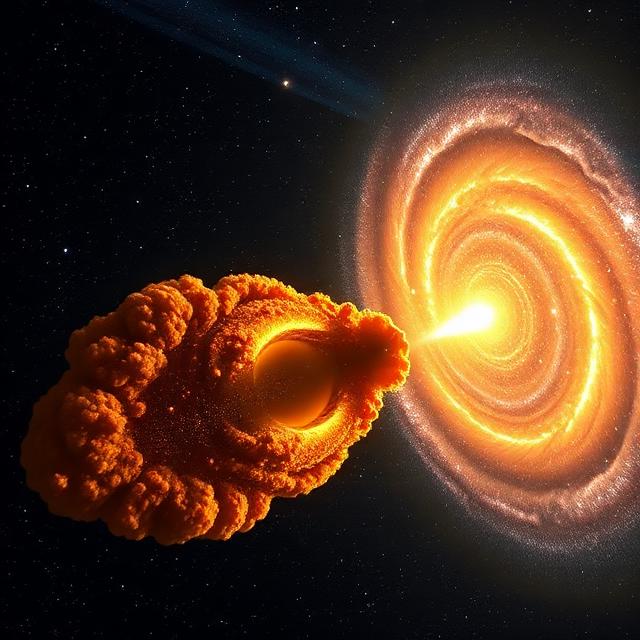
One of the biggest surprises from Gaia data was the discovery of a vast, “sausage”-shaped structure of stars in the inner galaxy. These stars move on highly radial, plunging orbits, unlike the orderly circular orbits of most disk stars. Chemical analysis confirmed they were ancient and metal-poor.
The conclusion? Around 8-10 billion years ago, a sizable dwarf galaxy, now nicknamed Gaia-Sausage-Enceladus (GSE), collided with the nascent Milky Way. It was torn apart by tidal forces, its stars scattered into the galactic halo and bulge. This was likely the last major merger that fundamentally reshaped our galaxy, puffing up its disk before it settled into its current form.
2. The Galactic Halo: A Graveyard of Ancient Mergers
The halo, the spherical cloud of stars surrounding the main disk, is no longer seen as a random assortment. It’s a cosmic graveyard, strewn with the remnants of dozens of smaller galaxies and star clusters consumed by the Milky Way over time. Gaia has identified over a dozen stellar streams—long, river-like associations of stars—which are the dissolving remains of these cannibalised systems, still orbiting together as ghostly traces of their former selves.
3. Multiple Stellar Populations: Generations in the Bulge
The galactic bulge, the dense central region, was once thought to be a simple, old structure. Archaeology reveals it’s complex. It contains:
- An ancient population: Stars as old as the universe itself, likely forming in the initial chaotic collapse.
- A younger, metal-rich population: Stars that may have formed from gas funnelled inward during mergers like the GSE event.
This shows the bulge wasn’t built in a single event, but through multiple episodes of star formation triggered by the galaxy’s violent early life.
4. The “Thick” and “Thin” Disks: A Two-Phase Construction
Our galactic disk has two distinct components. The thin disk (where we live) is where young, metal-rich stars like the Sun orbit in orderly circles. The thick disk contains older, hotter stars on more tilted orbits. Archaeology suggests the thick disk formed first, possibly stirred up by the GSE merger, while the thin disk formed later from cooler, settled gas, and continues to form stars today.
The Human Connection: Why Galactic Archaeology Matters
You might wonder: this is fascinating, but what does it have to do with me? The connection is profound and deeply human.
- We Are Stardust, Literally: Every atom in your body heavier than hydrogen and helium was created in the heart of a star or a stellar explosion. Galactic archaeology traces the journey of those elements. The iron in your blood was likely forged in a massive supernova that exploded before the Milky Way’s disk even finished forming. The gold in a wedding ring was created in the cataclysmic collision of two neutron stars, an event that may have seeded a dwarf galaxy later consumed by our own. We are not just living in the galaxy; we are products of its intricate chemical evolution.
- Our Place in Cosmic History: Understanding the galaxy’s violent, merger-driven past contextualizes our own existence. Our Solar System formed about 4.6 billion years ago, after the last major merger (GSE) had settled. We emerged during a relatively quiet, stable period in the galactic suburbs, a calm that may have been necessary for life to arise and evolve uninterrupted. Galactic archaeology tells us the story of the home that made our existence possible.
- The Future of Our Galactic Home: This isn’t just about the past. By understanding how galaxies assemble, we can predict the future. The Milky Way is on a collision course with the Andromeda Galaxy, due to merge in about 4.5 billion years. Galactic archaeology gives us a preview of this event by showing us the remnants of past mergers. We are, in a sense, studying our own galaxy’s future fate.
The Future of the Dig: Next-Generation Galactic Archaeologists
The field is exploding with new projects that promise even deeper insights:
- SDSS-V and the Milky Way Mapper: This ground-based survey is obtaining detailed spectra for millions of stars, building on Gaia’s map with rich chemical data.
- The James Webb Space Telescope (JWST): While not a galactic surveyor, JWST can peer into the hearts of other, distant galaxies, allowing us to see galaxy formation and mergers happening in the early universe. This provides “snapshots” we can compare to our own reconstructed history.
- The Nancy Grace Roman Space Telescope: Set to launch, it will perform massive surveys of the galactic bulge, penetrating the dust that obscures our view and revealing its history in unprecedented detail.
- The Vera C. Rubin Observatory: With its gigantic camera, it will discover millions more faint stellar streams and dwarf galaxy remnants, completing our census of the galactic halo’s debris.
FAQ Section
1. What is Galactic Archaeology in simple terms?
Galactic Archaeology is like being a cosmic historian. Instead of digging up ancient pottery or ruins, scientists “dig” through the galaxy by studying the chemical composition and motions of stars. By analyzing this stellar “DNA,” they can trace stars back to their birthplaces and reconstruct the Milky Way’s history, including ancient collisions and growth spurts over billions of years.
2. How can we tell how old a star is?
Astronomers use two main clues: chemistry and pulsations. Older stars have fewer heavy elements (“metals”) because they formed before many supernovae enriched the universe. Techniques like asteroseismology—which measures a star’s internal vibrations—provide an even more precise age, much like guessing a tree’s age by its rings.
3. What was the most significant discovery in Galactic Archaeology?
The discovery of the Gaia-Sausage-Enceladus (GSE) merger. Data from the Gaia space telescope revealed that around 8-10 billion years ago, a massive dwarf galaxy collided with and was consumed by the early Milky Way. This event fundamentally reshaped our galaxy, scattering stars into the halo and likely triggering the formation of the Milky Way’s thick disk.
4. What are stellar streams, and why are they important?
Stellar streams are long, ribbon-like chains of stars orbiting within our galaxy’s halo. They are the dissolving remains of ancient dwarf galaxies or star clusters that were torn apart by the Milky Way’s gravity. They serve as “fossilised” evidence of past galactic cannibalism, allowing us to map the galaxy’s growth over time.
5. How does the Gaia mission help Galactic Archaeology?
The European Space Agency’s Gaia spacecraft is creating an unprecedented 3D map of over two billion stars in the Milky Way. It provides precise measurements of their positions, distances, and motions. This allows scientists to rewind the orbits of stars, identify groups with shared origins, and detect the subtle imprints of ancient mergers—like having a time-lapse video of the galaxy’s evolution.
5. Why should the average person care about Galactic Archaeology?
Because it tells our origin story. Every atom in our bodies heavier than hydrogen and helium was forged in stars and scattered across the galaxy by supernovae. Galactic Archaeology traces the journey of those elements to our solar system. It also reveals that our existence is tied to a specific, relatively calm period in the Milky Way’s turbulent history—contextualising humanity’s place in the cosmos.
6. What’s the future of this field?
We’re entering a golden age! Upcoming missions like the Vera C. Rubin Observatory, Nancy Grace Roman Space Telescope, and expanded spectral surveys (like SDSS-V) will discover fainter stellar streams, probe the dust-obscured galactic centre, and provide detailed chemical maps for millions more stars. This will let us fill in missing chapters of our galaxy’s biography with incredible detail.
Conclusion: Your Invitation to Cosmic Curiosity
Galactic archaeology teaches us a humbling and magnificent lesson: our galaxy is not a finished, static object. It is a living entity with a memory—a memory stored in the motions and compositions of its stars. It has a biography marked by violent collisions, periods of calm, and continuous rebirth.
The next time you stand under a clear, dark sky, remember: you are not just looking at points of light. You are looking at the layered strata of our galactic history. That bright star might be a young disk star, born from well-recycled material. That faint smudge might be a globular cluster, a surviving relic from the galaxy’s infancy. The faint band of the Milky Way is the archaeological site itself, containing billions of artifacts waiting for their story to be told.
The Great Dig is ongoing. Every new dataset is a new trench opened, revealing more of the epic story of our cosmic home. And in piecing together that story, we ultimately learn more about where we came from, and what our place is in this vast, dynamic, and beautifully historical universe.
So keep looking up. You’re witnessing the greatest history show ever told.