Introduction: A Dance of Giants
Look up at the night sky, and it’s easy to think of the universe as static—a serene, unchanging tapestry of stars. But the truth is far more dramatic. Our cosmos is a dynamic, ever-changing arena where galaxies engage in a slow, breathtaking dance known as galactic mergers that can last billions of years. This dance is one of the most fundamental and awe-inspiring processes in the universe.
Imagine two cities, each containing hundreds of billions of stars, along with their planetary systems, nebulae, and mysterious dark matter, slowly drawn together by gravity. They don’t collide in a cataclysmic explosion of stars smashing together. Instead, they perform a majestic, gravitational tango, weaving their structures into something entirely new. This process isn’t just a cosmic spectacle; it’s the primary engine behind the evolution of galaxies, from humble spirals like our Milky Way to the giant elliptical behemoths at the hearts of galaxy clusters. These grand events are what we refer to as Galactic Mergers.
In this deep dive, we’ll explore the beautiful violence of galactic mergers, unravel their stages, witness their profound consequences, and discover how these events are not just distant history—they are our cosmic future, driven by the forces of Galactic Mergers.
What Exactly is a Galactic Merger?
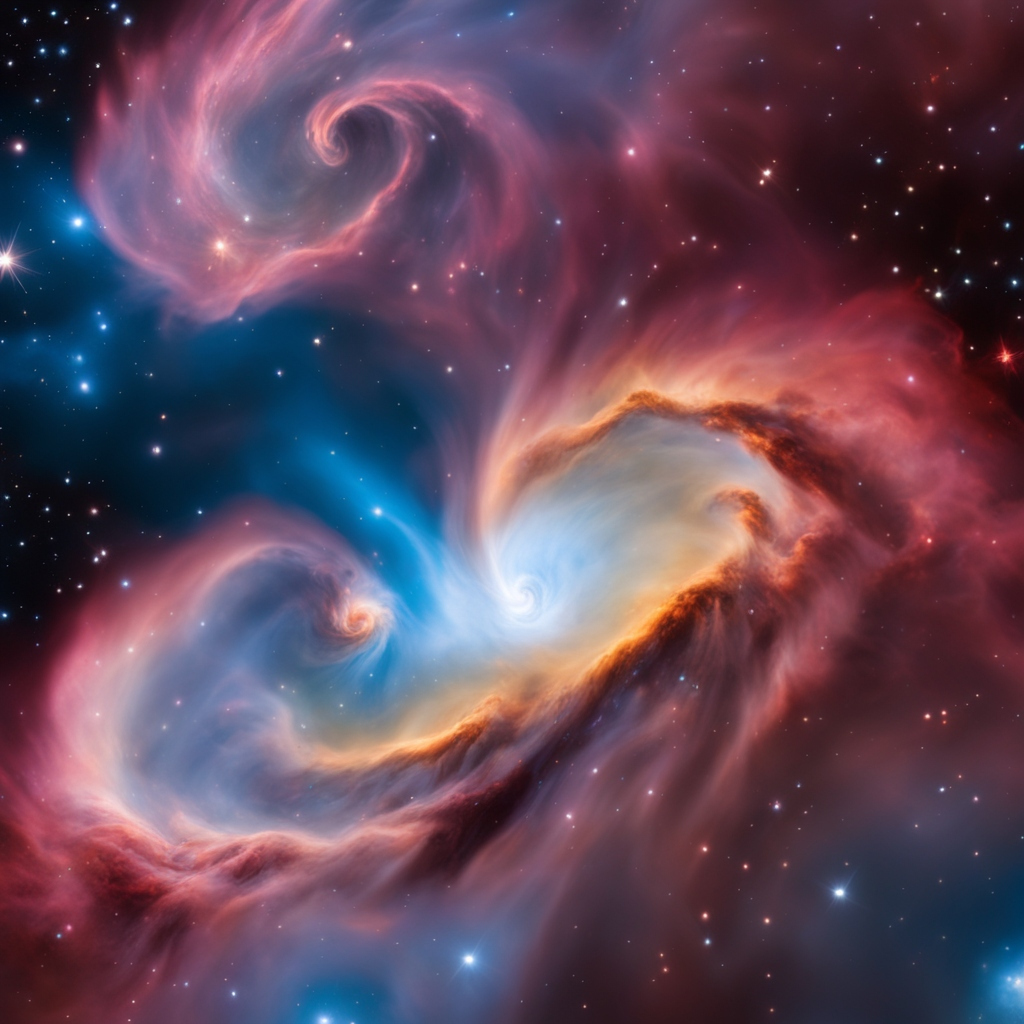
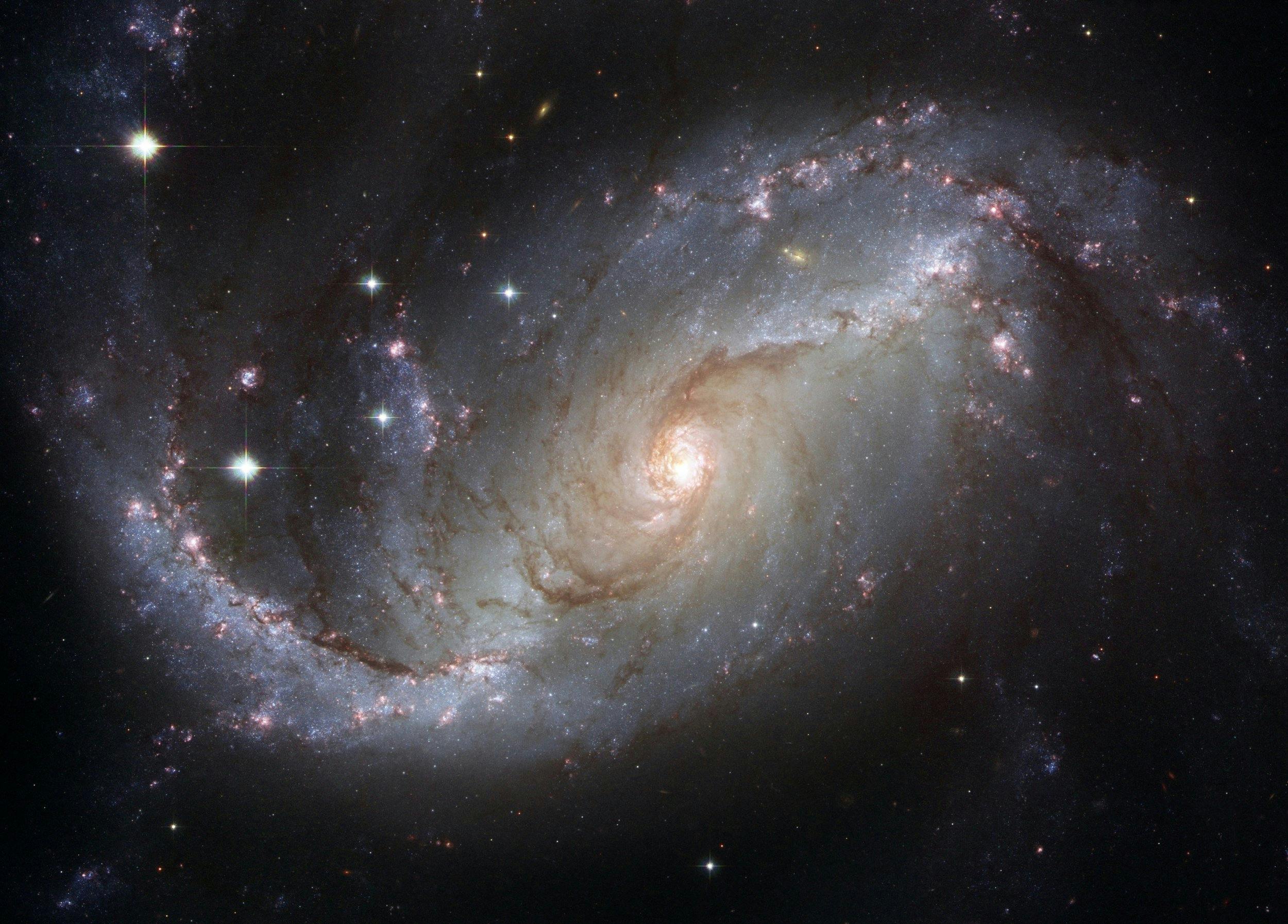
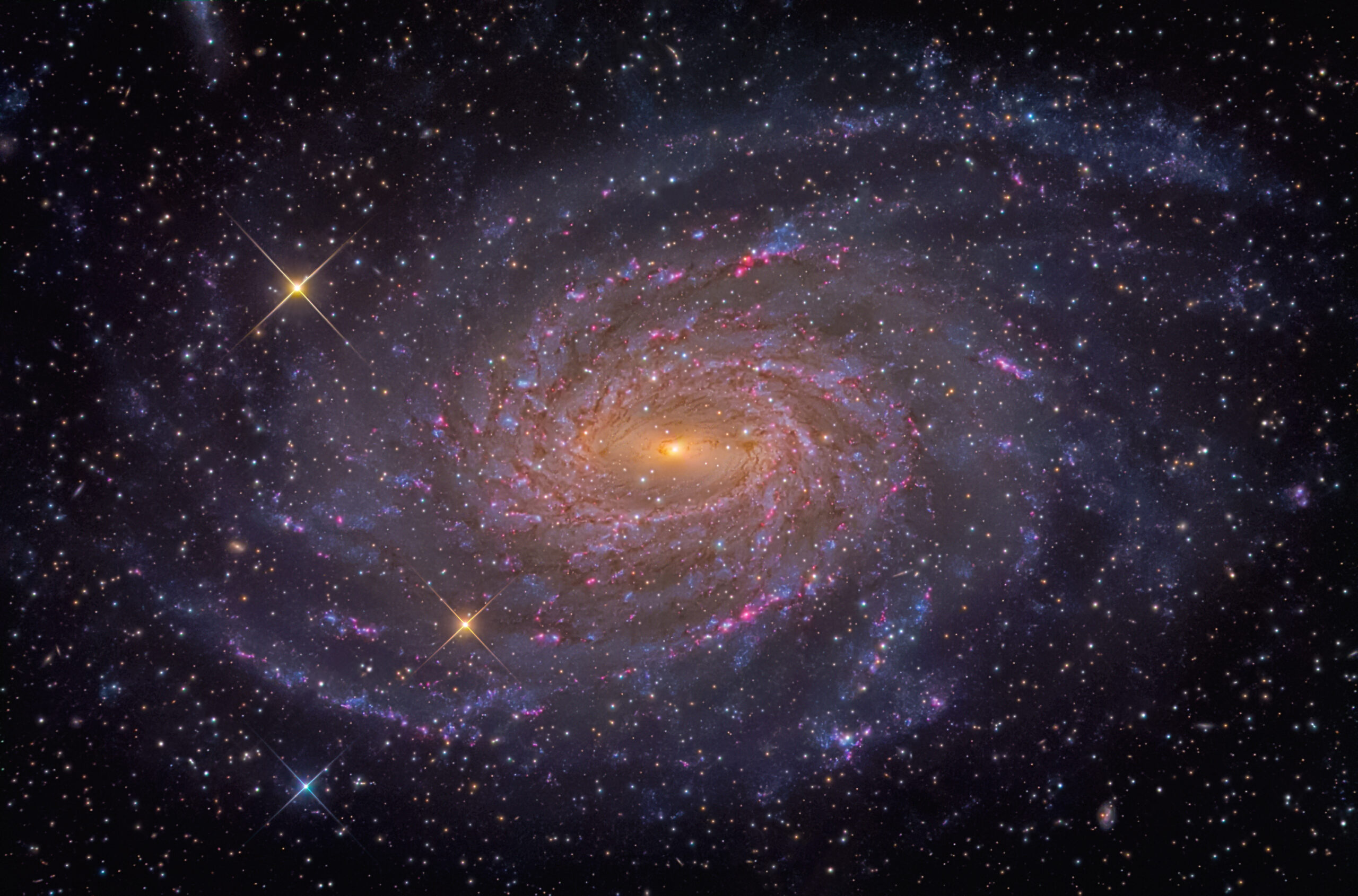
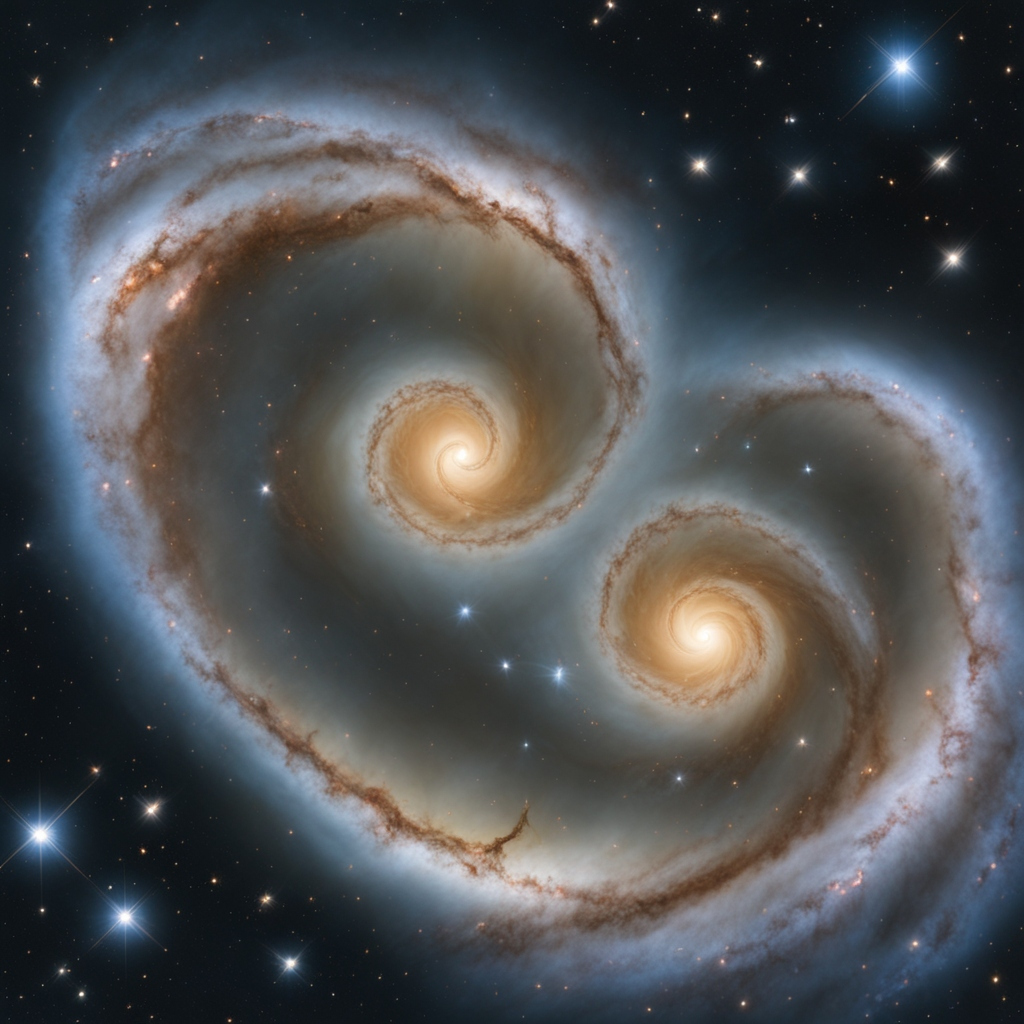
Galactic mergers represent the fascinating interplay of cosmic forces that shape the structure and fate of our universe.
At its core, a galactic merger occurs when two or more galaxies, bound by their mutual gravitational attraction, spiral inward and eventually coalesce into a single, new galaxy.
It’s crucial to understand the scale here. Galaxies are mostly space. The average distance between stars is so vast that when galaxies merge, stars rarely physically collide. A classic analogy is to imagine two swarms of bees flying through each other. While the swarms merge, individual bees rarely touch. The real interaction is between the diffuse gas and dust clouds, and, most significantly, the invisible gravitational glue—dark matter—that holds each galaxy together.
Why do they merge? It all comes down to gravity and the architecture of the universe. Galaxies are not isolated islands. They form groups and clusters. Within these cosmic neighborhoods, galaxies move under each other’s gravitational influence. If their relative motion is slow enough, gravity wins, binding them in an ever-tightening orbit that culminates in a merger.
The Stages of a Cosmic Courtship: A Billion-Year Romance
A galactic merger unfolds over timescales that dwarf human history, but astronomers have pieced together its distinct phases by observing countless examples at different stages.
Stage 1: The First Encounter and Gravitational Distortion
As galaxies first draw near (within a few hundred thousand light-years), their mutual gravity begins to wreak havoc. Long before they touch, tidal forces—the difference in gravitational pull from one side of a galaxy to the other—stretch and distort their shapes. Spectacular tidal tails of stars, gas, and dust are pulled out, often forming graceful, arcing bridges between the two galaxies. This is the “first date” where appearances start to change dramatically.
- Iconic Example: The Mice Galaxies (NGC 4676) are a textbook case of two spiral galaxies in this early stage, their long, streaming tails earning them their nickname.
Stage 2: The Inexorable Spiral and Violent Relaxation
Over hundreds of millions of years, the galaxies complete several close passes, losing orbital energy through gravitational interactions. Their cores sink toward the common center of mass. During these close encounters, the orderly rotation of spiral disks is utterly disrupted. Stars are flung onto new, randomized orbits in a process called “violent relaxation.” This marks the beginning of the end for distinct spiral structures.
Stage 3: Coalescence and Starburst
This is the most violent and transformative phase. The galaxies’ cores finally merge. While stars don’t collide, the colossal interstellar gas clouds within each galaxy do. This triggers a ferocious wave of new star formation, known as a starburst. A merging galaxy can form stars at a rate hundreds of times faster than a quiet galaxy like the Milky Way.
The Antennae Galaxies (NGC 4038/4039) are a stunning snapshot of this chaotic, star-birthing frenzy, their name derived from the long tidal tails visible in wider images.
Stage 4: The New Galaxy is Born
The firestorm of the starburst eventually subsides, as gas is either used up in star formation or blown away by powerful supernova explosions. What remains settles into a new, stable configuration. Often, the product of two merging spiral galaxies is a smooth, football-shaped elliptical galaxy, devoid of spiral arms and containing older stellar populations on random orbits. The merger is complete. The two have become one.
The Spectacular Consequences: More Than Just a Makeover
The impacts of a galactic merger ripple through every aspect of the galaxies involved.
1. Triggering Epic Star Formation (Starbursts)
As mentioned, the compression of gas clouds is the ultimate stellar nursery. These starbursts create dazzling clusters of young, hot, blue stars and illuminate surrounding dust into brilliant, pinkish emission nebulae. However, it’s a boom that can’t last. A merger can essentially use up a galaxy’s star-forming fuel in a relatively short cosmic time.
2. Feeding the Monsters: Supermassive Black Hole Activation
At the heart of nearly every large galaxy lies a supermassive black hole. During a merger, gas funnelled toward the galactic center doesn’t just form stars; a significant portion spirals into the black hole itself. As this material heats up, it can create an incredibly luminous active galactic nucleus (AGN), or quasar. This black hole “feeding frenzy” can outshine the entire host galaxy.
You can explore the latest research on this phenomenon from NASA’s Hubblesite: https://hubblesite.org/contents/articles/supermassive-black-holes.
3. Galactic Transformation: Spiral to Elliptical
This is the ultimate demographic shift in the universe. Most astronomers agree that the giant elliptical galaxies we see today—especially the massive “red and dead” ones in cluster centers—are the products of repeated mergers between spiral and smaller galaxies. Each merger randomizes stellar orbits and puffs up the galaxy’s size, creating the smooth, featureless ellipses we observe.
4. The Ripple Effects on Planetary Systems
What does a merger mean for planets and potential life? The direct threat to a star system is minimal. However, the increased radiation from the starburst and a potential AGN could be harmful to the atmosphere. More poetically, a close stellar pass could disturb a system’s Oort cloud, sending a shower of comets inward. On a much longer timescale, a merger can completely relocate a star, hurling it into the galactic halo or even ejecting it into intergalactic space as a “rogue star.”
Our Galactic Story: Past, Present, and Future
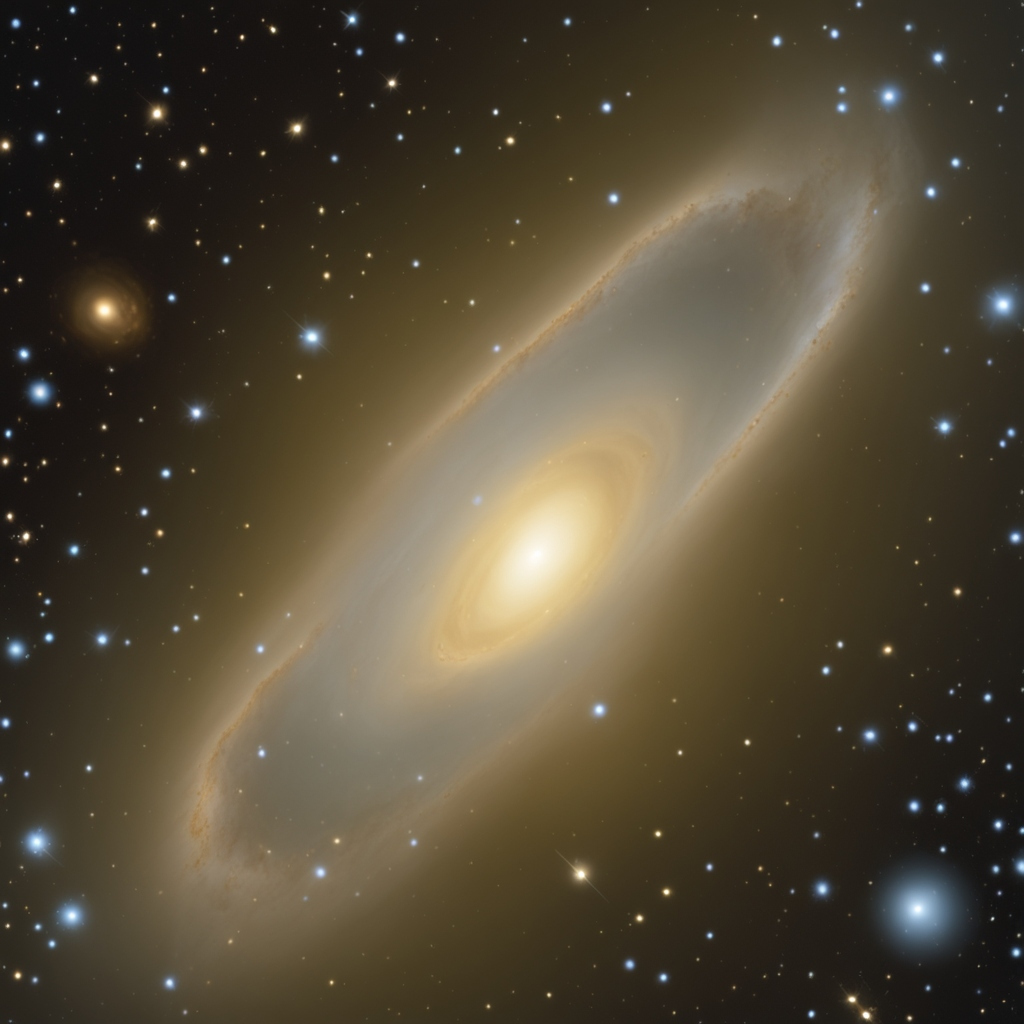
Galactic mergers are not just something that happens to “other” galaxies. Our Milky Way has a rich merger history and an impending merger destiny.
The Past: Galactic Archaeology
We are the product of mergers. By mapping the motions and compositions of stars in our galaxy’s halo, missions like Gaia have revealed fossilized streams of stars—the remnants of galaxies long ago consumed. The most significant was the Gaia-Enceladus galaxy, a dwarf galaxy that merged with the infant Milky Way about 10 billion years ago, shaping its thick disk and halo. We are, in a very real sense, the children of that ancient cosmic union.
The Future: The Milky Way and Andromeda Collision
Our most famous cosmic appointment is with the Andromeda Galaxy (M31). Currently 2.5 million light-years away, it is hurtling toward us at about 110 km/s. In about 4.5 billion years, we will begin to merge. The night sky from Earth (assuming the Sun hasn’t rendered it uninhabitable) will become spectacularly distorted, with Andromeda filling the view. Over the next several billion years, the two spirals will intertwine, likely forming a giant elliptical galaxy nicknamed “Milkomeda.”
The detailed simulations of this event, based on Hubble data, are publicly available from NASA: https://www.nasa.gov/mission_pages/hubble/science/milky-way-collide.html.
Studying Galactic Mergers: The Tools of the Trade
How do we understand events that take a billion years to unfold?
- The Cosmic Photo Album: We use telescopes as time machines. By observing the universe around us, we see different mergers frozen at different stages—from first encounter to final product. This allows us to assemble a chronological sequence.
- Supercomputer Simulations: Projects like the IllustrisTNG or FIRE simulations use the laws of physics to model the evolution of the universe, including mergers. They allow us to watch these processes in fast-forward and test our theories.
- Multi-Wavelength Astronomy: Mergers reveal different secrets at different wavelengths. Optical telescopes show the stars, infrared telescopes (like the James Webb Space Telescope) peer through dust to see hidden star formation, and X-ray observatories (like Chandra) reveal the hot gas and energetic black hole activity.
The European Space Agency’s Gaia mission is revolutionizing our understanding of our own galaxy’s merger history: https://www.esa.int/Science_Exploration/Space_Science/Gaia.
Conclusion: The Universe as a Living, Breathing Entity
Galactic mergers teach us a profound lesson: the universe is not static. It is a living, breathing, and ever-evolving system. The serene spiral galaxies we admire are not permanent fixtures; they are stages in a continuous cycle of birth, interaction, and transformation.
These cosmic dances are the architects of the largest structures we know. They forge new stars, awaken sleeping black holes, and reshape the very fabric of galactic civilization. They remind us that even on scales of billions of years and hundreds of thousands of light-years, change is the only constant.
So, the next time you gaze at the Andromeda Galaxy, a faint smudge in the autumn sky, remember: you are not looking at a stranger. You are looking at family, and our future home. You are witnessing the next great chapter in our galaxy’s story, a slow-motion ballet that began long before Earth formed and will conclude long after our sun fades. In the grand narrative of the cosmos, we are living in a relatively quiet interlude between acts of magnificent, creative violence. And that is a perspective both humbling and utterly thrilling.
FAQ Section
Q: What exactly happens when two galaxies merge? Do stars crash into each other?
A: This is the most common question, and the answer is surprisingly beautiful. While the event is dramatic, stars rarely physically collide. Galaxies are mostly space. The merger is a gravitational dance where the two galaxies’ structures (stars, gas, dark matter) are woven together over billions of years. The real collisions happen between vast clouds of gas and dust, which trigger furious waves of new star formation.
Q: What will happen when the Milky Way and Andromeda galaxies collide?
A: In about 4.5 billion years, our galaxy and its largest neighbor, Andromeda, will begin a slow gravitational tango. Over subsequent billions of years, they will pull at and distort each other’s shapes, eventually merging into a single, likely football-shaped elliptical galaxy nicknamed “Milkomeda.” Our solar system will probably be flung to a new orbit, but the sun will have died long before, and the vast distances between stars mean our system faces minimal direct physical danger.
Q: Are galactic mergers destructive or creative?
A: They are profoundly both. They destructively tear apart the elegant structures of spiral galaxies, randomizing star orbits. Yet, they are also the universe’s most powerful creative engines. The compression of gas clouds triggers “starbursts,” birthing generations of new stars. They also feed supermassive black holes, creating brilliant quasars. Ultimately, they are the primary mechanism for building the giant elliptical galaxies we see today.
Q: Has the Milky Way ever merged with another galaxy before?
A: Yes! Our galaxy has a rich merger history. Using data from missions like Gaia, astronomers have identified fossilized streams of stars in our galactic halo—the remnants of ancient dwarf galaxies consumed by the Milky Way. The most significant known event was the merger with the Gaia-Enceladus galaxy roughly 10 billion years ago, which helped shape our galaxy’s current structure.
Q: Could a galactic merger threaten life on a planet like Earth?
A: The direct threat from stellar collisions is negligible. However, the increased radiation from the intense starburst and a potential brightening of the central black hole (AGN) could theoretically harm planetary atmospheres or surface life. The greater risk might come from gravitational disturbances that could send comets showering inward from a star’s Oort cloud. Overall, the merger process is so slow that any immediate threat is very low.
Q: How do scientists study events that take billions of years to complete?
A: We use a combination of techniques:
- The Cosmic Photo Album: We observe many different galaxies at various merger stages, allowing us to piece together a timeline.
- Supercomputer Simulations: We input the laws of physics into powerful computers to model how gravity, gas, and stars interact over cosmic time.
- Multi-Wavelength Observations: We look at mergers using different “eyes” (infrared, X-ray, radio) to see different components, like hidden star birth or hot gas.
Q: What’s the most stunning example of a merging galaxy we can see?
A: Some of the most iconic examples include:
- The Antennae Galaxies: Two galaxies in a late-stage, chaotic merger, named for their long, tidal “antennae” tails.
- The Mice Galaxies: A perfect snapshot of two spirals in the early stages, with long, graceful tails pulled out by gravity.
- NGC 7252 (The Atoms for Peace Galaxy): The result of a merger that now resembles a giant, chaotic spiral, showcasing the final stages of coalescence.
Q: What role does dark matter play in galactic mergers?
A: Dark matter is the invisible gravitational scaffolding of the universe and is absolutely central to mergers. It makes up about 85% of a galaxy’s mass, forming a vast “halo” that extends far beyond the visible stars. When galaxies merge, their dark matter halos interact first, weaving together through gravity and creating the deep potential well that drags the visible matter (stars and gas) inward. Essentially, the dark matter halos set the stage and choreograph the entire dance.
Q: What happens to the supermassive black holes at the centers of merging galaxies?
A: As galaxies merge, their central supermassive black holes sink toward the new galactic core through a process called dynamical friction. They form a binary pair, orbiting each other. Eventually, they are predicted to merge, releasing ripples in spacetime known as gravitational waves. This final inspiral can take millions of years after the galaxies themselves have coalesced. Observatories like LIGO and Virgo are searching for these low-frequency waves from black hole binaries.
Q: Can we see a merger happening in real-time from Earth?
A: Given the billion-year timescales, we can’t watch a merger “live” like a movie. However, we have an incredible cosmic photo album. By observing the universe, we capture different mergers at different stages—from first encounter to final product. This allows astronomers to construct a precise timeline, much like seeing photos of a child, a teenager, an adult, and a senior to understand a human lifespan.
Q: Are there different types of mergers?
A: Yes, the outcome depends heavily on the size ratio of the merging galaxies:
- Major Merger: Two galaxies of roughly similar size (e.g., two spirals). This is the most dramatic, often creating an elliptical galaxy.
- Minor Merger: A large galaxy consumes a much smaller dwarf galaxy. This is far more common. The large galaxy’s structure (like its spiral arms) can remain intact but is often thickened or perturbed, and it gains a halo of accreted stars. The Milky Way is currently undergoing minor mergers with dwarf galaxies like the Sagittarius Dwarf.
Q: How do galactic mergers affect the chemical evolution of the universe?
A: Mergers are crucial for “galactic recycling” and spreading heavy elements. The starbursts they trigger create massive stars that live fast, die young, and explode as supernovae. These explosions enrich the galactic gas with newly forged elements like carbon, oxygen, iron, and silicon. The merger then churns and disperses these enriched materials throughout the new galaxy, seeding future generations of stars and planets with the building blocks for rocky worlds and, potentially, life.
Q: What’s the most famous image of a galactic merger?
A: One of the most iconic is Hubble’s image of the Antennae Galaxies (NGC 4038/4039). Its breathtaking detail reveals the chaos of colliding gas clouds, brilliant blue star clusters, and pink stellar nurseries. It’s a masterclass snapshot of the violent starburst phase. You can explore the high-resolution image and details directly from the Space Telescope Science Institute: https://hubblesite.org/contents/media/images/2006/46/2028-Image.html.