Look down at your thumb. Now, hold that gaze.
In the time it took you to read that sentence, about 100 billion nearly massless, chargeless, and mind-bogglingly tiny particles have just passed straight through it without you feeling a thing.
They are streaming through your body, your house, and the entire Earth as you read this, mostly coming from the nuclear furnace at the heart of our Sun. They are the ghosts of the subatomic world: neutrinos.
For decades, neutrino physics was a niche, almost esoteric field. Today, it stands at the forefront of some of the most profound questions in science. What is the fate of the universe? Why is there something instead of nothing? How do the most violent cosmic explosions work?
This isn’t just abstract physics. This is a cosmic detective story, and we are the detectives. So, grab your metaphorical magnifying glass. We’re going on a ghost hunt.
What in the World is a Neutrino? A Ghost Particle
To understand why neutrinos are so captivating, you first need to understand why they are so weird.
In the family portrait of the Standard Model of particle physics—our best catalog of the universe’s fundamental building blocks—you have the familiar electrons, the quarks that make up protons and neutrons, and a few other characters. And then you have the neutrinos, the quiet, strange cousins who barely interact with anyone.
Let’s break down their ghostly resume:
- Almost No Mass: For a long time, we thought they were completely massless, like photons of light. We now know they have a vanishingly small mass, so tiny it’s still not precisely measured. Imagine if an electron were a feather; a neutrino would be the weight of that feather compared to a mountain.
- No Electric Charge: They are neutral, hence the name “neutrino” (Italian for “little neutral one”). This means they are immune to the electromagnetic force that governs most of our everyday experiences, from magnets to the light you see.
- They Only Listen to the “Weak Force”: Neutrinos only interact via the weak nuclear force and gravity. The weak force has an extremely short range, meaning a neutrino has to pass incredibly close to an atomic nucleus to have any chance of interacting. This is the source of their ghostly nature.
The analogy isn’t perfect, but it helps to think of it this way: If you fired a neutrino through a block of lead so dense that it was one light-year thick (about 6 trillion miles), it would have a 50/50 chance of actually hitting something and being stopped. The rest would just pass through. That’s how elusive they are.
A Desperate Bet: The Story of the Neutrino’s Birth
The neutrino’s story begins not with a discovery, but with a crisis. In the early 1900s, scientists studying a type of radioactive decay called “beta decay” found a problem. Energy and momentum seemed to be disappearing from the reaction. This was a direct violation of the sacred laws of conservation of energy and momentum.
It was so troubling that the great physicist Niels Bohr briefly considered that these laws might not hold in the atomic nucleus.
But in 1930, a brilliant and bold physicist, Wolfgang Pauli, proposed a radical solution. He suggested that an unseen, undetectable particle was carrying away the missing energy and momentum. He famously wrote in a letter to colleagues, “I have done a terrible thing. I have postulated a particle that cannot be detected.” He was so embarrassed by his own idea that he barely published it.
This “desperate way out,” as he called it, was the birth of the neutrino hypothesis. It took another 26 years before Frederick Reines and Clyde Cowan actually detected one, earning Reines a Nobel Prize in 1995 (Cowan had sadly passed away). Their experiment, placed near a powerful nuclear reactor, was the first successful ghost hunt.
The Three Faces of the Ghost: Neutrino Flavors and Oscillation
If the story ended there, neutrinos would be a neat footnote. But the plot thickened dramatically.
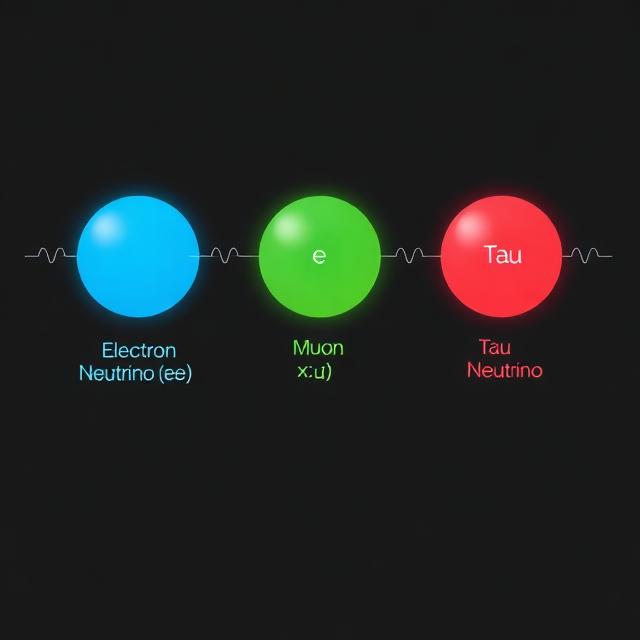
We now know there aren’t just one, but three types (or “flavors”) of neutrinos, each paired with a different charged particle:
- The Electron Neutrino (νₑ): Partner to the electron.
- The Muon Neutrino (ν_μ): Partner to the heavier muon.
- The Tau Neutrino (ν_τ): Partner to the even heavier tau particle.
For a long time, we thought a neutrino, once created, was locked into its identity. An electron neutrino was always an electron neutrino.
But then, another mystery emerged.
The Case of the Missing Solar Neutrinos
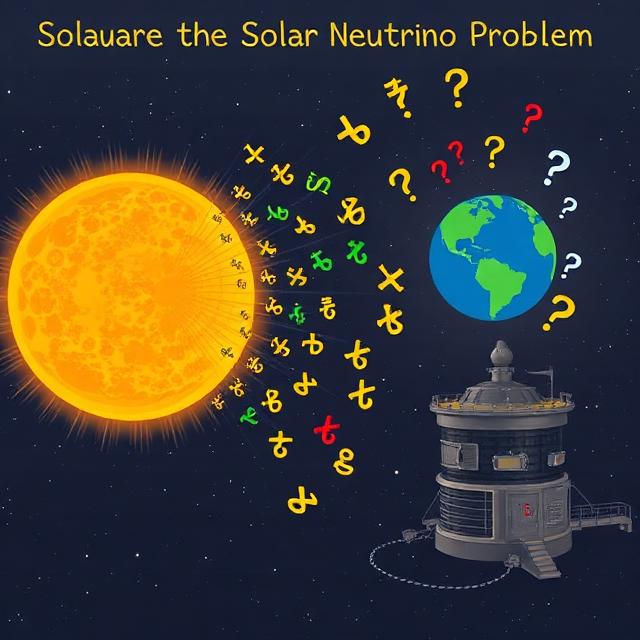
In the 1960s, physicist Raymond Davis Jr. built a revolutionary experiment 4,850 feet underground in the Homestake Gold Mine. His goal was to catch neutrinos coming from the Sun. His detector, a massive tank of perchloroethylene (dry-cleaning fluid), was sensitive only to electron neutrinos.
Theories predicted how many electron neutrinos the Sun should be producing. But Davis’s experiment only found about one-third of the predicted number.
Where were the missing solar neutrinos? For decades, this was the “Solar Neutrino Problem,” and it cast a long shadow over our understanding of both the Sun and particle physics.
Was our model of the Sun wrong? Or was something strange happening to the neutrinos on their 93-million-mile journey to Earth?
The answer was more fantastic than anyone had imagined.
The Great Identity Swap: Neutrino Oscillation
The solution to the mystery was Neutrino Oscillation. This is the single most important concept in modern neutrino physics, and it’s as mind-bending as it sounds.
A neutrino born as an electron neutrino doesn’t stay that way. As it travels through space, it morphs, oscillating between its three identities: electron, muon, and tau. It’s a shape-shifter. The electron neutrino leaving the Sun has a high probability of being a muon or tau neutrino by the time it reaches Earth.
This was the breakthrough. Davis was only catching electron neutrinos, but the others had transformed into flavors his detector couldn’t see.
Why is this such a big deal? Because neutrino oscillation implies that neutrinos have mass.
In the pure, original Standard Model, neutrinos were massless. For oscillation to happen, the “mass state” and the “flavor state” of the neutrino have to be different, a quantum mechanical quirk that requires mass. The discovery of oscillation was direct evidence that the Standard Model is incomplete. It was the first crack in a beautiful, but ultimately unfinished, theory.
This monumental discovery earned Takaaki Kajita (Super-Kamiokande, Japan) and Arthur B. McDonald (SNO, Canada) the 2015 Nobel Prize in Physics. They had proven that the ghost could change its mask.
How Do You Catch a Ghost? The Art of the Neutrino Detector
You can’t trap a neutrino in a box. So, how do you study something that refuses to interact?
You build a bigger, more sensitive trap. Neutrino detectors are some of the most epic, awe-inspiring pieces of scientific infrastructure on (and inside) the planet. They are typically built deep underground to shield them from the constant rain of cosmic rays that would drown out the delicate neutrino signal.
Let’s tour a few of the most famous ghost-hunting grounds:
1. Super-Kamiokande (Super-K), Japan
Nestled 1,000 meters under a mountain in Japan, Super-K is a cathedral of science. It’s a cylindrical tank containing 50,000 tons of ultra-pure water, lined with over 13,000 golden light-detecting bulbs called photomultiplier tubes.
When a rare neutrino interaction occurs in the water, it can create a particle moving faster than the speed of light in water (though still slower than light in a vacuum). This produces a faint blue glow of light called Cherenkov radiation, a sonic boom for light. The pattern of this light tells scientists the type, direction, and energy of the neutrino that caused it.
2. The Sudbury Neutrino Observatory (SNO), Canada
SNO, now decommissioned but legendary, was built 2,100 meters underground in a nickel mine. Its genius was using 1,000 tons of heavy water (where hydrogen has an extra neutron). Heavy water is sensitive to all three neutrino flavors equally. By comparing the total number of neutrinos (all flavors) from the Sun to the number of just electron neutrinos, SNO provided the definitive proof of neutrino oscillation.
3. IceCube, South Pole
This one is pure science fiction. IceCube isn’t a single tank, but a cubic kilometer of pristine Antarctic ice instrumented with over 5,000 optical sensors. It uses the ancient ice as both the detector and the shielding. It’s designed to catch extremely high-energy neutrinos from cataclysmic cosmic events like supermassive black holes and supernovae, giving us a new way to see the universe.
4. DUNE (Deep Underground Neutrino Experiment), USA/Fermilab
This is the future. DUNE, currently under construction, will shoot the world’s most intense beam of neutrinos from Fermilab near Chicago, 800 miles straight through the Earth to a massive detector in South Dakota, 1.5 kilometers underground. This long baseline will allow for unprecedented precision in studying neutrino oscillation and the difference between matter and antimatter.
Why Should You Care? The Cosmic and Earthly Impact of Neutrinos
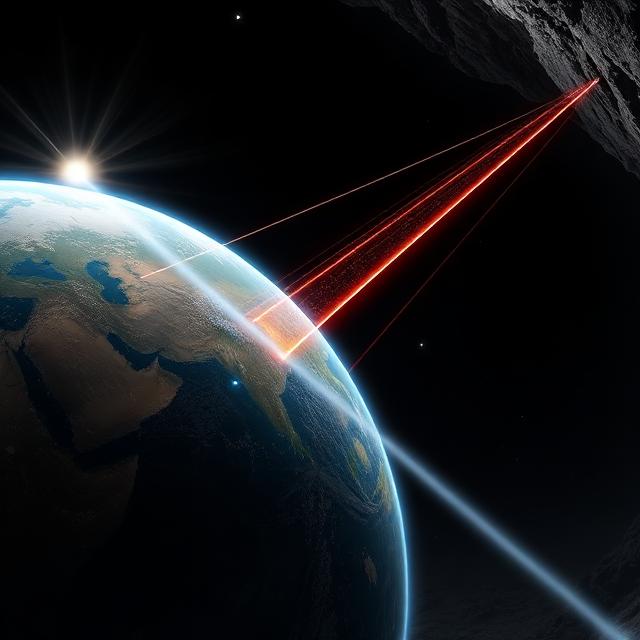
This is where we move from fascinating science to world-changing implications. Why do we spend hundreds of millions of dollars chasing these phantoms?
1. Probing the Inner Workings of the Sun and Stars
Neutrinos are the only direct probe we have into the core of a star. Light (photons) takes tens of thousands of years to bounce its way out from the Sun’s core, getting scrambled along the way. Neutrinos, born in the fusion reactions, zip out in just over two seconds. By studying solar neutrinos, we are seeing the Sun’s heart in real-time, confirming our models of how stars shine.
2. Witnessing the Death of Stars
When a massive star goes supernova, 99% of its colossal energy is released not as light, but as neutrinos. The 1987A supernova in a nearby galaxy delivered a handful of neutrinos to detectors on Earth hours before the light arrived, marking the birth of neutrino astronomy. Next time a star in our galaxy goes supernova, detectors like Super-K will be flooded with thousands of neutrinos, giving us a front-row seat to the death and birth of a star, and potentially a new black hole or neutron star.
3. The Matter-Antimatter Asymmetry Mystery
This is one of the deepest puzzles in physics: Why is the universe made mostly of matter? The Big Bang should have created equal amounts of matter and antimatter, which would have annihilated each other, leaving behind nothing but energy. Yet, here we are.
Neutrinos might hold the key. If neutrinos and antineutrinos behave differently (a phenomenon called CP Violation), it could point to a mechanism that favored matter in the early universe. Experiments like DUNE are specifically designed to hunt for this difference.
4. A Window to the Early Universe and Beyond the Standard Model
Because they interact so weakly, neutrinos from the very first seconds after the Big Bang are still streaming through the universe. Studying them is like having a fossil from the dawn of time. Furthermore, their tiny but non-zero mass is a clear sign of physics “Beyond the Standard Model.” Are they their own antiparticles? What gives them their mass? Each answer unlocks a new layer of reality.
5. Even Practical(ish) Applications?
While not as direct as a new smartphone, neutrino physics pushes technology to its limits. The photomultiplier tubes, ultra-pure water systems, and data-handling techniques developed for these experiments have found uses in medical imaging, nuclear non-proliferation monitoring, and even detecting radioactive materials in cargo containers.
The Future of the Ghost Hunt: What’s Next?
The field of neutrino physics is exploding with activity. We’ve moved from asking “Do they exist?” to using them as tools to explore the cosmos and the fundamentals of physics.
The next decade will see:
- DUNE and Hyper-Kamiokande (a successor to Super-K) are coming online, offering unprecedented sensitivity.
- JUNO in China, which will precisely measure the neutrino “mass ordering”—a fundamental property we still don’t know.
- Continued searches for neutrinoless double beta decay, a hypothetical process that, if found, would prove the neutrino is its own antiparticle, with huge implications for the matter-antimatter asymmetry.
A Universe of Ghosts
We began with a particle passing through your thumb, a ghost you could never feel. But as we’ve seen, these ghosts are anything but insignificant. They are cosmic messengers, shape-shifting keys to the universe’s greatest secrets, and a bridge between the infinitesimally small quantum world and the impossibly large cosmos.
They remind us that the universe is far stranger and more wonderful than it appears. The solid ground beneath your feet, the screen you’re reading this on—it’s all mostly space, perpetually traversed by a silent, ethereal wind from the heart of the Sun and the depths of deep space.
The ghost hunt continues. And with every new detector, every new beam, and every new flash of light in a deep, dark tank, we pull back the curtain just a little more on the hidden reality of our universe.
Frequently Asked Questions (FAQ)
1. What is a neutrino in simple terms?
A neutrino is a fundamental particle, like an electron, but with a crucial difference: it has no electrical charge and an almost undetectably tiny mass. This allows it to pass through almost everything in the universe—including you and the entire Earth—at the speed of light without interacting, making it the ultimate “ghost particle.”
2. Where do neutrinos come from?
Neutrinos are everywhere! They are the second most abundant particle in the universe (after photons). The largest source for us is the Sun, which showers Earth with billions of solar neutrinos every second. They are also produced in nuclear reactors, particle accelerators, during cosmic ray collisions in our atmosphere, and in colossal cosmic events like supernova explosions.
3. Can we see or feel neutrinos?
No, you cannot see or feel them directly. Their ghostly nature means they almost never interact with the atoms that make up your body. However, we can “see” them indirectly using massive, incredibly sensitive scientific instruments called neutrino detectors, often built deep underground.
4. What does “neutrino oscillation” mean?
Neutrino oscillation is the bizarre and proven phenomenon where a neutrino changes its “flavor” as it travels through space. An electron neutrino born in the Sun, for example, can transform into a muon or tau neutrino by the time it reaches Earth. This was the solution to the “Missing Solar Neutrinos” mystery and is the reason we know neutrinos have mass.
5. Why are neutrinos so important to science?
Neutrinos are crucial because they are messengers from processes we can’t otherwise see. They give us a real-time view into the core of the Sun, the explosion of dying stars, and the conditions just after the Big Bang. Studying them helps us test the limits of our fundamental physics theories and could explain why the universe is made of matter instead of antimatter.
6. How can scientists detect something that passes through everything?
They use a “brute force” method: build a massive target and wait. Giant detectors filled with ultra-pure water, heavy water, or ice are placed deep underground. While trillions of neutrinos pass through, a very few will randomly interact with an atom in the target, producing a tiny flash of light (Cherenkov radiation) that super-sensitive cameras can detect.
7. Do neutrinos affect humans or our health?
No, the vast, constant flux of neutrinos passing through your body is completely harmless. Their extremely weak interaction with matter means they deposit no meaningful energy and cause no damage. You are being harmlessly traversed by billions of them from the Sun every second, and you always have been.