

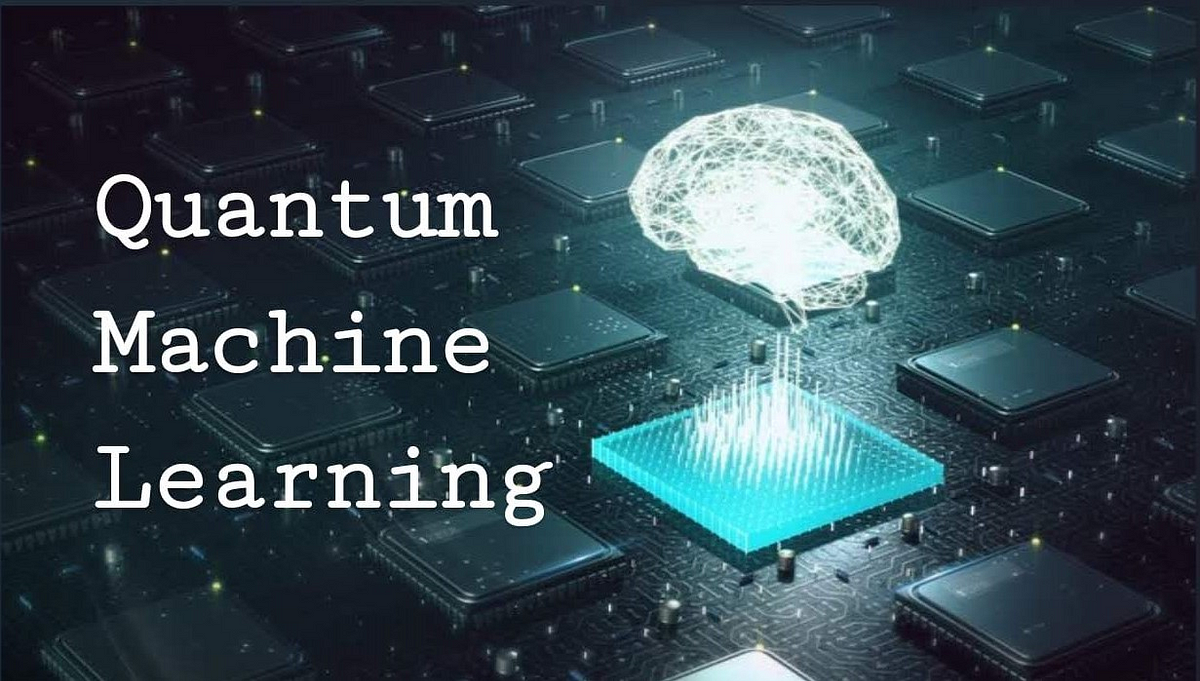
Let’s be honest. For all its brilliance, today’s artificial intelligence can be… well, a bit of a diva.
It demands enormous amounts of data, gulps down staggering quantities of energy, and can take weeks or even months to train on the world’s most powerful supercomputers. We’ve taught it to write sonnets and diagnose diseases, but the process itself often feels like a slow, brute-force crawl.
Now, imagine a different reality. Imagine training a complex AI model to find a new life-saving drug not in a year, but in a day. Or optimizing a global supply chain not with good-enough guesses, but with a mathematically perfect solution in minutes.
This isn’t just a faster computer. This is a different kind of computer altogether. This is the promise of Quantum Machine Learning (QML)—a field where the bizarre, counter-intuitive rules of quantum physics are harnessed to supercharge artificial intelligence. As we speed toward 2025, the question is no longer if this will happen, but how soon.
So, let’s untangle the hype from the reality. Can the enigmatic qubit truly teach our classical AI to learn at a pace we can barely conceive?
Part 1: The Basics – Untangling the Qubit from the Bit
Before we can see the future, we need to understand the fundamental shift. This isn’t an upgrade from a bicycle to a sports car. It’s an upgrade from a sports car to a teleportation device. The change starts at the very bedrock of computation.
Classical vs. Quantum: The Light Switch vs. The Spinning Coin
Think of the computer you’re using right now. At its heart, it’s built on bits. A bit is the simplest unit of information possible. It’s a binary state: a 0 or a 1. It’s like a standard light switch—either definitively OFF (0) or definitively ON (1). Every photo, song, and word on your screen is a magnificent tapestry of millions of these simple on/off switches.
Now, meet its quantum rival: the qubit.
A qubit is the rebel of the computing world. Thanks to a quantum property called superposition, a qubit can be a 0, a 1, or both at the same time. The best analogy is a spinning coin. While it’s in the air, is it heads or tails? It’s not either. It’s in a fuzzy, probabilistic state of being both simultaneously. It’s only when it lands (when we measure it) that it “collapses” to a definitive heads or tails.
This single property is the source of quantum computing’s mind-bending power. While 3 classical bits can represent only one of 8 possible combinations (000, 001, 010, etc.) at any given time, 3 qubits in superposition can represent all 8 combinations at once. This parallelism grows exponentially. With just 300 qubits, you could represent more states than there are atoms in the known universe. This is the “quantum advantage” in a nutshell.
What is Quantum Machine Learning? A Simple Definition
So, where does AI fit into this?
Quantum Machine Learning isn’t about replacing the AI algorithms we know and love. It’s not about deleting Python and TensorFlow. Instead, think of QML as installing a nitrous boost into your AI’s engine.
In simple terms, QML is the application of quantum algorithms to accelerate specific, computationally monstrous tasks that are central to machine learning.
Many core AI processes—like pattern recognition, optimization, and simulation—rely heavily on linear algebra, specifically massive matrix multiplications and vector calculations. It turns out that these tasks, which are slow and energy-intensive for classical computers, are things that quantum computers are naturally, almost perfectly, suited to handle.
They don’t run your entire AI. They take the heaviest, most cumbersome parts of the calculation and perform them at speeds that are simply impossible classically.
Part 2: The “How” – How Qubits Could Supercharge AI Learning
Okay, so qubits are weird and powerful. But how does that weirdness actually translate into faster, smarter AI? Let’s look under the hood.
The Secret Sauce: Why QML is So Promising
The promise of QML isn’t just a linear speed increase. It’s about tackling problems of a completely different scale.
1. Exponential Speedups in Linear Algebra
At its core, training a neural network is one giant, continuous math problem involving matrices—large grids of numbers. The time it takes a classical computer to multiply two matrices grows polynomially with their size. For the vast matrices in modern AI, this becomes a crippling bottleneck.
Quantum computers, however, can exploit their parallelism to manipulate these high-dimensional vectors and matrices in a single step. Algorithms like the Harrow-Hassidim-Lloyd (HHL) algorithm (a mouthful, we know) show that, in theory, they can solve certain linear systems exponentially faster. This means a problem that would take a classical supercomputer 10,000 years could potentially be solved by a powerful quantum machine in minutes. This isn’t just an upgrade; it’s a paradigm shift for the core math of AI.
2. Exploring Vast Solution Spaces Faster
Many AI problems are about finding the best possible solution from a near-infinite set of possibilities. Think of finding the most efficient route for a thousand delivery trucks, or the perfect molecular structure for a new battery.
A classical computer has to painstakingly check these possibilities one by one, or use smart shortcuts that still only provide a “good enough” answer. A quantum computer, leveraging superposition and another spooky property called entanglement, can effectively explore this vast “solution landscape” all at once. It’s like finding a needle in a haystack by weighing the entire haystack all at once and instantly knowing where the needle is.
3. Better Feature Mapping with Quantum Kernels
In machine learning, “features” are the specific characteristics of your data. The way you map these features can determine how well your model finds patterns. Classical AI can struggle with data that has incredibly complex, hidden relationships.
Quantum computers can naturally map data into immensely complex, high-dimensional feature spaces. Imagine you have two tangled strands of yarn. In a 2D space (a table), they’re a messy knot. But if you could lift them into 3D space, you might easily untangle them. Quantum computers can lift data into thousands of dimensions, making intricate patterns suddenly simple and separable for an AI to learn. This is the power of the quantum kernel.
Part 3: The 2025 Reality Check – Potential vs. Hype
This all sounds like science fiction, and frankly, a lot of it still is. So, let’s ground ourselves. As we look toward the pivotal year of 2025, what can we realistically expect?
Is 2025 the “Quantum Leap” Year for AI?
The answer is nuanced. 2025 will not be the year your smartphone gets a quantum chip. But it is poised to be a critical inflection point. Here’s the optimistic view versus the realist’s sobering perspective.
The Optimist’s View (The Potential):
- Hardware Progress: Companies like IBM, Google, and Rigetti are in a fierce race to scale up qubit counts and, more importantly, qubit quality. We’re moving from dozens of noisy qubits to hundreds, with improved stability. IBM’s roadmap, for instance, aims for over 1,000 qubits by the end of 2025.
- Hybrid Models are Maturing: The most significant near-term progress is in hybrid quantum-classical algorithms. Here, a classical computer runs the main AI program and offloads a specific, well-defined subtask to a small quantum processor. This pragmatic approach is where we’ll see the first real-world commercial applications.
- Software & Investment Boom: The ecosystem is exploding. Startups are emerging, venture capital is flowing, and cloud-based quantum computing (from IBM, Amazon Braket, Microsoft Azure) is making these machines accessible to researchers and companies worldwide, accelerating software development.
The Realist’s View (The Hurdles):
(This is where we separate the sci-fi from the science.)
The Decoherence Problem: A Fragile Existence
Remember our spinning coin? A qubit’s superposition is incredibly fragile. The slightest interaction with its environment—a stray vibration, a temperature change—can cause it to “decohere,” collapsing from its magical both/and state into a boring, classical 0 or 1. Keeping qubits stable is like trying to keep thousands of those spinning coins perfectly balanced, without any of them falling over, for as long as the calculation takes. It’s an immense engineering challenge.
Error Rates and Noise: The Static on the Line
Today’s quantum computers are “noisy.” They make mistakes. A calculation might run perfectly in theory, but in practice, the signal is drowned out by quantum noise. This has led to the term NISQ—Noisy Intermediate-Scale Quantum—which perfectly describes the current era. A huge portion of the quantum hardware is dedicated not to computation, but to quantum error correction, a complex process of using many “physical” qubits to create one stable, reliable “logical” qubit. We are still years away from having enough stable qubits for robust, error-corrected computations.
The Talent Gap: The Ghost in the Machine
Perhaps the most under-discussed challenge is the human one. There is a severe global shortage of people who are fluent in both the arcane language of quantum mechanics and the practical world of software engineering and data science. You can’t just take a Python developer and have them program a quantum computer. This skills gap is a major brake on the pace of innovation.
Real-World Use Cases We Might See by 2025
Given these hurdles, what tangible progress can we expect by 2025? Look for “quantum advantage” in these specific, high-value niches:
- Drug Discovery and Materials Science: This is the killer app. Simulating molecular interactions is exponentially hard for classical computers. QML could model new proteins for drugs or discover new catalysts for carbon capture with a precision that’s impossible today, leading to breakthroughs in medicine and climate tech.
- Ultra-Efficient Logistics & Supply Chains: Optimizing fleet routes, air traffic control, or factory floor schedules are classic optimization problems. Hybrid QML models could find solutions that save billions of dollars in fuel and time for global enterprises.
- Financial Modeling: Banks are heavily investing in QML to create next-generation models for portfolio optimization, high-frequency trading, and fraud detection by finding complex, non-obvious patterns in market data.
- A Note on Breaking Encryption: It’s crucial to mention that one of the first proven quantum advantages will likely be in breaking current RSA encryption. This has massive cybersecurity implications and is driving a global shift towards “post-quantum cryptography.” It’s a double-edged sword that highlights the transformative power of this technology.
Part 4: The Future is Hybrid
So, what’s the path forward? The narrative of a lone quantum computer solving all our problems is a fantasy. The future, especially for 2025 and the years immediately following, is one of collaboration.
The Path Forward: A Classical-Quantum Partnership
The most exciting and practical work happening right now is in Hybrid Quantum-Classical Algorithms.
Imagine a team where a seasoned, logical manager (the classical computer) oversees a brilliant, intuitive, but somewhat erratic genius (the quantum processor). The manager breaks down a massive problem, identifies a specific, intensely complex subtask that plays to the genius’s strengths, and hands it off. The genius does their thing, returns an answer, and the manager integrates it into the bigger picture.
This is the blueprint. Frameworks like PennyLane and Qiskit are already designed for this hybrid approach. They allow developers to build workflows where a classical AI model in PyTorch or TensorFlow can call a quantum circuit as a subroutine. This is how we will bridge the gap—not with a revolution, but with a strategic, step-by-step integration.
Conclusion: A New Dawn for AI is on the Horizon
As we stand on the doorstep of 2025, the landscape of Quantum Machine Learning is one of breathtaking potential tempered by formidable, real-world challenges.
The promise is real: qubits can, in theory, teach AI to learn not just linearly faster, but exponentially faster. They offer a key to unlock problems in medicine, logistics, and materials science that have been permanently out of reach for classical computers.
Yet, the hurdles of decoherence, noise, and a scarce talent pool remind us that this is a marathon, not a sprint. 2025 will not be the year of a singular “quantum winter” or a big-bang revolution. Instead, it will be a year of quiet, significant progress in hybrid algorithms, hardware stability, and tangible, if niche, commercial applications.
The race to teach AI with qubits is not just a race for faster computation. It’s a race to redefine the possible. The foundation being laid today, in labs and on cloud platforms around the world, is for the AI revolution of the 2030s and beyond. The journey has already begun, and it’s one of the most thrilling stories in modern technology.
FAQ: Your Quantum Machine Learning Questions, Answered
Is Quantum Machine Learning real yet?
Yes, but primarily in research labs and early-stage commercial experiments. We have the algorithms and the basic hardware, but we are in the “Noisy Intermediate-Scale Quantum” (NISQ) era, where results are often hampered by errors. It’s real, but not yet ready for mainstream consumer applications.
Will quantum computers replace classical computers for AI?
Almost certainly not. Classical computers are excellent at most tasks we do every day (spreadsheets, web browsing, running most of an AI model). The future is hybrid, where quantum computers act as specialized accelerators for specific problems, working in tandem with powerful classical systems.
What are the biggest companies working on QML?
The field is led by a mix of tech giants and specialized startups. The key players include IBM (Qiskit), Google (TensorFlow Quantum, Sycamore processor), Microsoft (Azure Quantum, Q#), Amazon (Braket), Rigetti Computing, and D-Wave Systems.
Do I need to learn quantum physics to work in AI?
For the vast majority of AI roles today, no. But for those who want to be at the bleeding edge and work directly on QML, a strong conceptual understanding of linear algebra, quantum mechanics (like superposition and entanglement), and the specific programming frameworks (Qiskit, PennyLane) is becoming essential. The most sought-after talent will be “bilingual” in both classical and quantum computing.

Hi
It is nice blog.😊😊😊😊😊