Look up.
The sky seems so vast, so empty. It’s easy to forget that just a few hundred miles above our heads, a bustling celestial metropolis is in constant motion. Thousands of active satellites zip around the Earth at mind-boggling speeds of over 17,000 miles per hour. They are the unsung heroes of our modern world, enabling everything from GPS navigation and weather forecasts to global communications and financial transactions.
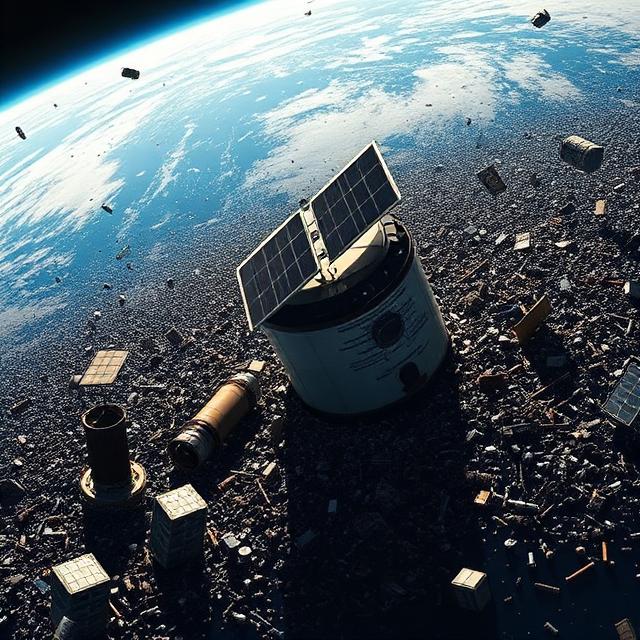
But this metropolis has a problem. It’s becoming a cosmic traffic jam, cluttered with a ghost population of defunct satellites, discarded rocket parts, and millions of shards of debris from decades of space exploration. In this high-speed environment, a collision isn’t just a fender-bender; it’s a catastrophic, hyper-velocity explosion that creates thousands of new, unpredictable hazards.
So, how do we prevent this orbital free-for-all? How do we ensure that the GPS guiding your road trip or the satellite providing your internet doesn’t get blindsided by a piece of space junk?
Welcome to the high-stakes, high-tech world of space collision avoidance. This isn’t science fiction; it’s a daily, critical operation that protects our technological backbone in space.
The Silent Problem: It’s Crowder Than You Think Up There
Before we dive into the solutions, we need to understand the scale of the problem. Our near-Earth environment is not the pristine vacuum we imagine.
What Exactly is “Space Debris”?
Space debris, or “space junk,” is the collection of defunct human-made objects in orbit. This includes:
- Dead Satellites: Satellites that have run out of fuel or reached the end of their operational life.
- Spent Rocket Bodies: The upper stages of rockets that launched payloads into orbit.
- Mission-Related Debris: Things like lens caps, bolts, and other items released during missions.
- Fragmentation Debris: The result of explosions, collisions, or anti-satellite tests. This is the most numerous and dangerous category.
The European Space Agency’s (ESA) Space Debris Office provides a sobering snapshot:
- Over 36,500 debris objects larger than 10 cm are regularly tracked and cataloged.
- About 1 million pieces between 1 cm and 10 cm are orbiting untracked.
- A staggering 130 million pieces between 1 mm and 1 cm are out there.
Why is a Tiny Bolt a Massive Problem? The Physics of Hyper-Velocity
The danger isn’t just the number; it’s the speed. In Low Earth Orbit (LEO), where the International Space Station (ISS) and many satellites reside, objects travel at approximately 17,500 mph (28,000 km/h).
At that velocity, kinetic energy is king. A collision isn’t a gentle bump; it’s a bomb-like release of energy.
- A 1-centimeter paint fleck can hit with the force of a hand grenade.
- A 10-centimeter object (about the size of a softball) can completely obliterate a satellite or spacecraft, creating a cloud of new debris.
This was terrifyingly demonstrated in 2009, when an active Iridium communications satellite and a defunct Russian military satellite, Kosmos-2251, collided. They were traveling at a relative speed of over 26,000 mph. The result was a catastrophic fragmentation event, creating over 2,300 large, trackable pieces of debris (and countless smaller ones) that will remain in orbit for decades, posing a continuous threat to other objects.
This scenario is the core fear of space operators: the Kessler Syndrome. Proposed by NASA scientist Donald Kessler in 1978, it’s a theoretical cascade effect where the density of objects in orbit becomes so high that collisions create more debris, leading to even more collisions, eventually rendering entire orbital regions unusable for generations. While we’re not there yet, the risk is real and growing with every new satellite launched.
The Guardians on the Ground: How We Track the Chaos
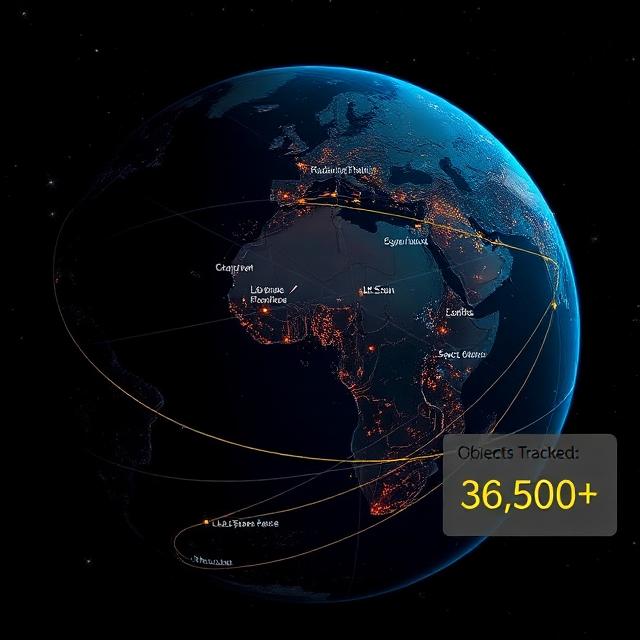
You can’t avoid what you can’t see. The first and most crucial line of defense in space collision avoidance is the global Space Surveillance Network (SSN).
The Global Watchtowers: Radar and Optical Telescopes
A combination of powerful technologies is used to keep an eye on the sky:
- Ground-Based Radar: Ideal for tracking objects in Low Earth Orbit (LEO). These powerful radar systems bounce signals off objects to determine their distance, speed, and trajectory. They are excellent for tracking the vast majority of debris, regardless of weather or daylight.
- Ground-Based Optical Telescopes: Used primarily for tracking objects in higher orbits, like Geostationary Orbit (GEO—about 22,236 miles up). These telescopes use sunlight reflected off satellites and debris to pinpoint their locations. They are limited by weather and can only operate at night (when the ground is dark but the objects are still in sunlight).
The data from these sensors—operated by various militaries and organizations worldwide, with the U.S. Space Command’s 18th Space Defense Squadron being a primary source—is fed into supercomputers to create and maintain the master space catalog. This catalog is a dynamic database containing the orbital parameters (a “two-line element” or TLE set) of every known tracked object.
The Limitations: The Unseeable Danger
This system is incredible, but it’s not perfect. Our tracking networks have resolution limits. We can reliably track objects down to about 10 cm in LEO and about 1 meter in GEO. This means the millions of objects smaller than that are invisible to us.
A satellite operator knows about the tracked debris, but their spacecraft could be hit at any moment by an untracked piece of shrapnel. This is an unavoidable risk, mitigated by robust spacecraft design (like shielding critical components), but it can never be eliminated.
The Art and Science of Conjunction Assessment: Predicting the Future
Tracking objects is step one. The real magic—and the core of space collision avoidance—lies in predicting future close encounters, known as “conjunctions.”
What is a Conjunction?
In orbital mechanics, a conjunction is when two objects are predicted to pass close to one another. “Close” is a relative term; in the vastness of space, a pass within a few kilometers might be considered routine. The threshold for concern is typically much tighter.
This prediction process is called Conjunction Assessment (CA). It’s a complex dance of physics, probability, and data analysis.
Here’s how it works in practice:
- Data Distribution: Organizations like the 18th Space Defense Squadron (SDS) take their master catalog and run predictions for all known objects. They generate Conjunction Data Messages (CDMs) and send them to satellite operators, warning them of potential close approaches days in advance.
- Orbital Propagation: Satellite operators use their own, highly precise tracking data for their specific satellite (often more accurate than the public catalog). They combine this with the CDM data for the other object and use sophisticated software to propagate both orbits forward in time.
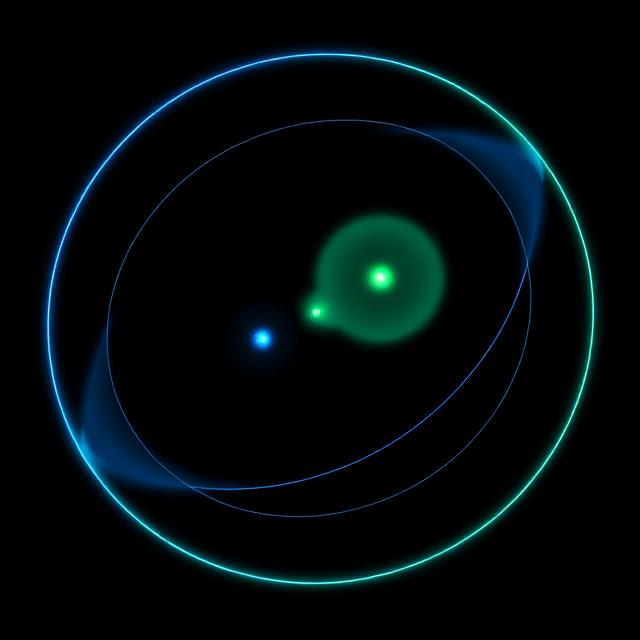
- The Dance of Uncertainty: This is the critical part. Orbits are not perfectly knowable. Factors like solar radiation pressure, the Earth’s non-uniform gravity, and atmospheric drag create tiny uncertainties. Therefore, the future position of any object is not a single point, but a probability cloud.
The key metric that emerges from this analysis is the Probability of Collision (Pc).
The Million-Dollar Question: What Probability is Too High?
There is no universal “red line,” but generally, satellite operators have a risk threshold. A common industry standard is a Pc of 1 in 10,000 (or 0.0001). If the predicted Pc exceeds this threshold, the operator begins to seriously consider a maneuver.
But it’s not just a simple number. Operators must consider:
- The “Keep-Out” Zone: How close will the objects actually get? A miss distance of 100 meters is less concerning than 10 meters, even with the same Pc.
- Fuel Cost: Every maneuver uses precious propellant, directly shortening the satellite’s operational lifespan. A “false alarm” maneuver is incredibly costly.
- Operational Disruption: Maneuvering a communications or Earth-observation satellite often means taking it offline, interrupting service for customers.
- The “Cry Wolf” Effect: With the number of conjunctions skyrocketing (especially for satellites in mega-constellations like Starlink), operators are bombarded with alerts. They must intelligently filter out the non-threatening ones to avoid alert fatigue.
The Moment of Truth: Executing a Collision Avoidance Maneuver
When the decision is made to move, it’s a carefully choreographed sequence.
Let’s take the most famous resident of LEO as an example: the International Space Station (ISS).
The ISS is a behemoth, with a large cross-sectional area, making it a prime target. It regularly performs “Pre-Determined Debris Avoidance Maneuvers” (PDAMs).
- The Alert: U.S. Space Command provides NASA with conjunction data typically more than 24 hours in advance.
- The Analysis: Flight controllers at NASA’s Johnson Space Center and their Russian counterparts at Mission Control Moscow analyze the threat. They calculate the Pc and the required “burn” to increase the separation.
- The Decision: If the Pc exceeds the threshold (for the ISS, it’s 1 in 10,000, but they often act on much lower probabilities if there’s high uncertainty), the decision is made to maneuver.
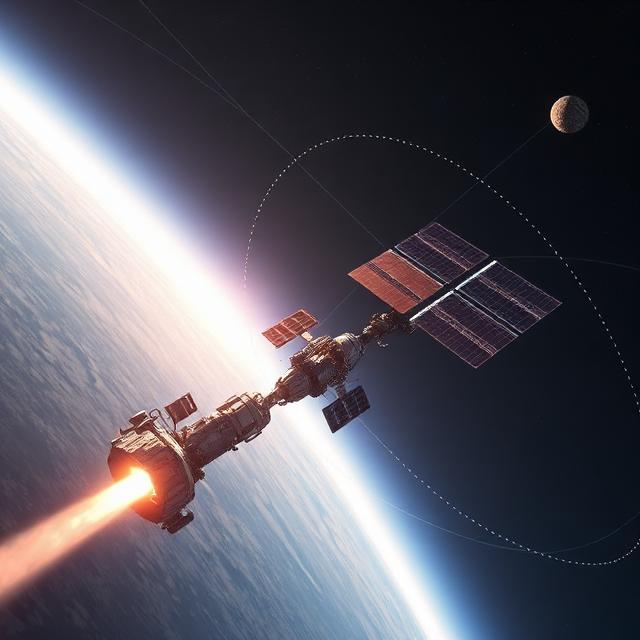
- The Maneuver: The ISS typically uses the thrusters of a docked Russian Progress cargo spacecraft or another module to gently push the entire station into a slightly higher orbit. This is a slow, controlled process.
- The Verification: After the maneuver, tracking data is used to confirm that the new orbit has created a safe miss distance.
For a commercial satellite, the process is similar but often more automated. Companies like SpaceX, for their Starlink constellation, have automated systems that assess thousands of potential conjunctions daily and execute maneuvers autonomously to avoid the highest-risk events, a necessity when managing thousands of satellites.
The Human and Economic Cost: The Burden of Space Traffic Management
This entire system, while effective, places a massive burden on satellite operators.
- Financial Cost: A single avoidance maneuver can cost tens of thousands of dollars in operational planning, fuel, and lost revenue from service interruption. For a large constellation, this adds up to millions per year.
- Human Capital: Highly skilled engineers and astrodynamicists are required to monitor and analyze these conjunction alerts 24/7. This is a significant and growing operational overhead.
- The “Tragedy of the Commons”: This is the most insidious problem. When one satellite maneuvers to avoid another, it uses its own fuel and shortens its life for the collective good. But what if the other object is a dead satellite or a piece of debris that cannot move? There’s an inherent unfairness. The burden of collision avoidance falls almost entirely on the active, valuable assets.
This has led to growing calls for international “Rules of the Road” in space. Should a defunct satellite have the “right of way”? Who is liable if a maneuver goes wrong? These are the diplomatic and legal questions we are only beginning to grapple with.
The Future of Space Collision Avoidance: Smarter, Cleaner, and More Automated
The current system is straining under the weight of its own success. The future of space safety and sustainability depends on several key advancements:
1. Enhanced Tracking and Data Fusion
We need to see better. New technologies are coming online:
- Space-Based Surveillance: Satellites equipped with optical sensors in orbit can track debris without atmospheric interference, providing more precise data on objects, especially in GEO.
- Commercial Tracking Services: Companies like LeoLabs are building their own global radar networks, offering higher-fidelity data and more frequent updates to commercial clients, filling a critical gap.
- Data Sharing and Standardization: Initiatives like the Space Data Association create cooperative platforms for operators to share their satellite positional data more accurately and securely, reducing uncertainty for everyone.
2. Automation and Artificial Intelligence
Humans can no longer manually assess every conjunction. The future is automated collision avoidance.
- AI-Powered Prediction: Machine learning algorithms can analyze historical conjunction data, weather models (for drag prediction), and other factors to make more accurate Pc predictions, filtering out false alarms.
- Autonomous Maneuvering: As seen with Starlink, the trend is toward satellites that can “see” a threat and move without waiting for a command from a ground station. This is faster and more efficient, crucial for reacting to last-minute changes.
3. Active Debris Removal (ADR)
Avoidance is a defensive game. The ultimate solution is to clean up our mess. Active Debris Removal is the offensive play—the concept of sending dedicated missions to deorbit large, high-risk pieces of debris.
Proposed technologies include:
- Robotic Arms and Tethers: A “chaser” satellite would rendezvous with a piece of debris, capture it using a net, harpoon, or robotic arm, and then either drag it down to burn up in the atmosphere or boost it to a “graveyard” orbit.
- Laser Ablation: Using ground-based or space-based lasers to vaporize small amounts of material from the surface of a debris object, creating a tiny thrust that slowly pushes it into a safer orbit over time.
While still in its technological and regulatory infancy, ADR is widely seen as essential for preventing the Kessler Syndrome. The European Space Agency’s ClearSpace-1 mission, slated to capture a piece of an old rocket adapter, is a pioneering step in this direction.
4. Designing for Demise and Responsible End-of-Life
Prevention is better than a cure. The international community is increasingly adopting guidelines for space sustainability:
- The 25-Year Rule: Operators should ensure their satellites deorbit naturally within 25 years of mission completion.
- Design for Demise: Building satellites that will more completely burn up upon atmospheric re-entry, leaving no dangerous fragments to reach the ground.
- Passivation: At the end of life, venting leftover fuel and discharging batteries to prevent catastrophic explosions that create new debris.
Frequently Asked Questions (FAQ)
1. What is the single biggest piece of space debris we track, and is it a threat?
The title for the largest tracked debris often changes, but historically, it has been held by massive defunct objects like the Envisat Earth observation satellite (about 8 metric tons) or spent rocket bodies like the SL-16 Zenit-2 second stages (each about 9 metric tons). These objects are significant threats not because they are likely to hit an active satellite tomorrow, but because of their “worst-case scenario” potential. A collision involving an object this large would create thousands of new debris fragments, drastically increasing the collision risk for everything else in orbit and potentially triggering the Kessler Syndrome cascade.
2. How much “warning time” do satellite operators usually have before a potential collision?
It varies, but for a well-tracked conjunction, operators typically receive initial alerts several days in advance. The U.S. Space Command and other agencies provide Conjunction Data Messages (CDMs) that can start coming in 3 to 7 days before the predicted close approach. However, the final decision to maneuver is often made within 24 hours of the event. As tracking data becomes more precise closer to the conjunction, the Probability of Collision (Pc) can change significantly, sometimes allowing operators to stand down from a planned maneuver. In rare cases with high uncertainty, a last-minute maneuver might be executed just hours beforehand.
3. Who is responsible for moving a satellite if two active satellites are on a collision course?
This is a complex and often debated “rules of the road” issue in space. There is no single, universally enforced law. Generally, it involves coordination and negotiation between the two operators. Factors considered include which satellite has more maneuverability, which one would use less fuel, the operational disruption of a maneuver, and the respective value of the satellites. Often, the operator who received the conjunction alert first or who can perform the simplest maneuver will take action. The burden does not always fall 50/50, highlighting the need for better international standards.
4. If a tiny piece of debris can cause catastrophic damage, how is the International Space Station (ISS) protected?
The ISS is a special case due to its size and human crew. It is equipped with “Whipple Shields”—a type of hypervelocity impact protection. These are multi-layered shields where the outer layer breaks up the incoming debris particle, spreading its energy across a wider area on the inner layer, which then stops the resulting fragments. This doesn’t make it invincible, but it can withstand impacts from debris up to about 1 cm in size. For larger, trackable objects, the ISS performs Pre-Determined Debris Avoidance Maneuvers (PDAMs) to move out of the way, as detailed in the blog.
5. Is cleaning up space junk (Active Debris Removal) actually feasible, or is it just science fiction?
It is absolutely feasible and moving from science fiction to active development. While technologically and financially challenging, several missions are paving the way. The European Space Agency’s ClearSpace-1 mission, scheduled for later this decade, is a prime example. It is designed to rendezvous with, capture, and deorbit a piece of debris using robotic arms. Other concepts involve using nets, harpoons, or even lasers for nudging debris. The main hurdles are no longer just engineering, but also the significant cost and the complex legal and regulatory frameworks governing who is allowed to remove someone else’s defunct satellite from orbit.
Our Collective Responsibility for the Final Frontier
The silent dance of collision avoidance happening above us is a testament to human ingenuity. It’s a complex, global effort that blends cutting-edge technology with profound physics and international cooperation. It protects the invisible infrastructure that has become fundamental to our daily lives.
But this system is under stress. The dream of a connected world, with global internet from space and unprecedented Earth observation, hinges on our ability to be good stewards of the orbital environment.
Space collision avoidance is not just a technical problem for rocket scientists. It’s a sustainability challenge, an economic imperative, and a test of our global governance. It asks us a simple question: Will we treat space as an infinite junkyard, or will we preserve it as a shared resource for future generations?
The next time you use your GPS, check the weather forecast, or make a satellite phone call, remember the invisible shield of work, worry, and wisdom that keeps those satellites safely dancing in the void. The future of our connection to the final frontier depends on it.
What are your thoughts on the growing problem of space debris? Should there be an international treaty to enforce clean-up? Share your ideas in the comments below!