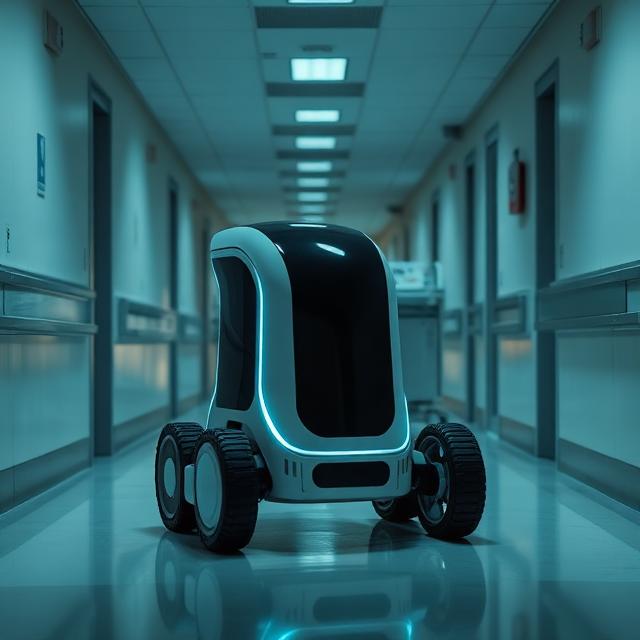
Imagine a bustling hospital corridor at 3 AM. A small, sleek robot glides silently past the nurses’ station, its soft blue lights casting a gentle glow. It approaches a medication cart, aligns itself with millimeter precision, connects, and in moments, begins its journey to replenish supplies. No human intervention, no missed deliveries, no disruption to the critical quiet of the night shift. This isn’t a scene from a sci-fi film; it’s the reality being built today by autonomous docking robots.
Forget the clunky, fixed-path robots of yesteryear. The new generation of autonomous mobile robots (AMRs) with advanced docking capabilities is like the ballroom dancers of the material handling world—perceiving their environment, making intelligent decisions, and executing flawless, precise connections entirely on their own. They’re transforming warehouses, factories, hospitals, and even restaurants from static landscapes into dynamic, fluid ecosystems.
In this deep dive, we’ll explore the intricate world of autonomous docking. We’ll unpack how these robots “see” and “think,” discover where they’re making the biggest impact, and ponder a future where this silent dance between machines becomes the heartbeat of our logistical infrastructure.
Chapter 1: Beyond the Charging Dock – What Really is Autonomous Docking?
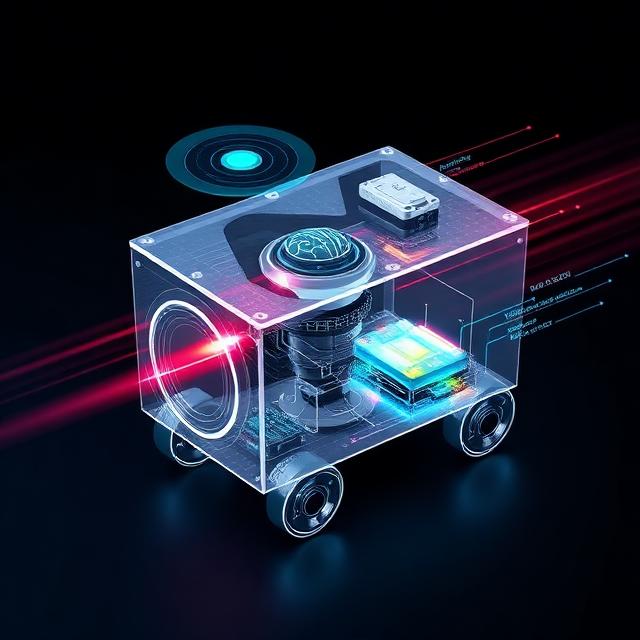
At its core, autonomous docking is the ability of a robot to independently navigate to a specific target—a cart, a rack, a machine, or another robot—and physically connect with it. This connection can be for charging, loading/unloading, towing, or even forming collaborative assemblies.
It’s a significant leap from basic autonomy. A robot that can roam a warehouse floor, avoiding obstacles, is impressive. But a robot that can find a specific pallet rack (one of hundreds), precisely align its fork or platform with the pallet’s legs, lift it, and then seamlessly integrate back into traffic? That’s a game-changer. This process relies on a sophisticated marriage of technologies:
As we look into the future of technology, Swarm Robotics will play a pivotal role in enhancing the efficiency and capabilities of these autonomous systems.
As we look into the future of technology, Swarm Robotics will play a pivotal role in enhancing the efficiency and capabilities of these autonomous systems.
- Perception Suite (The “Eyes and Ears”): Docking robots use a combination of sensors to create a real-time map of their world.
- LiDAR (Light Detection and Ranging): Spinning lasers create precise 3D point-cloud maps, ideal for navigation and coarse positioning.
- Computer Vision & Cameras: 2D and 3D cameras read visual markers (like QR codes or AprilTags) on dock stations or targets. More advanced systems use visual odometry and natural feature recognition to dock without any markers at all.
- Proximity Sensors: Ultrasonic, infrared, or laser sensors provide the final few millimeters of precision, ensuring a smooth, crash-free connection.
- Force-Torque Sensing: In advanced applications, these sensors in the docking mechanism allow the robot to “feel” the connection, making micro-adjustments for a perfect mate, much like a USB-C plug sliding smoothly into a port.
- The Brain: AI, Machine Learning, and SLAM: Raw sensor data is useless without intelligence. This is where Simultaneous Localization and Mapping (SLAM) algorithms come in. SLAM allows the robot to build a map of an unknown environment while simultaneously tracking its location within it. For docking, this is augmented by machine learning models trained to recognize specific dock shapes, handles, or connection points under varying light and clutter conditions.
- The Actuators (The “Muscles”): The final physical connection requires precise control. This could be a motorized lift, a synchronized conveyor belt on the robot’s top, a robotic arm, or a simple but robust mechanical latch. The actuator executes the final move dictated by the brain and sensors.
[Internal Link: To understand the broader ecosystem these robots operate in, read our guide on The Internet of Things (IoT) and Smart Warehousing.]
Chapter 2: The “Where” – Revolutionizing Industries, One Dock at a Time
The applications for autonomous docking are as diverse as industry itself. Here’s how they’re making waves:
1. Logistics & E-Commerce Fulfillment: The Heart of the Modern Warehouse
This is arguably the most mature application. Here, docking isn’t just for charging; it’s the core of material movement.
- Goods-to-Person (G2P) Systems: AMRs like Locus Robotics or Fetch Robotics agents autonomously drive under mobile shelf units (pods), lift them, and transport them to human pick stations. The dock is the pod. This reduces walk time for workers by up to 90%, skyrocketing order-picking efficiency.
- Autonomous Pallet Handling: Larger robots from companies like Seegrid or Boston Dynamics’ Stretch robot use advanced vision systems to locate, approach, and pick up pallets from the floor or racks, then transport and dock them at loading bays or stretch-wrapper machines.
- Cross-Docking & Sortation: Robots can receive packages from a conveyor, dock with a specific chute or container based on destination ZIP code, and unload, automating a highly repetitive sortation task.
2. Manufacturing: The Agile Production Line
Modern manufacturing demands flexibility. Fixed conveyor belts are giving way to mobile, adaptable systems.
- Line-Side Delivery: Docking robots autonomously replenish parts bins at assembly stations just as they run low, triggered by the factory’s Manufacturing Execution System (MES). This creates a continuous, just-in-time flow.
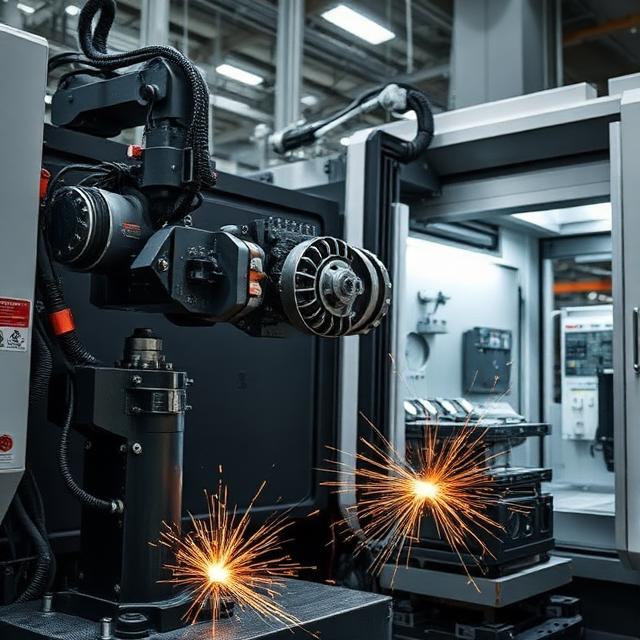
- Machine Tending: A robot can dock with a CNC machine, unload a finished part, load a raw billet, and press “start,” enabling lights-out production.
- Mobile Assembly: Robots can become moving workstations, docking with different stations for different assembly steps, bringing the product to the tool.
3. Healthcare: The Gentle Caregivers
In hospitals, precision and reliability are non-negotiable.
- Medication & Supply Transport: Robots like Aethon’s TUG autonomously dock with locked carts, transporting them from pharmacies to nurse stations or delivering linens and meals, reducing the burden on clinical staff and minimizing errors.
- Laboratory Logistics: Sensitive samples can be moved between labs, storage, and analysis stations via secure, temperature-controlled docking robots, ensuring chain-of-custody and timely processing.
4. Hospitality & Retail: The Unseen Helpers
- Room Service & Delivery: Hotels and large resorts are using robots to deliver towels, amenities, and room service orders, docking with service elevators and autonomously navigating to guest rooms.
- Back-of-House Logistics: In large retail stores or restaurants, robots can manage inventory in stockrooms, autonomously bringing crates of produce to the kitchen floor or moving stock to the shop floor.
[Internal Link: Curious about the brains behind these operations? Explore our article on How AI is Powering the Next Generation of Supply Chain Management.]
Chapter 3: The Tangible Benefits – Why Businesses Are Investing
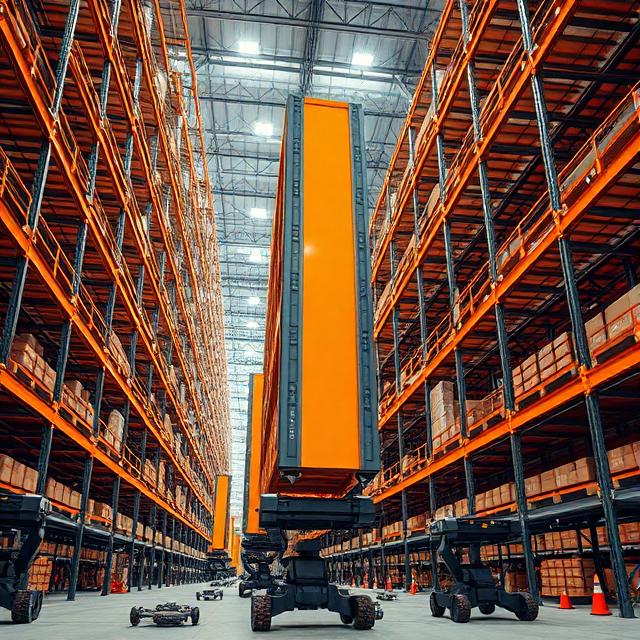
The move to autonomous docking isn’t just about cool tech; it’s driven by powerful bottom-line and strategic advantages.
- Skyrocketing Efficiency & Productivity: 24/7 operation, no breaks, and optimized routes mean more tasks completed faster. The docking precision eliminates manual alignment time.
- Unprecedented Accuracy & Consistency: Robots don’t get tired or distracted. A docking procedure is executed the same way, every single time, eliminating damage from misalignment and ensuring perfect data capture (e.g., scanning a pallet ID at the exact moment of pickup).
- Enhanced Safety: By taking over repetitive, heavy lifting and towing tasks in dynamic environments, they significantly reduce workplace accidents, strain injuries, and forklift incidents.
- Maximized Space Utilization: Mobile systems require fewer fixed aisles than traditional forklifts or conveyors. Facilities can use vertical space more effectively with robots accessing high-density storage.
- Scalability & Flexibility: Need to change your warehouse layout or production flow? Simply remap the robot’s environment and redefine dock points. It’s software-based, not a physical infrastructure overhaul. You can start with a few robots and scale up during peak seasons.
- Data Generation: Every docking event, route, and delay is logged. This creates a treasure trove of operational data, allowing managers to identify bottlenecks, optimize processes, and make data-driven decisions.
Chapter 4: The Challenges & Considerations – The Dance Isn’t Always Perfect
Adopting this technology isn’t without its hurdles. Being aware of them is key to successful implementation.
- The Initial Investment: The capex for robots, fleet management software, and potential infrastructure tweaks can be significant, though ROI is typically swift and clear.
- Integration Complexity: The robots must speak the language of your existing Warehouse Management System (WMS), ERP, or MES. This integration is critical and can be a technical challenge.
- Dynamic Environment Management: While robots are great at avoiding static obstacles, highly unpredictable environments (e.g., a warehouse with constant pedestrian traffic or fallen debris) require robust safety protocols and careful zoning.
- Maintenance & Downtime: A fleet of robots is a fleet of assets that need maintenance, software updates, and battery management. A well-planned preventative maintenance schedule is essential.
- The Human Factor: Workforce training and change management are crucial. The goal is to augment and elevate human work, not replace it. Successful deployments involve staff in the process, repositioning them to more cognitive, less physically taxing roles.
Chapter 5: The Future of Autonomous Docking – What’s Next on the Horizon?

The technology is evolving at a breakneck pace. Here’s what we can expect in the coming years:
- Swarm Intelligence & Multi-Robot Coordination: Imagine fleets of robots acting as a cohesive swarm. One robot docks with a heavy payload, and two others autonomously dock with it on either side to collaboratively tow a load too large for one. They will share maps and intentions in real-time.
- Standardization of Docking Interfaces: We may see the rise of universal physical and communication protocols for docking, much like USB, allowing robots from different manufacturers to interact with standardized carts, batteries, and tools.
- Advanced AI & Predictive Docking: Using historical data, robots will predict when and where docking will be needed. They will pre-position themselves, optimize traffic flows in anticipation of peak demand, and even perform self-maintenance at docks before a fault occurs.
- Expansion into Last-Mile & Outdoor Docking: Think delivery robots autonomously docking with a porch locker to securely leave a package, or agricultural robots docking with a harvester to unload produce in the field.
- Hyper-Precision for Micro-Logistics: In laboratories or electronics manufacturing, we’ll see microscopic-precision docking for handling sensitive components, guided by advanced computer vision and haptic feedback.
FAQ: Your Questions on Autonomous Docking Robots, Answered
Here are answers to some of the most common questions we receive about the fascinating world of autonomous docking robots.
Q1: What’s the main difference between an AGV and an autonomous docking robot?
This is a key distinction! An Automated Guided Vehicle (AGV) typically follows fixed, pre-defined paths (like wires in the floor or magnetic tape) and requires a very structured environment. Its “docking” is often a simple, repetitive stop at a location. An Autonomous Mobile Robot (AMR) with docking capabilities is much smarter. It uses sensors and AI to navigate freely, understand its environment, and make decisions. Its docking is dynamic, precise, and can adapt to changes, like a slightly moved cart or a new obstacle in its path.
Q2: How do these robots know exactly where to dock? Is it just QR codes?
While QR codes (or similar fiducial markers like AprilTags) are a common and reliable method for final precision alignment, they’re just one tool in the toolbox. Advanced systems use a multi-sensor fusion approach:
- LiDAR & SLAM provide the general location and navigation.
- Cameras then identify a visual marker or, in markerless systems, recognize the natural features of the dock itself (like the shape of a cart handle or a charging port).
- Proximity sensors (ultrasonic, infrared) take over for the last few centimeters, guiding the final connection with millimeter accuracy to prevent crashes.
Q3: Aren’t these robots going to take away human jobs?
The primary goal of autonomous docking robots is task augmentation, not human replacement. They are designed to take over the most repetitive, physically taxing, and simple transport tasks (e.g., moving empty pallets, fetching parts bins, delivering linens). This frees up human workers to focus on higher-value tasks that require critical thinking, problem-solving, dexterity, and customer interaction—like complex assembly, quality control, patient care, and system management. In many industries facing labor shortages, they help existing teams do more and be more effective.
Q4: What happens if something or someone gets in the way during a docking maneuver?
Safety is the top priority. These robots are equipped with multiple layers of safety systems:
- 360-degree sensors constantly monitor the environment.
- SLAM algorithms differentiate between static and dynamic obstacles.
- If a person or object enters a predefined safety zone, the robot will first slow down, then stop completely if the obstacle remains. It will either wait for the path to clear or recalculate a new approach path. They are designed to be collaborative and safe around people.
Q5: Can these systems work in older facilities not built for robots?
Yes, one of the greatest strengths of AMRs is their flexibility. Unlike fixed automation (conveyors, AGVs), they don’t require major infrastructure changes. They can navigate uneven floors (within reason), through standard doorways, and around existing infrastructure. The key requirements are typically just a reliable Wi-Fi network for fleet communication and reasonably clear, well-defined aisles. The robots map the facility as it is.
Q6: How long does it typically take to see a return on investment (ROI)?
ROI timelines vary based on application, scale, and labor costs, but many businesses report a return within 1 to 2 years. The biggest drivers are increased throughput (more orders picked per hour), reduced labor costs associated with mundane travel, decreased product damage from precise handling, and the ability to operate multiple shifts without fatigue. A clear operational analysis before implementation is crucial to project specific ROI.
Q7: Are there any industries where autonomous docking isn’t a good fit?
They may be challenging in extremely unpredictable, unstructured, or densely crowded public environments (e.g., a busy retail sales floor during a holiday sale). They also require a certain scale of repetitive movement to justify the investment; a very small operation with minimal material flow might not see the benefit. The technology is best suited for environments with defined workflows, repeatable material movement tasks, and a willingness to adapt processes for human-robot collaboration.
Q8: What’s the biggest hurdle for a company implementing this technology?
Often, it’s not the technology itself, but successful change management and integration. The technical challenge of connecting the robot fleet management software to the existing Warehouse Management System (WMS) or Enterprise Resource Planning (ERP) software is significant. Furthermore, training and gaining buy-in from the workforce, redesigning processes to maximize the robot’s value, and establishing a maintenance routine are critical, non-technical success factors.
Have more questions? The world of automation is always evolving. Reach out or explore our other resources to continue the conversation!
Conclusion: Partnering with Precision
Autonomous docking robots represent more than an automation upgrade; they signify a shift towards truly adaptive, responsive, and intelligent environments. They are the silent partners in our workplaces, taking on the dull, the dirty, and the dangerous, and freeing human potential for creativity, problem-solving, and complex decision-making.
The quiet hum of their motors and the soft click of a successful dock are the sounds of a new operational symphony—one of seamless flow, relentless efficiency, and elegant precision. As the technology becomes more accessible and capable, this silent dance will expand from the warehouse floor to the hospital wing, the factory aisle, and beyond, fundamentally reshaping how we move the world around us.
The question for businesses is no longer if this technology is relevant, but when and how they will choose to join the dance.