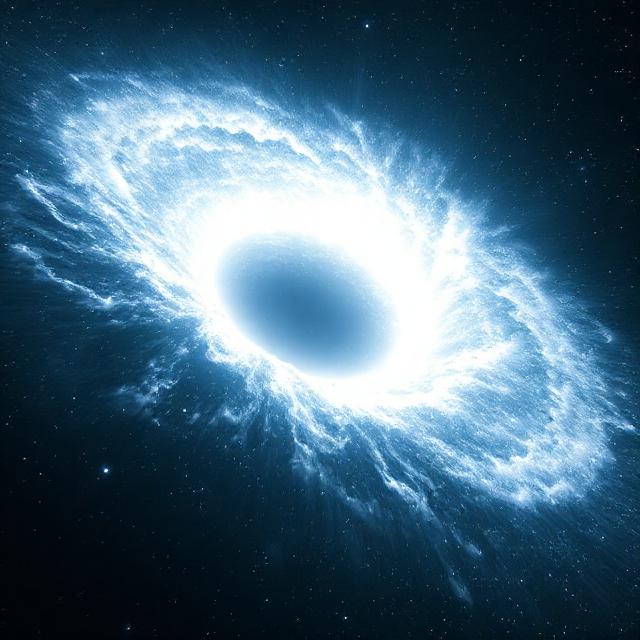
Let’s play a quick game of word association. I say, “Black Hole.” What comes to mind?
Probably a cosmic vacuum cleaner. A point of no return. An invisible monster in space, so dense and powerful that not even light can escape its gravitational clutches. Thanks to movies like Interstellar and actual images from the Event Horizon Telescope, black holes have cemented their place in our imagination as the ultimate cosmic predators.
But what about their exact opposite?
What if I told you that the mathematics that predicts black holes also predicts their mirror image: White Holes?
Imagine a cosmic gusher. A one-way exit door from the universe. A region of spacetime where nothing—absolutely nothing—can ever enter, but matter and energy can only ever burst outward.
White Holes are not just a theoretical construct; they expand our understanding of the universe and challenge our perceptions of its boundaries.
It sounds like science fiction. It might just be the most tantalizing “what if” in all of theoretical physics. This isn’t just a black hole running in reverse; it’s a concept that challenges our understanding of time, the Big Bang, and the very fabric of reality itself.
So, buckle up. We’re about to venture into one of the most speculative and fascinating corners of the cosmos to answer the question: What in the universe is a white hole?
Part 1: The Yin to a Black Hole’s Yang
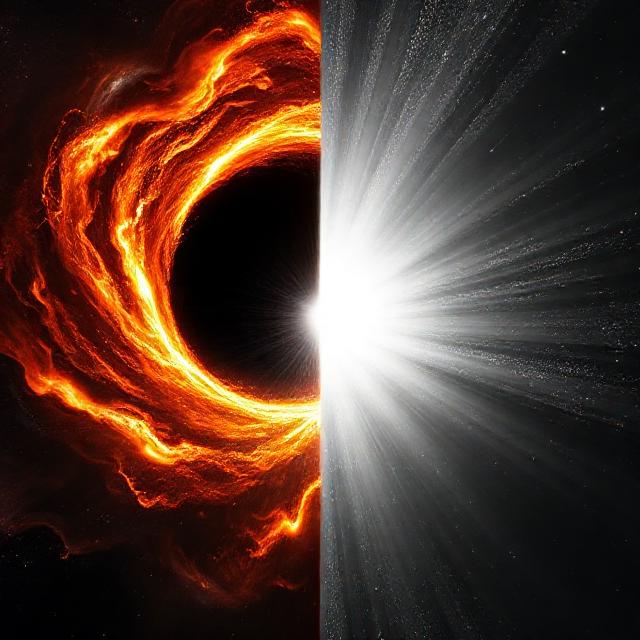
To understand a white hole, we first need to have a solid grasp of its infamous twin: the black hole.
A Quick Black Hole Refresher
A black hole is born when a massive star collapses under its own gravity, crushing down into an infinitesimally small point called a singularity. This singularity is surrounded by an invisible boundary called the event horizon.
Think of the event horizon as the point of no return. It’s not a physical surface you’d bump into; it’s a gravitational threshold. Cross it, and the escape velocity exceeds the speed of light. Since nothing can go faster than light, nothing can escape. It’s a cosmic roach motel: matter and energy check in, but they don’t check out.
Flipping the Script: The Birth of the White Hole Idea
The idea of white holes didn’t come from a wild dream. They emerged naturally—and shockingly—from the cold, hard mathematics of Albert Einstein’s theory of General Relativity.
In 1916, Karl Schwarzschild found the first exact solution to Einstein’s fiendishly complex equations, describing the gravitational field outside a spherical, non-rotating mass. This Schwarzschild solution perfectly described a black hole.
But the solution had a quirk. It was symmetric in time.
Our everyday experience tells us that time only moves forward. You can smash a cup, but you can’t unsmash it. This is the arrow of time. But Einstein’s equations, at their most fundamental level, don’t care about the direction of time. They work just as well if time runs backward.
When you take the Schwarzschild solution and mathematically run time in reverse, the black hole’s properties flip. The event horizon, which was an inescapable boundary, becomes an unreachable boundary.
- Black Hole: Nothing can get out.
- White Hole: Nothing can get in.
It’s the ultimate cosmic “Keep Out” sign. If you shot a laser beam at a white hole, the light would simply bounce off its event horizon. It would be like a mountain that is perpetually erupting, but you can never reach its slopes to climb it.
Part 2: The Properties of a Hypothetical Giant
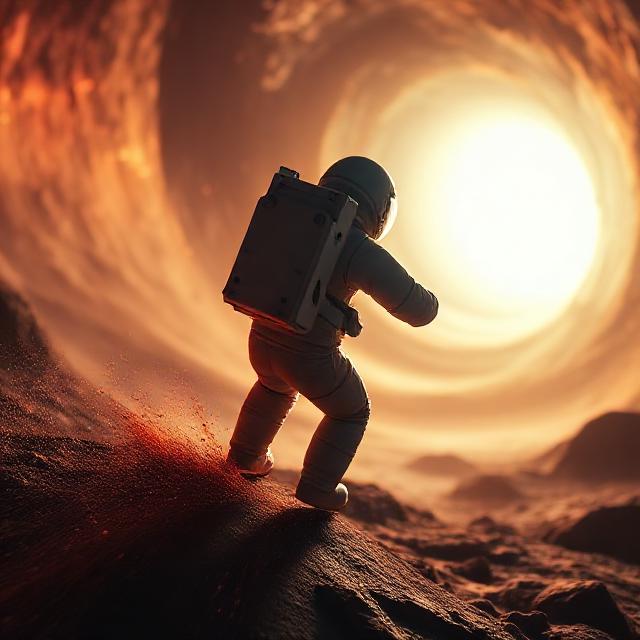
So, what would a white hole actually do? If we could find one, what would we see?
1. The One-Way Door
This is the core concept. A white hole would only expel matter and energy. Any object or particle approaching it would be violently repelled. Its event horizon is a barrier to entry, not exit.
2. A Fountain of Energy
A white hole wouldn’t need to “accrete” material like a black hole. It would be a spontaneous source of immense energy, spewing out radiation, light, and potentially entire streams of matter. Some theories suggest this matter wouldn’t be new, but rather the same material that fell into a connected black hole long, long ago.
3. A Potential Big Bang in Miniature
One of the most profound ideas is that a white hole could resemble the birth of a universe. The sudden, violent, and immense outpouring of energy and matter from a single point is eerily reminiscent of our own Big Bang. In fact, some cosmologists have speculated that our entire universe could be the interior of a white hole.
4. They (Probably) Can’t Form, They Just Are
This is a key difference. Black holes form from stellar collapse. We understand the process. White holes, however, have no known formation mechanism. If they exist, the implication is that they have always existed, since the beginning of time, as a fundamental part of the universe’s structure. They wouldn’t be born from a star; they would be primordial.
Part 3: The Bridge to Another Universe? Wormholes and the Quantum Connection
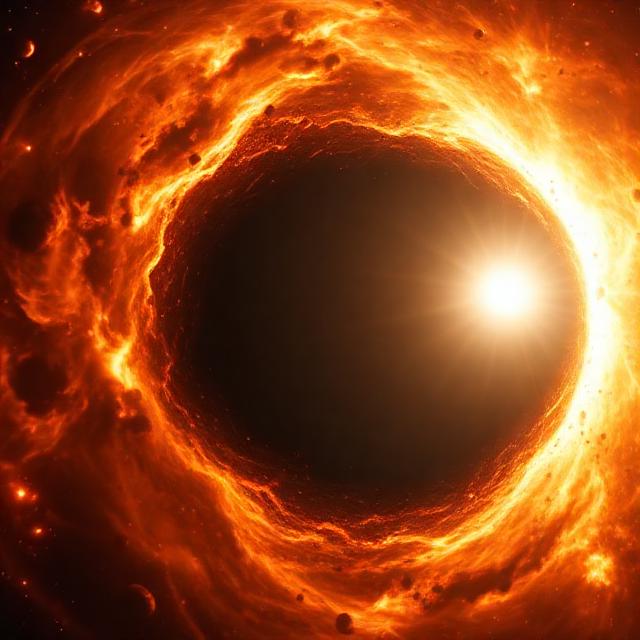
Now, let’s make things even weirder. The story of white holes is deeply tied to another sci-fi staple: wormholes.
In 1916, the same Schwarzschild solution described what we now call an Einstein-Rosen bridge—a tunnel connecting two different points in spacetime. For decades, this was seen as a mathematical curiosity. The problem? The bridge was unstable. It would snap shut in an instant, crushing any would-be traveler.
But what if something could hold it open?
This is where white holes come back into the picture. One tantalizing theory suggests that a black hole and a white hole could be the two mouths of a stable wormhole.
- You enter the black hole (the one-way entrance).
- You travel through the wormhole (the bridge).
- You are ejected from the white hole (the one-way exit).
The catch? The white hole wouldn’t be in another part of our universe. It would be the gateway to a different universe entirely. This idea turns the cosmos into a vast, cosmic Swiss cheese, filled with tunnels connecting separate realities. The black hole absorbs information, and the white hole in another universe spits it out, resolving some pesky paradoxes.
The Quantum Glue
The real hope for white holes lies in the quest for a theory of quantum gravity—the missing link between General Relativity (the law of the very big) and Quantum Mechanics (the law of the very small).
Black holes create a huge problem in physics: what happens to the information about the stuff that falls in? According to quantum mechanics, information cannot be destroyed. But according to general relativity, it’s lost forever inside a black hole. This is the Black Hole Information Paradox.
White holes might be the solution. Some leading theories, like Loop Quantum Gravity (LQG), suggest that the immense gravitational collapse of a star doesn’t end in a singularity. Instead, at a microscopic scale, the effects of quantum gravity cause a “quantum bounce.” The collapsing matter hits a point of maximum density and then rebounds, exploding outward.
In this scenario, a black hole would naturally transform into a white hole.
The mind-blowing implication? The black holes we observe in our universe could right now, at their core, be undergoing this transformation. Because time is so severely warped, what looks like a black hole lasting billions of years from the outside might only take a fraction of a second for the core to bounce and turn into a white hole. We just haven’t seen one “pop” yet.
Part 4: The Cosmic Skeptic: Why We’ve Never Found One
With all these incredible possibilities, why hasn’t NASA announced the discovery of a white hole? The answer is simple: we have absolutely no confirmed observational evidence that they exist.
Here’s why they might be purely hypothetical:
1. They Violate the Second Law of Thermodynamics
This law states that entropy, or disorder, in the universe always increases. A white hole, spontaneously spewing out ordered energy, seems to decrease entropy. It’s like a room getting cleaner on its own—it goes against the fundamental grain of our universe.
2. They Are Incredibly Unstable
Many physicists argue that a white hole would be the most unstable object in the universe. The second even a single particle of dust entered its vicinity, the entire structure would collapse. It would be like a perfectly inverted pyramid; the slightest touch would bring it tumbling down, likely immediately converting into a black hole.
3. No Known Formation Process
As mentioned, we don’t know how a white hole could come into being. The universe seems to have a strong preference for processes that move from order to disorder (like forming black holes), not the other way around.
Have We Almost Seen One?
Despite the lack of proof, astronomers have occasionally been baffled by cosmic events that are difficult to explain. Some have looked at incredibly powerful and brief explosions, like certain gamma-ray bursts (GRBs), and wondered if they could be the final, violent death throes of a small black hole undergoing a quantum bounce and exploding as a white hole.
Other candidates have included mysterious radio bursts from deep space called Fast Radio Bursts (FRBs), which release immense energy in milliseconds. While most have plausible astrophysical explanations, the door isn’t completely closed on more exotic possibilities.
Conclusion: The Dream That Refuses to Die
So, do white holes exist? The honest answer is, we almost certainly don’t think so. They are likely mathematical ghosts in the machine of General Relativity—artifacts of a theory that doesn’t yet account for the quantum world.
But they are ghosts that refuse to fade away.
The enduring allure of the white hole isn’t just about the object itself. It’s about what it represents: a missing piece in our cosmic puzzle. It’s a tool for thought, a probe that helps us stress-test our most fundamental theories. The fact that it emerges from the math at all tells us that our understanding of spacetime, gravity, and time itself is incomplete.
White holes challenge us to ask bigger questions. Was the Big Bang a primordial white hole? Is our universe connected to others through a network of black and white holes? Can information escape from a black hole through a quantum bounce?
In the end, the search for white holes is really the search for a deeper truth about the universe. They are a beautiful, paradoxical, and spectacular reminder that the cosmos is far stranger and more wonderful than we can often imagine. And the journey to find the answers—whether they point to white holes or not—is what makes science the greatest adventure of all.
Frequently Asked Questions (FAQ)
Q: Has a white hole ever been discovered?
A: No. There has never been a confirmed observation of a white hole. They remain a purely theoretical prediction of the mathematics of General Relativity.
Q: What is the difference between a white hole and a wormhole?
A: A white hole is a hypothetical one-way exit. A wormhole (or Einstein-Rosen bridge) is a theoretical tunnel connecting two points in spacetime. A wormhole would have two mouths; one could behave like a black hole (entrance) and the other like a white hole (exit).
Q: Can anything enter a white hole?
A: By definition, no. The fundamental property of a white hole is that nothing can cross its event horizon from the outside. It can only expel energy and matter.
Q: Do white holes violate the law of conservation of energy?
A: Not necessarily. The matter and energy a white hole emits would have to come from somewhere. In theories where a white hole is connected to a black hole, the energy it expels would be balanced by the energy the black hole absorbed.
Q: Could a white hole be used for time travel?
A: This is deep in the realm of speculation. If white holes are part of stable wormholes, they could, in theory, create shortcuts through spacetime, which is a foundation for many time travel concepts in science fiction. However, there is no known physical way to achieve this.